Reading a portable gas monitor — RIKEN KEIKI GX-3R Pro
Read the gas identity, unit and fitted sensors together. This guide covers the GX-3R Pro configuration, display, pre-use checks and response to alarms.
What kind of instrument is the GX-3R Pro?
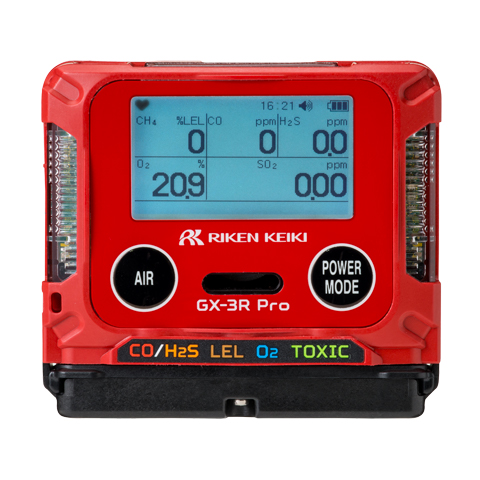
This RIKEN KEIKI portable multi-gas monitor can measure up to five gases using up to four sensors. Combinations of combustible gas, oxygen, carbon monoxide, hydrogen sulfide and an additional gas depend on the ordered configuration. The Pro name does not mean every gas is detected.
The instrument is diffusion type and has no internal sampling pump. Remote pumped sampling requires compatible equipment such as the RP-3R(Pro/S), with its own instructions. Adding an arbitrary hose does not create a validated pumped sampling arrangement.
The front has an LCD, AIR button and POWER/MODE button. Alarms use light, sound and vibration. Keep clothing and tape away from gas inlets and the buzzer.
RIKEN KEIKI official GX-3R Pro product information · GX-3R Pro Korean operating manual · PT0ko-1778 · RIKEN KEIKI RP-3R(Pro/S) · Separate pump for GX-3R Pro
Read the gas and unit before the number
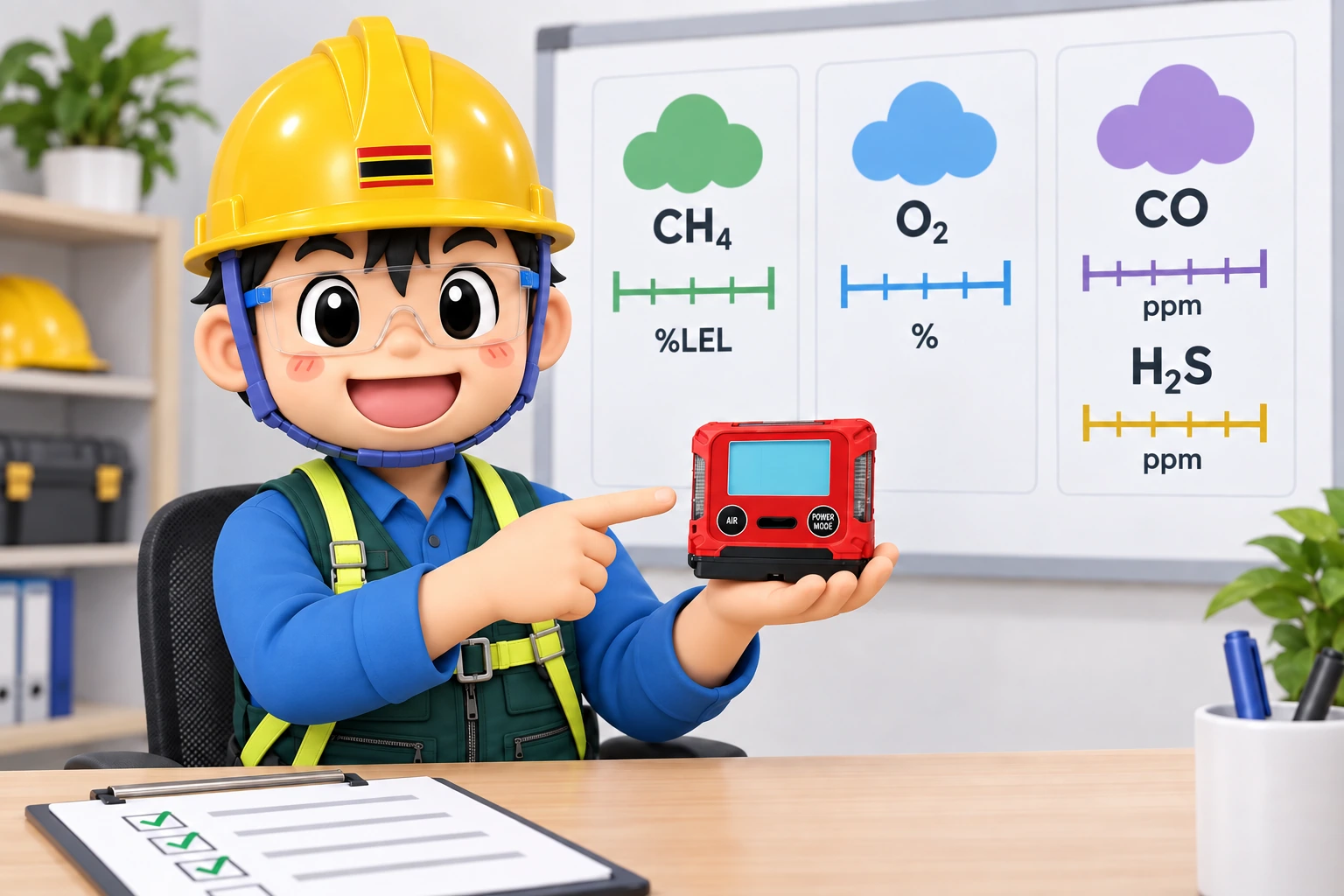
Confirm each channel’s gas and unit. Oxygen vol% and combustible-gas %LEL are different scales. CO2 may be displayed in ppm or vol% depending on the sensor and settings, so read the actual unit.
Current concentration, PEAK, TWA and STEL are different display modes. PEAK concerns recorded extremes; TWA and STEL concern time-averaged exposure. Record the mode and do not treat a configured alarm point as a universal statutory exposure limit.
| Display | Meaning |
|---|---|
| O2 · vol% | Oxygen volume percentage |
| CH4 or HC · %LEL | Relative to the reference combustible gas’s lower explosive limit, not volume percent |
| CO, H2S etc. · ppm | Parts per million of the indicated gas |
| FAIL / ---- | Sensor fault or unavailable detection, not a zero reading |
Korean manual · LCD and alarms, pp.19–26
Check your workplace
- Can the fitted sensors detect the gases required for this task?
- Is this a current, PEAK, TWA or STEL display, and what is the unit?
- Have testing, calibration status, sampling location and time been checked?
From power-on to measurement
In a safe location check the housing, filter, battery, test history and calibration status. Hold POWER for at least five seconds until the buzzer sounds. Check the LCD, alarm lights, sound and vibration at startup, and read the gas and alarm configuration before measurement.
The Korean manual calls for air adjustment after startup and before use. Let readings stabilise in verified fresh air with conditions similar to the workplace. Never use AIR to zero a suspect atmosphere. CO2 is excluded from air adjustment by default and has a separate procedure; do not change that setting casually.
The manual specifies combustible-channel display updates every five seconds, or fifteen seconds in long battery mode. These are not complete sampling wait times. Pumped sampling also requires allowance for sample transport and sensor response.
Korean manual · Startup, air adjustment and detection, pp.34–41 · RIKEN KEIKI RP-3R(Pro/S) · Separate pump for GX-3R Pro
Check sensor status and alarms before trusting zero
A channel showing ---- after a sensor-fault reset cannot detect that gas. Silencing the alarm does not restore the sensor. Stop using the instrument for a task when a required channel cannot be confirmed operational.
The combustible sensor needs oxygen for accurate detection and can lose sensitivity after exposure to substances such as silicones. A low %LEL reading alone cannot establish safety in an oxygen-deficient atmosphere or for every combustible substance.
For a gas alarm, over-range condition or fault, follow the site stop-work, withdrawal and reporting procedure. Do not change the zero or alarm limits in the hazard area merely to continue work. Investigate instrument condition from a safe location.
GX-3R Pro Korean operating manual · PT0ko-1778 · Korean manual · LCD and alarms, pp.19–26
Putting it into practice
Record the GX-3R Pro serial number, fitted sensors, gas, unit, location/height, time, reading and alarms or faults. “CH4 0 %LEL” describes that channel under those sampling conditions; it does not establish adequate oxygen or absence of gases that the instrument cannot detect.
Technical insight
Read values with their measurement conditions
GX-3R Pro readings depend on the installed sensors and sample delivery. A display update interval is not the travel time of a remote sample, and an absent gas channel cannot provide a result.
Record instrument identification, sensor configuration, location and sampling method. For a pump or hose, check the accessory instructions and response before interpreting the reading.
Match the Korean manual to the actual sensors, alarm settings and instrument nameplate. Apply the requirements of the country and workplace concerned.
Korean safety resources
- KOSHA · Safe work guide for preventing confined-space asphyxiation
Korean-language PDF: permits p.20, safety measures p.24, rescue p.44. Legal references reflect the edition’s publication period.
Sources
- GX-3R Pro Korean operating manual · PT0ko-1778제조사 제품 설명 / Manufacturer instructions
- RIKEN KEIKI official GX-3R Pro product information제조사 제품 설명 / Manufacturer instructions
- Korean manual · LCD and alarms, pp.19–26제조사 제품 설명 / Manufacturer instructions
- Korean manual · Startup, air adjustment and detection, pp.34–41제조사 제품 설명 / Manufacturer instructions
- Korean manual · Maintenance, pp.86–88 and 101–105제조사 제품 설명 / Manufacturer instructions
- Korean manual · Gas-calibration preparation, pp.88–98제조사 제품 설명 / Manufacturer instructions
- Korean manual · BUMP test, pp.99–100제조사 제품 설명 / Manufacturer instructions
- RIKEN KEIKI RP-3R(Pro/S) · Separate pump for GX-3R Pro제조사 제품 설명 / Manufacturer instructions