Bump testing versus calibration — GX-3R Pro
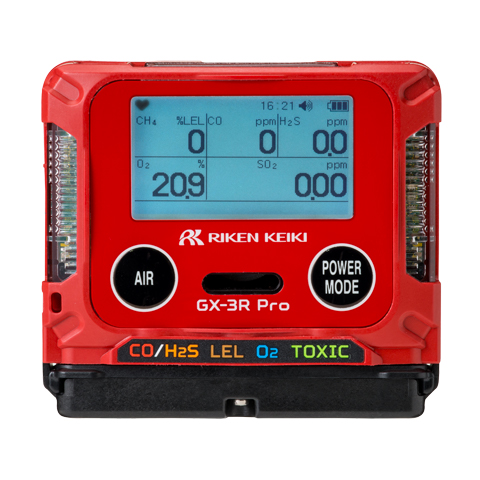
BUMP testing, fresh-air adjustment and gas calibration serve different purposes. Identify the procedure performed, check each gas channel and record follow-up actions.
Power-on checks, bump tests and calibration differ
Checking lights, sound and vibration at power-on is different from applying test gas to check sensor response. The GX-3R Pro has separate BUMP test and calibration menus.
Fresh-air adjustment alone does not demonstrate response to a test gas or verify span sensitivity. Identify the actual procedure whenever a record uses the general term calibration.
| Procedure | What it checks or adjusts |
|---|---|
| Startup check | LCD, lights, buzzer and vibration |
| BUMP test | Channel response and pass/fail against configured test gas |
| AIR adjustment | Reference-point adjustment in verified fresh air |
| Gas calibration / span adjustment | Sensitivity adjustment against a known gas concentration |
Korean manual · Startup, air adjustment and detection, pp.34–41 · Korean manual · Maintenance, pp.86–88 and 101–105 · Korean manual · BUMP test, pp.99–100
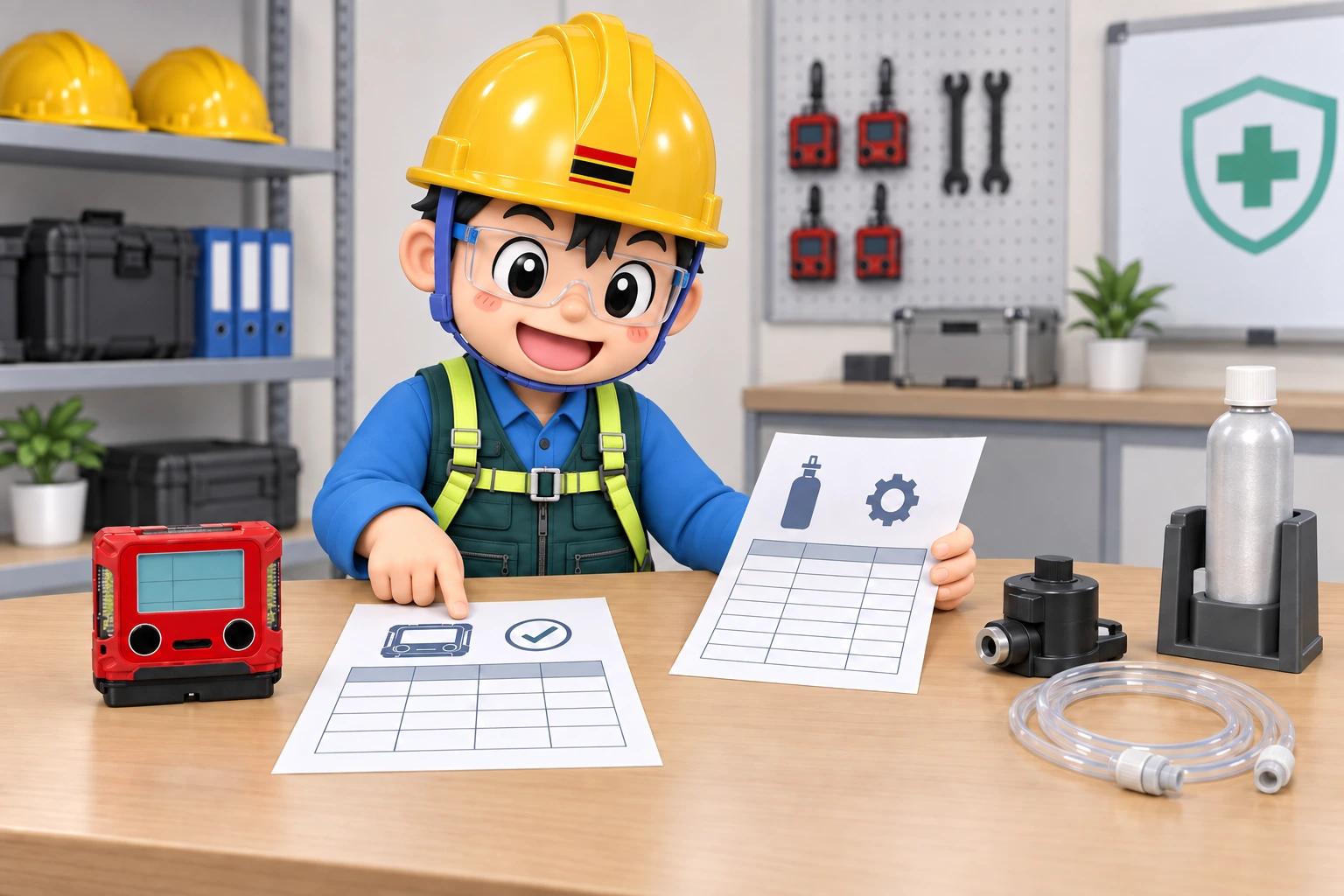
Preparing and running a GX-3R Pro bump test
Match the actual sensors to the gas identity, concentration and expiry. Section 7-2-1 describes preparation using a dedicated calibration adapter, sampling bag and pump. Do not copy another manufacturer’s flow rate or connections, and never use lighter gas for a response check.
After preparation, select the BUMP test in user mode and cylinder group A–E matching the actual test gas. Confirm the selection, apply gas in the order described in section 7-3-1 and check the results. Do not record a test for a gas that is not fitted or was not tested.
The Korean manual’s pages 88–90 and 99–100 contain the precise preparation and operating sequence. Span adjustment requires dedicated equipment and gas; arrange it with the manufacturer or trained maintenance personnel.
Korean manual · Gas-calibration preparation, pp.88–98 · Korean manual · BUMP test, pp.99–100
Check your workplace
- Do gas, concentration, adapter and delivery method match the fitted sensors?
- Have BUMP and automatic-calibration results been checked separately?
- Has failed, contaminated or unstable equipment been held out of service?
Read BUMP and automatic-calibration results separately
The manual shows BUMP results on the left and calibration results on the right, with P for pass and F for fail. If configured, a failed BUMP test can trigger automatic gas calibration. A successful final screen must not be recorded as an initial bump-test pass.
Hold equipment out of service if test or calibration failures remain. Check gas, connections and sensor condition. Resetting an alarm or disabling a reminder does not resolve a failure.
The manual’s default 30-day BUMP expiry reminder is a configuration value, not a universal test interval or a guarantee of performance for that period. Use a maintenance plan appropriate to actual conditions and workplace procedures.
Korean manual · BUMP test, pp.99–100 · Korean manual · Maintenance, pp.86–88 and 101–105
Care and periodic maintenance
The Korean manual specifies checks before daily work, monthly alarm-function checks and periodic maintenance at least annually, ideally every six months. These are different tasks, not one interchangeable calibration interval. Contamination, impact or abnormal response requires attention without waiting for the scheduled date.
Inspect battery condition, readings and filter contamination or blockage. Switch off before cleaning and use a well-wrung damp cloth. Do not spray water or use alcohol, organic solvents or ordinary detergents. Charge and replace batteries only in a non-hazardous location.
Sensors and filters are consumables. If span adjustment fails or readings remain unstable, stop using the instrument and contact the manufacturer. Complete the required functional checks after parts replacement before returning it to service.
Korean manual · Maintenance, pp.86–88 and 101–105 · GX-3R Pro Korean operating manual · PT0ko-1778
Putting it into practice
Record model, serial number, sensor configuration, test date/time, gas identity/concentration/expiry, channel-specific BUMP results, whether calibration occurred, its results, actions and operator. If automatic calibration followed a failed bump test, preserve both results rather than deleting the initial failure.
Technical insight
Make test history traceable
Passing a response test and adjusting concentration accuracy are different events. Combining GX-3R Pro BUMP and CAL into one “checked” field loses that distinction.
Track the instrument, test type, test-gas details, result and action after failure. Connect release for use to that history so a failed unit does not return to the working equipment pool.
Confirm gas-calibration equipment, gas preparation and span adjustment with RIKEN KEIKI or a trained maintenance provider.
Korean safety resources
- KOSHA · Safe work guide for preventing confined-space asphyxiation
Korean-language PDF: permits p.20, safety measures p.24, rescue p.44. Legal references reflect the edition’s publication period.
Sources
- GX-3R Pro Korean operating manual · PT0ko-1778제조사 제품 설명 / Manufacturer instructions
- RIKEN KEIKI official GX-3R Pro product information제조사 제품 설명 / Manufacturer instructions
- Korean manual · LCD and alarms, pp.19–26제조사 제품 설명 / Manufacturer instructions
- Korean manual · Startup, air adjustment and detection, pp.34–41제조사 제품 설명 / Manufacturer instructions
- Korean manual · Maintenance, pp.86–88 and 101–105제조사 제품 설명 / Manufacturer instructions
- Korean manual · Gas-calibration preparation, pp.88–98제조사 제품 설명 / Manufacturer instructions
- Korean manual · BUMP test, pp.99–100제조사 제품 설명 / Manufacturer instructions
- RIKEN KEIKI RP-3R(Pro/S) · Separate pump for GX-3R Pro제조사 제품 설명 / Manufacturer instructions