Horizontal lifelines and energy-absorbing lanyards: anchors and clearance
Three functions to distinguish before connecting
A horizontal lifeline provides a connection route as a worker moves. A lanyard connects the harness to an attachment point, while an energy absorber deploys during arrest to reduce impact force. Having all three does not prevent contact with the ground or equipment if the combination is incompatible or clearance is insufficient.
A work-positioning lanyard and a fall-arrest lanyard have different functions. Petzl's GRILLON instructions distinguish work positioning from fall arrest. A product family with several applications still requires the conditions for the actual installation to be followed.
Why deflection and deployment add to the required space
A horizontal line deflects downward under a fall load. An absorber does not arrest the fall at its original length: ABSORBICA uses progressive tearing of internal webbing. Both the resulting extension of the lanyard assembly and lifeline deflection must be included.
The GRILLON horizontal-lifeline instructions combine loaded deflection, maximum lanyard length after a fall, user height and a safety margin. Measuring only to the floor can overlook a pipe or projecting item that would be struck first. An offset installation must also account for contact with edges or obstacles during a fall.
Pulling the line as tight as possible is not a solution to deflection. The instructions explain that greater initial tension slightly reduces clearance but increases anchor loading. Anchor capability and line tension must therefore be assessed as part of the same installation.
- 1 End anchorsUse the specified anchors for the installation loads rather than improvising with a hoist or platform.
- 2 Horizontal lineCheck sag under a fall load separately from the line’s taut appearance.
- 3 Lanyard andCheck the permitted connector combination and length as well as physical engagement.
- 4 Energy absorberCheck deployment length and fall indicators and keep deployment history apparent.
- 5 Obstacles belowCheck fall clearance against the ground, pipes and equipment.
- 6 Rescue arrangementsCheck access routes and rescue means for suspension risk after fall arrest.
What the GRILLON identification establishes
The product photograph shows the Petzl GRILLON Lifeline L052AA03, including its adjuster, rope and end attachment. It does not show a complete system with an energy-absorbing lanyard and harness. The anchors and the user's connecting equipment require separate verification.
The verified L0014700H instructions specify EN 795:2012 Type C and single-person use for the horizontal-lifeline application. These conditions cannot be transferred to another line or an installation of a different length, or used to justify simultaneous attachment by several people. Manufacturer conformity markings must also be distinguished from Korean safety-certification requirements.
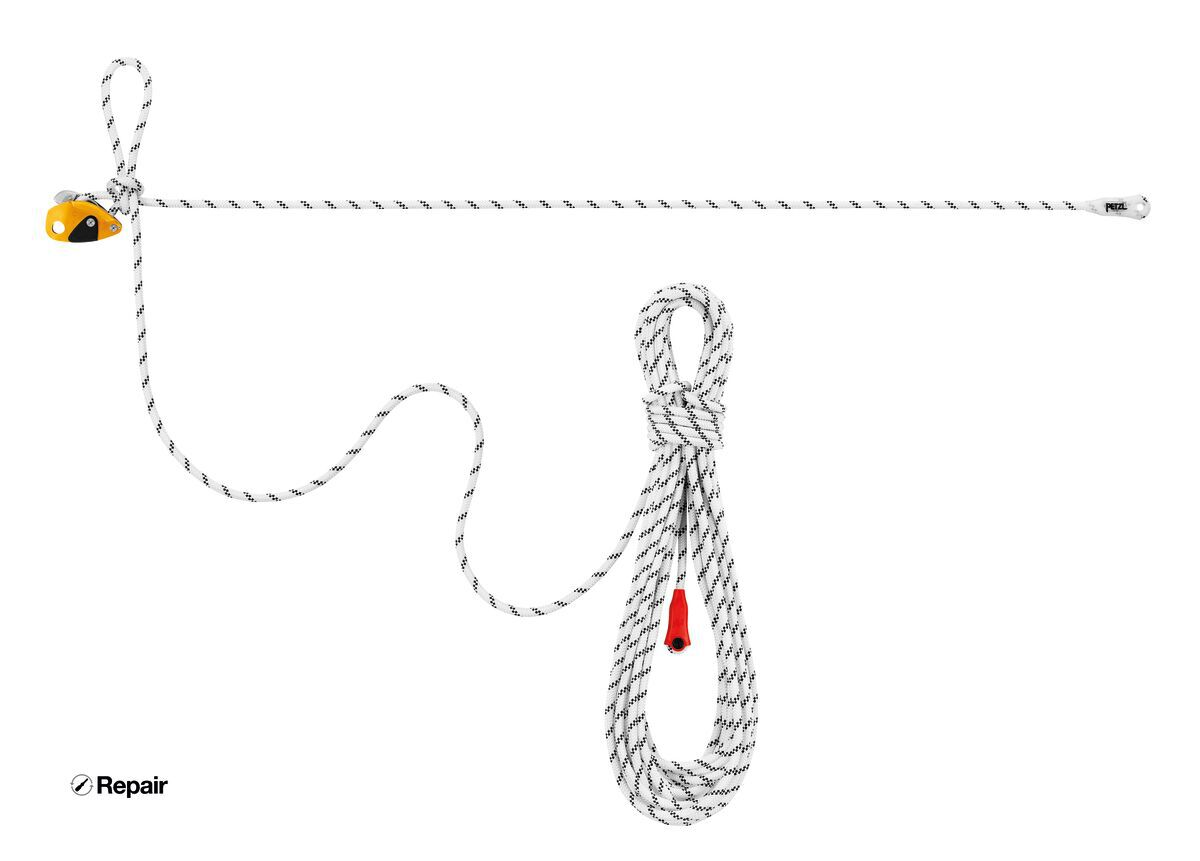
- Adjuster: check that external objects cannot press on the cam.
- Rope: inspect its full length and termination stitching for damage.
- End attachment: verify connector orientation and compatibility in the instructions.
Selecting compatible connecting equipment
GRILLON's instructions distinguish permitted equipment for this horizontal-lifeline application and prohibit use with retractable-type fall arresters. A connector fitting physically does not establish compatibility. The permitted connection methods and fall conditions in each device's instructions must agree.
For an assembly with a separate energy absorber, absorber length differs from the total length of lanyard, absorber and connectors. ABSORBICA's instructions identify these separately. Check the model's performance tables for the user including tools and clothing, anchor height and actual assembly.
Rescue arrangements belong in equipment selection. Arresting a fall does not end the danger if access to the suspended worker and rescue equipment are not ready. Petzl requires a rescue plan and the means to implement it promptly.
Inspect rope and locking components separately
Inspect the rope for cuts, abrasion, heat or chemical damage and the condition of termination stitching. Examine the adjuster for deformation, cracks, corrosion and proper cam and handle movement. Illegible identification or incomplete history makes previous fall loading and storage damage difficult to establish.
Connectors require correct orientation as well as closure and locking. GRILLON warns that external pressure on its cam can affect locking. An undamaged rope does not make an adjuster pressed against a structure acceptable. Connections also need monitoring as movement changes their orientation.
An absorber inspection goes beyond the outside of its pouch. ABSORBICA calls for checks of its fall indicator, webbing, safety stitching and attachment loops. Folding a deployed element back into the pouch or substituting an unrelated rope is not restoration under the instructions.
When a lanyard fell with the lifting equipment
OSHA Fatal Facts 8 describes a fatality during extension of a material hoist. Two workers on top of the carriage initially connected their lanyards to its gin pole. One transferred to a lifeline anchored to a roof-level steel beam; the other remained attached to the pole.
The carriage fell and the pole failed, killing the worker attached to it. OSHA identified improperly installed safety brakes, omitted inspection after prolonged inactivity, chain installation contrary to manufacturer instructions and an unsuitable anchorage. This was not a Petzl product incident; it illustrates an anchor failing with the equipment from which protection was needed.
Retirement decisions need a traceable history
Pre-use checks do not replace detailed periodic inspection. Petzl requires inspection and records appropriate to intensity of use and conditions. A major fall or load, failed inspection or unknown history are retirement criteria; a severe event can require retirement after a single use.
Inspection records should link identification, manufacture, purchase and first-use dates to observed damage and decisions. A clean appearance does not override the manufacturer's lifespan, and being within that lifespan does not justify continued use of damaged equipment. Storage, cleaning and component replacement must follow the specific instructions.
Korean pre-work duties and manufacturer conditions
Article 44 of Korea's Rules on Occupational Safety and Health Standards requires suitable attachment facilities when harnesses are used at places with a fall risk at a height of at least two metres. Support ropes require measures against sagging or loosening, and harnesses and ancillary equipment must be checked before work begins.
These duties and the specific product's design conditions both apply. Manufacturer limits on users or compatibility are not general Korean statutory values, and an overseas conformity marking does not verify Korean certification. Assessing an installation requires site anchor information and instructions for each component.