SCBA and supplied-air respirators: protection from air source to facepiece
Start with the source of breathing air
A self-contained breathing apparatus uses air in a cylinder carried by its wearer. A supplied-air respirator receives air through a hose from an external source. Both differ from filtering surrounding air through a cartridge, but a cylinder or hose alone does not make a system suitable for every hazardous environment.
Check the air source, reducer, connector, hose and facepiece as one configuration. A pressure indication or an airflow does not establish that the gas is breathable. Selection must also address sustained supply and the means of leaving if something goes wrong.
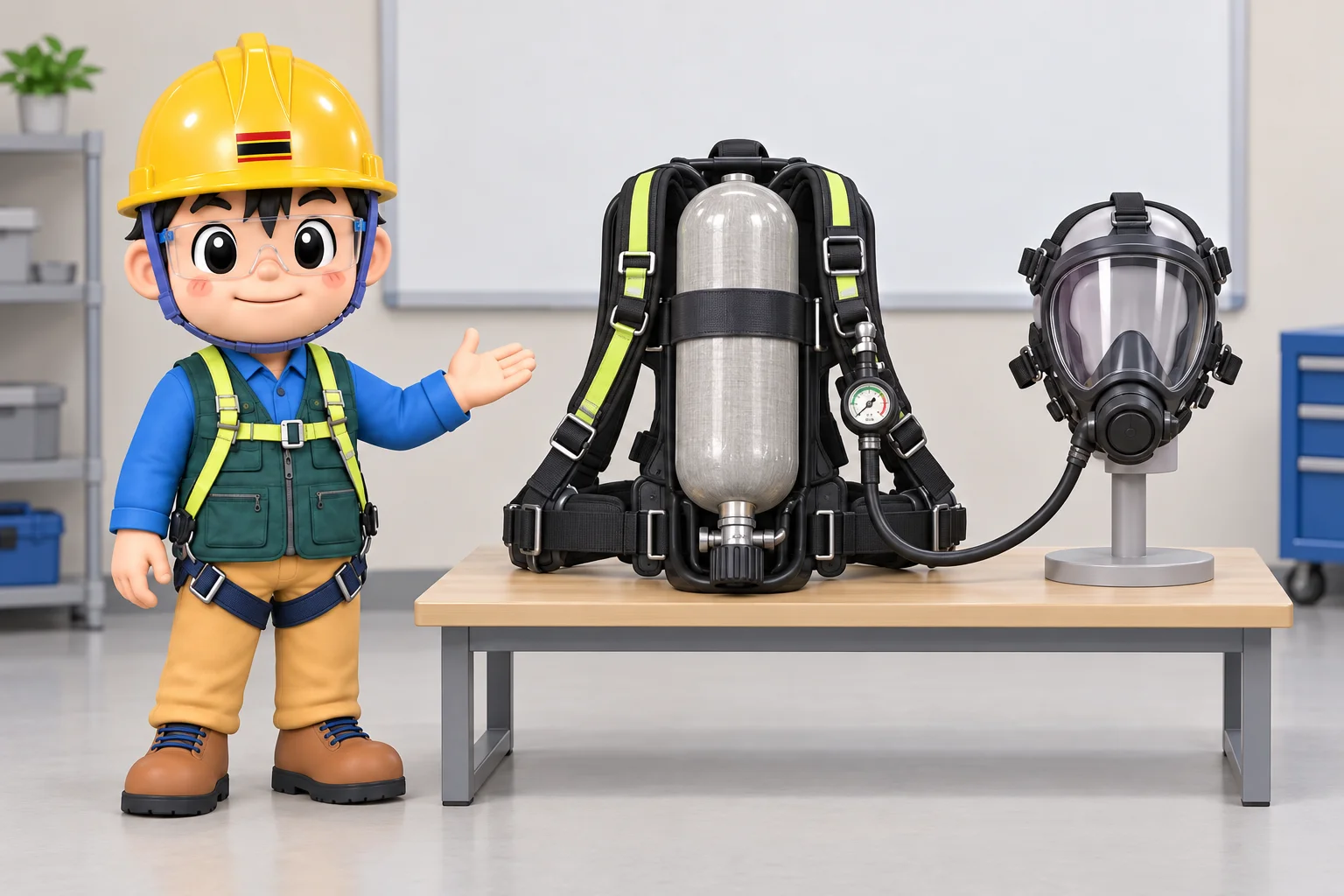
Not a photograph of an actual site
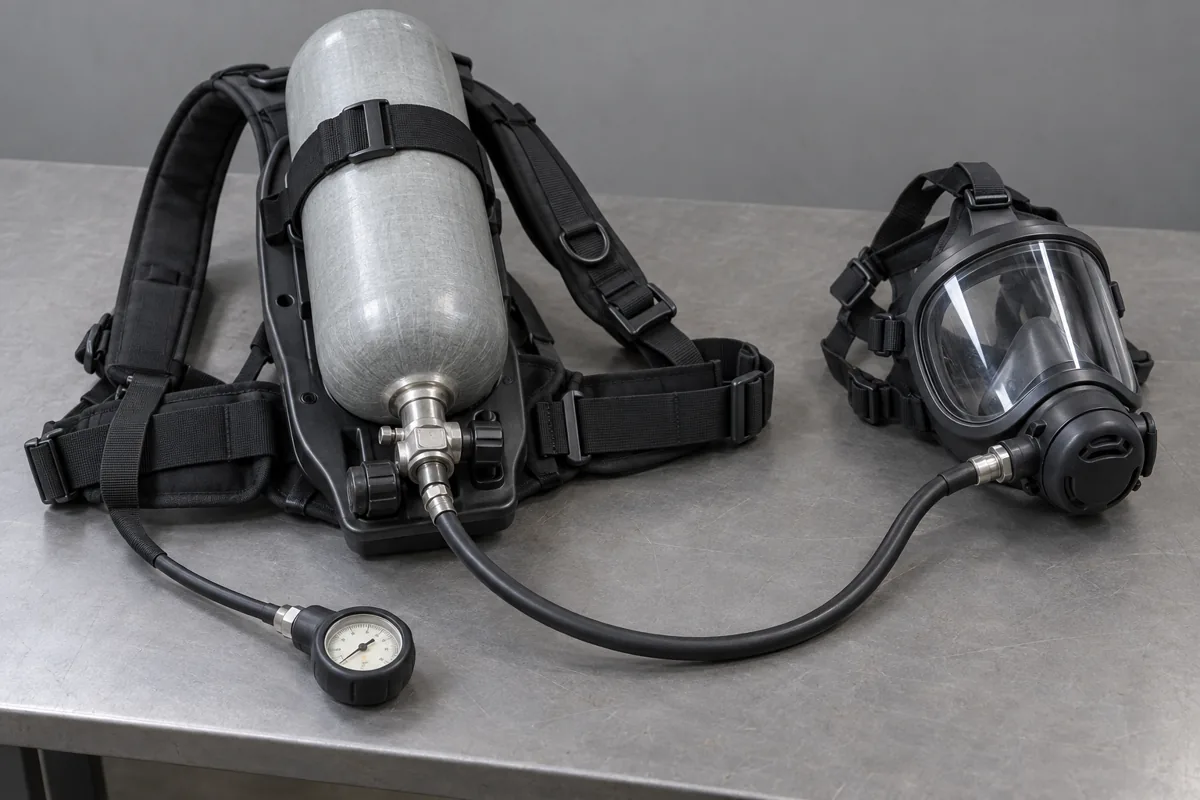
- Cylinder and harness: the wearer carries the air supply. Check cylinder fastening and harness condition, and distinguish this from an external supplied-air source.
- Hose and facepiece: this path delivers breathing air to the mask. Check the approved assembly’s connections, leak tightness and face seal on the actual equipment.
- Pressure gauge: Before use, check the remaining source pressure together with the alarms and exit plan.
Cylinder pressure and delivery at the wearer are different
Air from a high-pressure cylinder passes through a reducer to reach the pressure needed by the system. The facepiece regulator supplies air according to the product’s operating mode. Pressure upstream of the reducer is not the same measurement as the condition of air delivered to the wearer.
A crushed hose or loose connection can interrupt delivery while air remains at the source. Conversely, intact connections can carry the wrong gas if it enters the source. Mechanical continuity and breathing-air quality therefore require separate checks.
- 1 SCBAAir from a carried cylinderplan remaining air against the return route.
- 2 Supplied-airExternal source and hoseverify the breathing-air source and protected hose route.
- 3 ReducerControls supply pressureuse the test method for the actual model.
- 4 FacepieceCheck the wearer’s face sealverify sealing separately from visual condition.
- 5 AlarmsDistinguish remaining air and supply faultstest both indications and warnings.
- 6 EscapeReturn after supply failuretrain actions for the configuration and site procedure.
Read supply, facepiece and escape arrangements together
NIOSH distinguishes supplied-air respirators, SCBA and combination systems. Check whether a combination has an auxiliary cylinder and the approved purpose of that arrangement. Do not treat escape-only equipment as an entry apparatus.
The MSA G1 2018 Edition manual distinguishes the cylinder, reducer, regulator, facepiece and alarms. Rated service duration is affected by activity, breathing and other conditions. Assigning the entire marked duration to work inside does not provide for air needed to return.
The Dräger PAS AirPack 1 is an externally positioned air-supply unit, rather than a complete respirator with a facepiece. Its instructions specify compatible breathing equipment, hoses and accessories. Connectors fitting together do not justify mixing configurations.
| Type | Air-source location | Limitation to check |
|---|---|---|
| SCBA | Cylinder carried by wearer | Remaining air, return route and conditions |
| Supplied-air | External source and hose | Supply continuity, routing and wrong-connection prevention |
| Combination | External supply and auxiliary cylinder | Changeover and approved auxiliary-cylinder purpose |
Select against the atmosphere and the return route
Identify possible oxygen deficiency, contaminants and concentrations, skin exposure and the movement involved. Respiratory protection alone cannot resolve exposure through the skin. Check other PPE or equipment that could interfere with the face seal.
A supplied-air system needs a safe location for the source and a protected hose route. Examine sharp edges, vehicle routes, hot surfaces and snagging points during movement. Keep the installed arrangement within the product’s allowed configuration and establish a separate plan for leaving after a supply failure.
Check the face seal and alarms separately
Inspect cylinder retention, valves, hoses, connectors, facepiece and straps. MSA separates visual inspections from functional tests. Face sealing, air delivery and indications or alarms are distinct checks. An undamaged appearance does not justify skipping functional tests.
If a pre-use test reveals a leak or alarm fault, separate the unit from serviceable equipment until corrective work is verified. Do not transfer one product’s test pressures or timing to another. Keep the test procedure aligned with the actual equipment instructions.
A line that runs a tool may not supply breathing air
Plant compressed air and breathing air have different purposes. A functioning pneumatic tool or normal pressure reading does not justify connecting a respirator. Beyond colour and labels, identify any connection through which another gas could enter the breathing-air system.
A low-pressure warning is not a display of spare working time. Actions on an alarm must be trained for the equipment configuration and site procedure. Do not disconnect fittings or experiment with valves in a hazardous area to investigate an alarm.
A connection labelled air supplied nitrogen
Case 1 in OSHA’s 2004 airline-respirator bulletin describes a foundry worker using a pneumatic tool and an airline respirator. A paper tag identified the line as air, but it carried nitrogen. A splitter fed the tool and the respirator, and the worker died from asphyxiation.
OSHA calls for separation of breathing-air systems from other gas systems and incompatible connections. This is not an instruction to make unapproved changes to respirator components. Tracing the source and preventing a wrong connection address complementary problems. The incident is not evidence of a PAS AirPack or G1 failure.
Connect filling, cleaning and maintenance records
Clean, disinfect, dry and store the facepiece by the permitted product method. Link cylinders and regulators to filling, inspection and maintenance records. Store hoses without lasting kinks or crushing and protect connectors from contamination.
Dräger includes unused equipment in its maintenance and testing programme. Storage in a cabinet does not establish immediate readiness. Set maintenance and cylinder-inspection requirements from the actual instructions and applicable Korean requirements; a foreign manual’s interval is not a universal Korean statutory interval.
The ventilation exception has specific conditions
Article 620 of Korea’s Rules on Occupational Safety and Health Standards requires ventilation to maintain suitable air before and during confined-space work. Its exception concerns situations where explosion or oxidation risks prevent ventilation, or the nature of the work makes ventilation extremely difficult, with SCBA or supplied-air masks provided and worn.
Having protective equipment available does not by itself allow ventilation to be omitted. Establish whether the actual conditions meet the exception. NIOSH or EN information in foreign instructions describes the relevant approved configuration; it does not automatically replace Korean product certification or site suitability checks.
Questions along the breathing-air path
Which source is reached when the hose is traced back from the facepiece? What prevents a connection between breathing air and tool-air or nitrogen systems? What actions do the wearer and outside personnel take on supply interruption or a low-pressure warning?
Record the precise cylinder, facepiece, connector and supply-unit configuration rather than only the generic equipment type. This allows comparison after parts change during maintenance. Separate leak-test and alarm-test results make the next point of investigation clearer.