English names and summaries of Korean laws are unofficial translations. The Korean text on the Korean Law Information Center (law.go.kr) prevails.
Serious Accident Response in Korea: first steps and reporting
Key terms in Korean and English
- Occupational Safety and Health Act (산업안전보건법)
- Serious Accidents Punishment Act (중대재해 처벌 등에 관한 법률)
- regional employment and labor office (지방고용노동관서)
- industrial accident (산업재해)
- serious accident (중대재해, OSH Act)
- serious industrial accident (중대산업재해, SAPA)
- occupational disease (직업성 질병)
- acute poisoning (급성중독)
- responsible management officer (경영책임자등)
- employer (사업주)
- work stoppage (작업중지)
- work stoppage order (작업중지 명령)
- work stoppage review committee (작업중지해제 심의위원회)
- Industrial Accident Investigation Report (Form No. 30) (산업재해조사표)
- accident investigation report (재해조사보고서)
- safety and health improvement plan (안전보건개선계획)
- recurrence prevention measures (재발방지 대책)
- administrative fine (과태료)
- public disclosure (공표)
- collapse (무너짐)
- electric shock (감전)
- fire (화재)
1. First, check whether it is a "serious accident"
Korea has two legal definitions. Check both.
| OSH Act: serious accident (중대재해) | SAPA: serious industrial accident (중대산업재해) | |
|---|---|---|
| Basis | Article 2 subparagraph 2 of the OSH Act; Article 3 of the Enforcement Rule | Article 2 subparagraph 2 of the SAPA |
| Death | One or more fatalities | One or more fatalities |
| Injury | Two or more workers at the same time needing medical care for 3 months or more | Two or more workers from the same accident needing treatment for 6 months or more |
| Multiple cases | Ten or more injured workers or workers with occupational disease at the same time | Three or more workers with acute poisoning or other prescribed occupational diseases from the same hazard within one year |
| What follows | Work stoppage and evacuation, immediate report (Article 54), Form No. 30 (Enforcement Rule Article 73) | Investigation of the responsible management officer's duties; recurrence prevention measures (Article 4(1) subparagraph 2 of the SAPA) |
If in doubt, act as if it qualifies. The cost of not reporting is far greater.
2. First steps
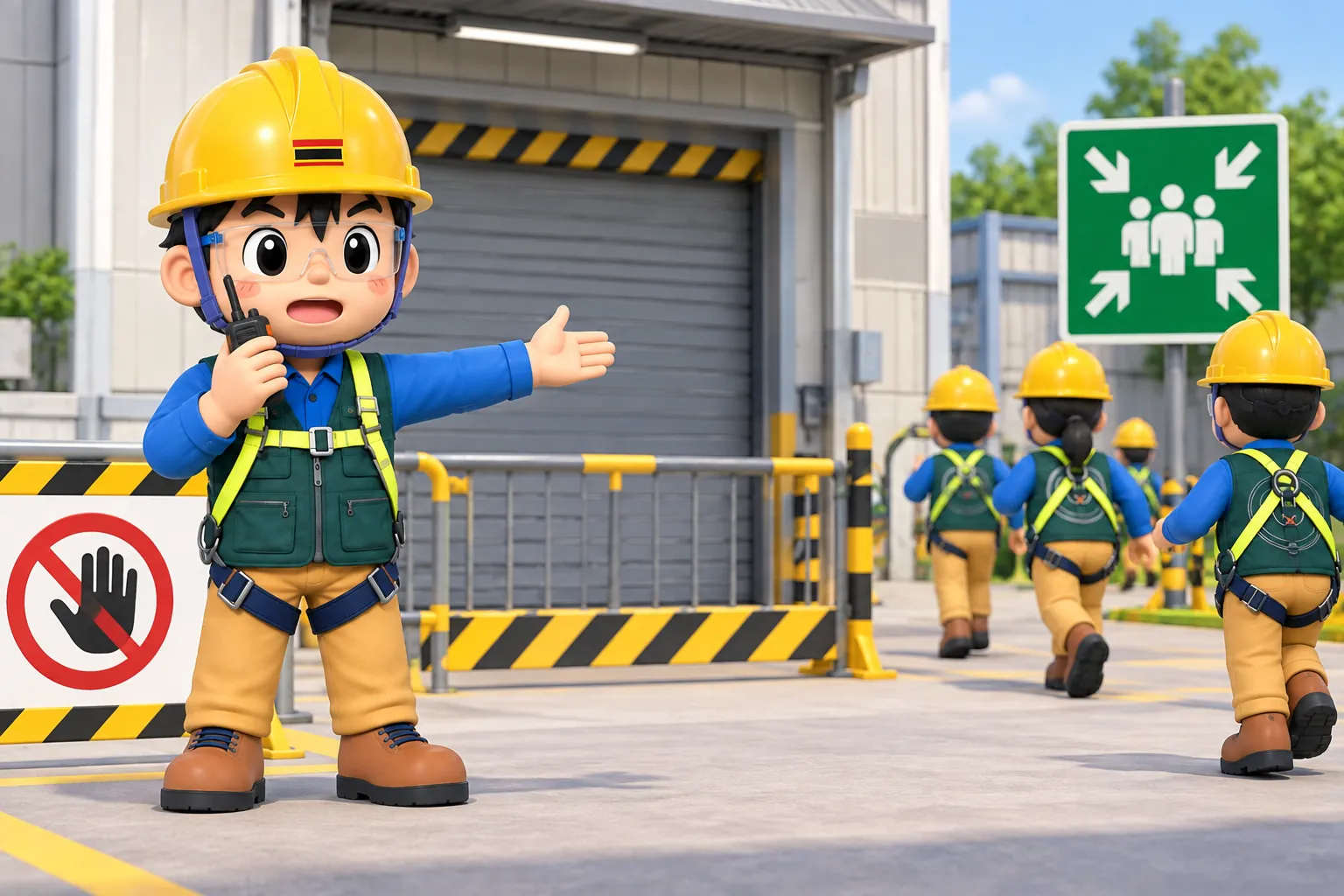
Step 1 — Immediately: stop, evacuate, rescue
- Stop the work and evacuate workers. This is the employer's duty when a serious accident occurs (Article 54(1) of the OSH Act). Violation: up to 5 years' imprisonment or a criminal fine of up to KRW 50 million (Article 168).
- Call 119 and give first aid. Treat crush injuries, falls and electric shock as critical even if the injured worker is conscious.
- Prevent further harm. Stop the same work, the same equipment, and any area exposed to spreading gas or fire.
- Follow your emergency manual if you have one. The SAPA Enforcement Decree requires such a manual covering work stoppage, evacuation, removal of hazards, rescue and prevention of further harm (Article 4 subparagraph 8).
Step 2 — Preserve the scene
- No one may damage the accident scene or obstruct the cause investigation (Article 56(5) of the OSH Act).
- Control access and record who controlled it and when.
- If anything had to be moved for rescue or to prevent a second accident, record what, why and when, with photographs.
Step 3 — Report without delay
- To: the head of the regional employment and labor office with jurisdiction over the workplace (Article 67 of the Enforcement Rule)
- How: by telephone, fax or other appropriate means
- What (three items):
- Outline of the accident and the damage
- Measures taken and outlook
- Other important matters
- When: without delay after becoming aware of the serious accident. If a natural disaster or similar event prevents reporting, report without delay once it ends (Article 54(2) of the OSH Act).
- Penalty: failing to report or reporting falsely — administrative fine of up to KRW 30 million (Article 175(2)).
- No concealment: employers must not conceal the occurrence of an industrial accident (Article 57(1)).
- Police and fire reports are separate from the MOEL report. Do both.
- At contracted sites, inform the principal contractor at once and decide in advance who reports to MOEL so the report is not delayed.
Step 4 — Same day onward: cooperate and manage the work stoppage
- Work stoppage order: MOEL may order the stoppage of the work involved in the accident, or the same type of work, if there is an imminent risk of another accident. If a collapse, fire, explosion or leak could spread, it may stop all work at the workplace (Article 55(1)–(2)). The order is issued on Form No. 28. Violating the order: up to 5 years' imprisonment or KRW 50 million (Article 168).
- Cause investigation: MOEL may investigate. Since the February 2026 amendment, it may also have KOSHA or outside experts investigate technical causes; they may enter the workplace, interview staff and request documents (Article 56(1)–(3)).
- Investigation reports: reports prepared by KOSHA or experts are, in principle, made public after indictment (Article 56-2, added 19 February 2026).
- Improvement plan: MOEL may order a safety and health improvement plan (Article 56(4)).
Step 5 — Apply to lift the work stoppage
- Complete the hazard improvements first.
- Before applying, hear the opinions of the workers in the affected work on the improvements (Article 69(2) of the Enforcement Rule). Record the date, attendees and opinions.
- Submit the application to lift the work stoppage order (Form No. 29) to the regional office (Article 69(1)).
- A labor inspector checks the measures, and the work stoppage review committee meets within 4 days from the day after the application (Saturdays and holidays count, but no more than 3 consecutive such days). The order is lifted once the measures are judged complete (Article 69(3)).
Step 6 — Within one month: submit Form No. 30
- If a worker dies, or needs 3 or more days off work due to injury or disease, submit the Industrial Accident Investigation Report (Form No. 30) to the regional office within one month of the accident, including electronically (Article 73(1) of the Enforcement Rule).
- Have it confirmed by the workers' representative and attach any dissent; if there is no representative, the injured worker may confirm it (Article 73(3)).
- Failing to report or reporting falsely: administrative fine of up to KRW 15 million (Article 175(3) of the OSH Act).
- The immediate report in Step 3 does not replace Form No. 30.
Step 7 — Record and keep
- Record the workplace outline and worker details, the date, time and place, the cause and sequence, and the recurrence prevention plan (Article 72 of the Enforcement Rule). Keeping a copy of Form No. 30 satisfies this.
- Keep for 3 years (Article 164(1) of the OSH Act).
Step 8 — Set and carry out recurrence prevention measures
- The SAPA requires the employer or responsible management officer to set and carry out recurrence prevention measures after an accident (Article 4(1) subparagraph 2).
- Write measures in terms of equipment, procedures, people and budget, with owners, deadlines and evidence of completion. Apply them to other lines or sites with the same hazard.
Step 9 — Afterwards
- Training for the responsible management officer: after a serious industrial accident, the responsible management officer of the corporation must complete up to 20 hours of safety and health training. Failure without good reason: administrative fine of up to KRW 50 million (Article 8 of the SAPA; Article 6 of the Enforcement Decree).
- Public disclosure: where a sentence becomes final for a serious industrial accident caused by a breach of duty, MOEL may disclose the workplace name, date, place, details and cause (Article 13 of the SAPA; Article 12 of the Enforcement Decree).
- Penalty levels (for reference): SAPA, fatal case — responsible management officer: imprisonment of at least 1 year or a criminal fine of up to KRW 1 billion (both may be imposed); corporation: up to KRW 5 billion (Articles 6(1) and 7). OSH Act — breach of safety or health measures causing a worker's death: up to 7 years' imprisonment or KRW 100 million (Article 167(1)).
Timeline at a glance
| When | Action | Basis |
|---|---|---|
| Immediately | Stop work, evacuate, call 119, prevent further harm | OSH Act Art. 54(1); SAPA Decree Art. 4 sub. 8 |
| Immediately | Preserve the scene, control access | OSH Act Art. 56(5) |
| Without delay | Report three items to the regional office by phone or fax | OSH Act Art. 54(2); Rule Art. 67 |
| Same day onward | Cooperate with inspectors; comply with any stoppage order | OSH Act Arts. 55, 56 |
| After improvements | Hear affected workers → apply to lift (Form No. 29) | Rule Art. 69 |
| Within one month | Form No. 30 with workers' representative's confirmation | Rule Art. 73 |
| Ongoing | Record cause and prevention plan; keep 3 years | Rule Art. 72; OSH Act Art. 164 |
| Ongoing | Set and carry out recurrence prevention measures | SAPA Art. 4(1) sub. 2 |
| On notice | 20-hour training for the responsible management officer | SAPA Art. 8; Decree Art. 6 |
Occupational Safety and Health Act · OSH Act Enforcement Rule · Serious Accidents Punishment Act · SAPA Enforcement Decree
Handing over site actions and outside communications together
The access-control contact should pass remaining hazards and responder access arrangements to the person handling outside calls. If messages have different senders and recipients, accounts can diverge; keep communications in a shared record.
At a change of responsibility, distinguish completed actions from those in progress. Completing a call and completing site actions should not share a single completion marker, so the next person can continue the support still needed.