English names and summaries of Korean laws are unofficial translations. The Korean text on the Korean Law Information Center (law.go.kr) prevails.
Plan for a fall even during a brief ceiling check: portable ladder accident
At a glance
A worker investigating an apartment ceiling leak fell while descending a ladder and died.
The worker used a stored ladder without inspecting it first.
Having someone hold the ladder should be considered alongside measures against the worker falling and striking their head.
From preparation to the aftermath
In spring 2022, an apartment maintenance worker and the apartment manager found water beneath an open ground-floor area during a patrol. An outside contractor had inspected the leak days earlier without finding its source. They decided to examine the ceiling again, moving from a patrol into a short inspection without preparing separate access equipment.
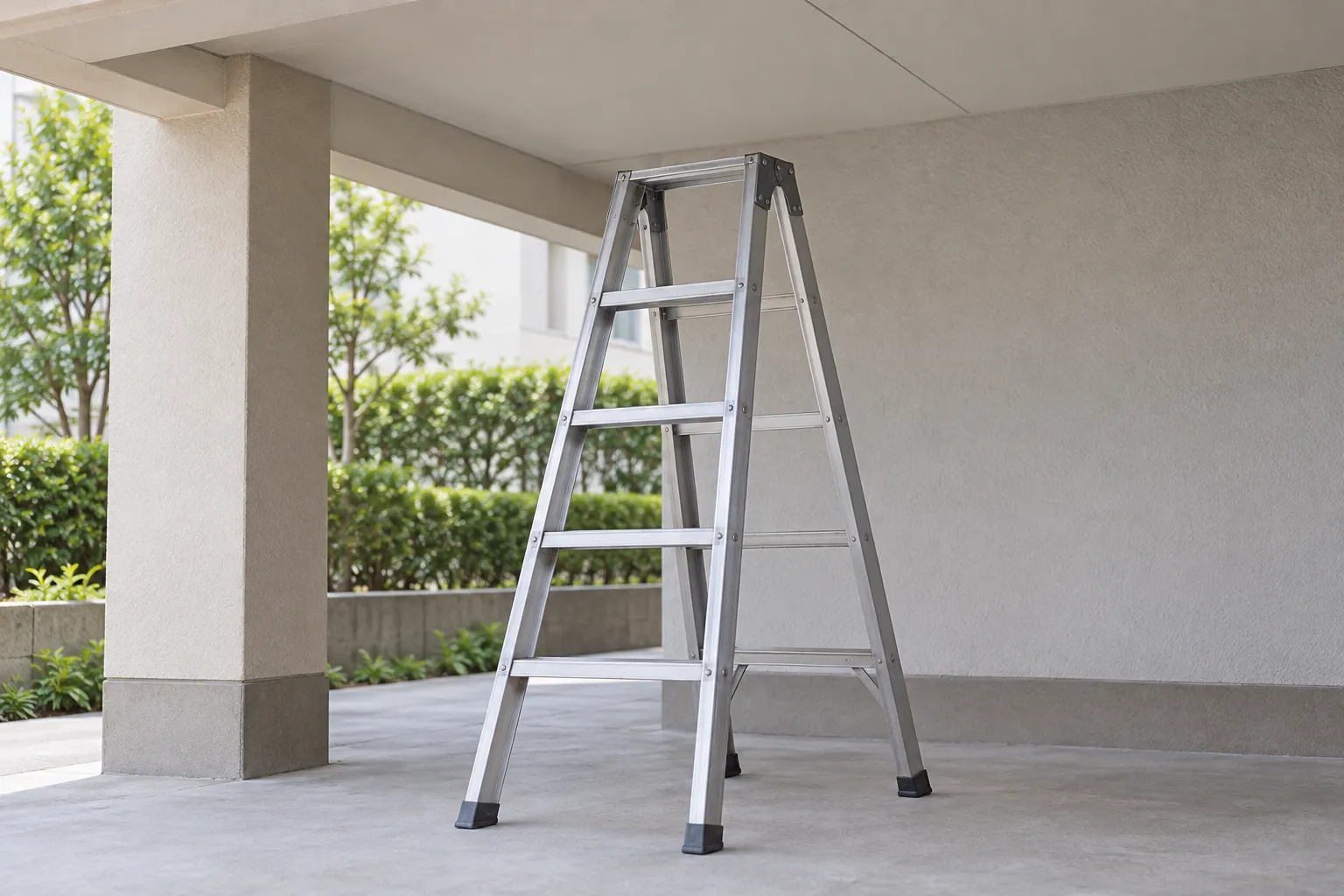
They fetched a steel stepladder left in a nearby flower bed. It belonged to the management office but had not been returned to storage. They opened it without checking its condition. The apartment manager held it while the worker climbed and examined the ceiling with a torch.
When no clear leak trace was found, the worker began descending. The white paper describes a foot slipping inward on a tread, loss of balance and a backward fall. Its diagram places the slipping position at about 1.1m, distinct from the ladder’s overall height. The worker struck their head on the ground without a safety helmet.
The nearby manager called for help and performed cardiopulmonary resuscitation, but the worker died. The white paper reports the manager’s explanation that the task had seemed too brief to fetch a helmet. Someone was holding the ladder, but equipment checks and protection against a fall and head impact had been omitted.
Descent and foot placement after the inspection
Supporting the ladder and supporting the person are different matters. Holding it below may reduce ladder movement, but cannot prevent every misplaced foot or loss of balance. Examine not only whether the ladder overturns, but how feet meet the treads and whether hands can support the person.
A ceiling inspection directs attention overhead. After using a torch and looking around the ceiling, the worker must redirect attention to the treads during descent. Treating descent as outside the task leaves its final stage unmanaged. Plan tool carrying and hand support before climbing.
A leak changes both the ceiling problem and conditions beneath it. Before placing a ladder, examine whether the floor is wet. Drainage and ladder-foot contact also need checking when planning similar inspections.
Being left in a flower bed does not prove component failure. Uncontrolled storage does, however, make damage, deformation and contamination since the last use harder to track. Combine assigned storage, pre-use inspection and segregation of unsuitable ladders to prevent unchecked reuse.
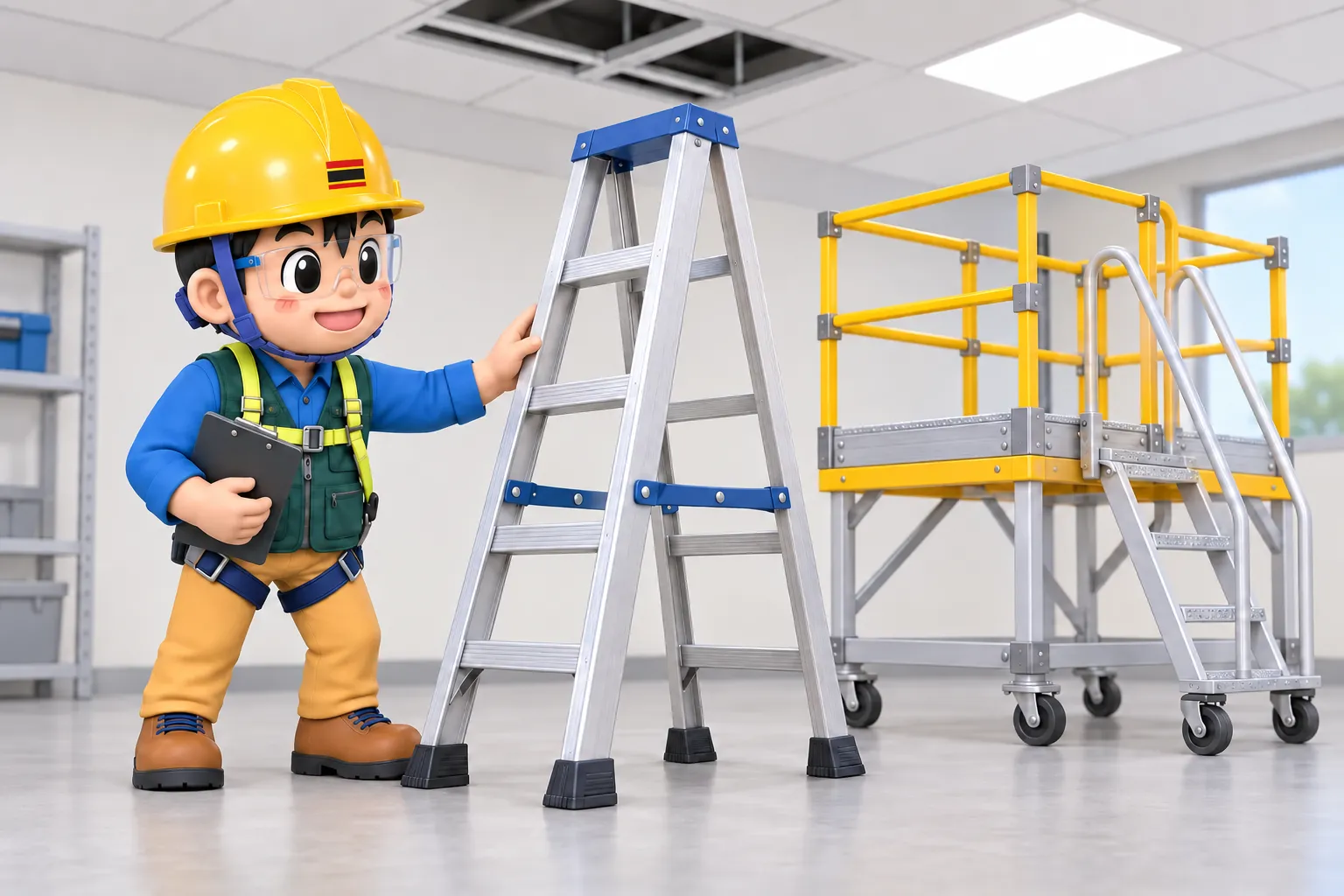
Reach is not the only selection criterion. Consider support while inspecting, ascent and descent, tool use and nearby vehicles or residents. For recurring ceiling checks, first assess whether equipment with a work platform can be provided, using actual space and access conditions.
A wide inspection area calls for descending and repositioning rather than reaching sideways. Failure to find the leak may lead to expanding the search. Reassess access when the planned area changes, particularly if greater height or two-handed work is needed.
A helmet does not replace stability measures or suitable access. Measures against falling and protection against head impact are needed together. Having someone hold the ladder is not a reason to omit head protection.
An apartment office can distinguish task levels when receiving a complaint. Observation from the floor and access near the ceiling require different preparation. If an outside contractor could not locate the leak, arrange suitable equipment and scope rather than rushing to solve it during patrol.
Watch for an inspection becoming a repair. Moving ceiling material or touching pipework changes force and posture from merely looking with a torch. Instead of reaching further when the leak remains elusive, come down and reconsider access and equipment. Equipment chosen for observation may not suit repair.
Before use, check support on opening, spread restraint and treads. A person holding the ladder is not a substitute for removing defective equipment from use. Segregate it so the next person does not unknowingly reuse it.
What the comparison shows
The same chapter describes a worker in a decorative-film wholesale workplace slipping near the final tread during descent. The height was about 30cm and the worker died. Although the tasks differed, both accounts highlight descent after work and the absence of a helmet. Nearing the bottom does not make the consequences of impact minor.
In a warehouse waterproofing case, a worn ladder failed during descent. That failure mechanism cannot be assigned to the apartment accident. The comparison shows why personal balance and equipment integrity require separate checks: assisting the user does not establish that the ladder is fit for service.
The warehouse work involved waterproofing a canopy. Even extended straight, the ladder did not reach it, requiring a transfer after climbing along the wall. A side member failed during descent, and worn and corroded connections were found afterwards. Both unsuitable reach and unchecked condition mattered.
Foot placement and balance are central to the apartment sequence, rather than ladder failure. Checking only for the comparison accident’s failure mechanism misses that distinction. Even intact equipment does not prevent a person losing balance during descent. Examine both equipment and movement while keeping the actual sequences separate.
Causes and protective layers
| Layer | At the time | Workplace action |
|---|---|---|
| Access equipment | A nearby ladder was used immediately | Select access for the inspection scope |
| Equipment check | Storage and pre-use checks omitted | Inspect members, joints and feet; segregate defects |
| Descent | Foot slipped inward on a tread | Plan foot placement, hand support and tool carrying |
| Impact protection | No helmet worn | Provide and check head protection before climbing |
Investigation and proceedings
The MOEL white paper identifies missing ladder checks and helmet provision and instruction. It does not set out an enforcement decision or judgment for this case.
Why the consequences were severe
The manager was close by but could not prevent the fall. Reduce the fall exposure before relying on someone’s presence. In an emergency, communicate the exact location and clear access for responders; response arrangements do not replace preparation.
Questions at the work position
| Question | What to examine |
|---|---|
| Has patrol become work? | Reassess preparation when ceiling access is needed |
| Is its condition known? | Storage, joints, deformation and contamination |
| Where will hands and feet be during descent? | Tool carrying, treads and sequence |
| Does the equipment suit an expanded inspection? | Height, two-handed work and sideways reach |
Korean legal references
Current safety-rule Article 42 prioritises a work platform and sets conditions in paragraph 4 for portable ladders where a platform and fall-arrest net are impracticable. This paragraph was added in 2024 and must be distinguished from provisions at the 2022 accident. Current planning must address the floor, stability, manufacturer load limit, height and tread restrictions, PPE and pre-use checks.
Also check the helmet requirements for fall-risk work under Article 32. Select a platform suited to the current task and check both ladder-use and protective-equipment conditions.
Occupational Safety and Health Act (Korean) · Rules on Occupational Safety and Health Standards (Korean)
Sources
MOEL and KOSHA, 2023 Serious Accident White Paper, 250–275 pages. Official publication (Korean)