English names and summaries of Korean laws are unofficial translations. The Korean text on the Korean Law Information Center (law.go.kr) prevails.
Can the secondary guarding detect roof projections?: Entrapment during pipe removal
Key terms in Korean and English
- serious accident (중대재해, OSH Act)
- caught in or between (끼임)
- guardrail (안전난간 / 난간)
- pipework (배관)
- overhead truss (천장 트러스)
- secondary guarding (anti-entrapment device) (과상승 방지장치)
At a glance
On 23 January 2024, a day labourer removing pipework at a car factory in South Gyeongsang Province was trapped between a work-platform guardrail and the roof structure.
The worker died during treatment on 1 February 2024.
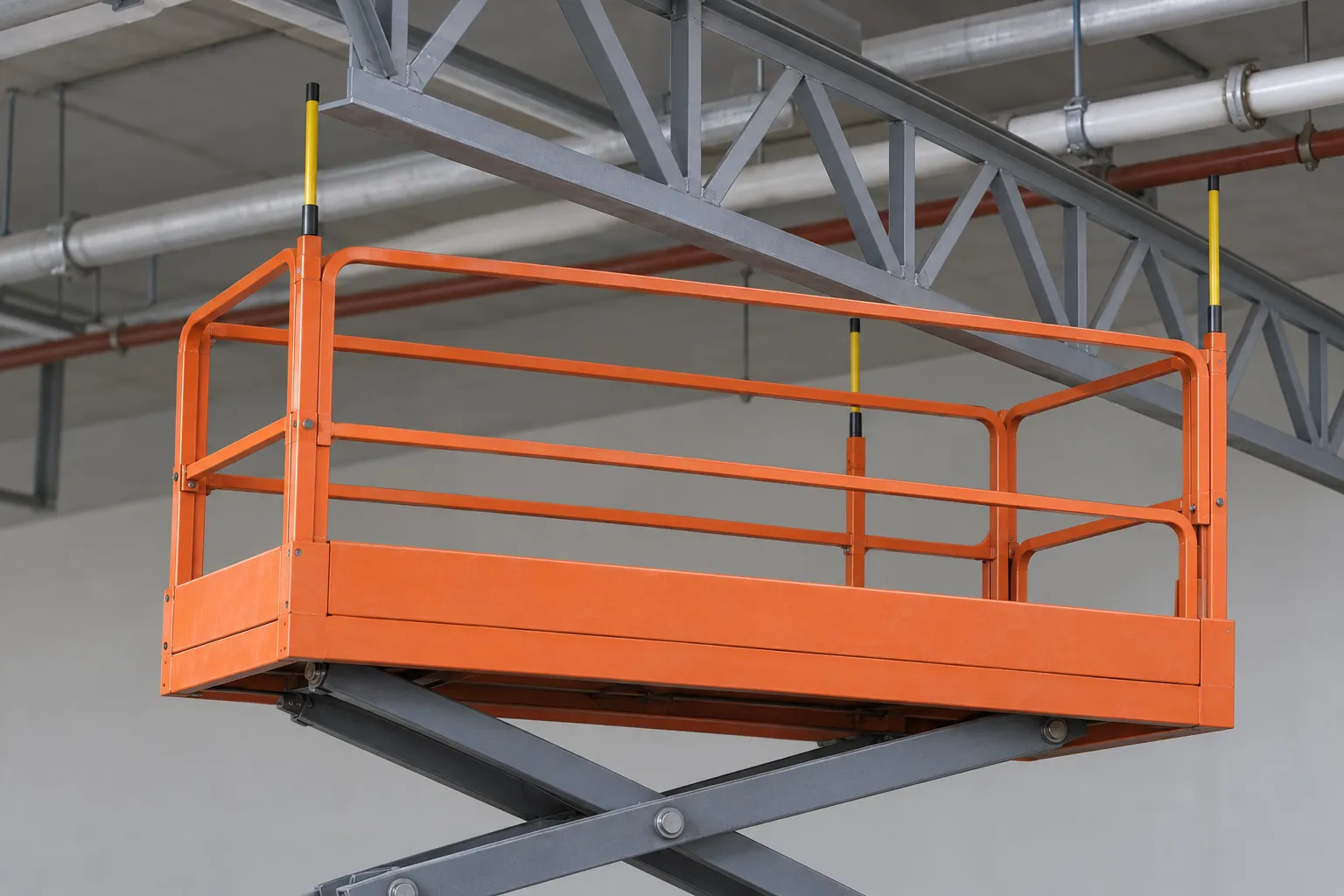
From preparation to the aftermath
Workers were removing overhead air pipework during demolition of idle equipment in a car factory. The contractor used a scissor lift. As the platform rose, the lead connected to the cutting tool moved with it, so the work included managing the lead to avoid entanglement as well as cutting.
The worker who started on 23 January 2024 was on the first day at that site. Together with a colleague, the worker boarded the platform to remove pipework about 7.5 m high and took charge of the lead. Bar-type secondary guarding was fitted at the platform corners.
At about 15:00, the platform rose while the assisting worker watched the lead to keep it clear. When the colleague noticed something wrong, the worker’s head and arm were trapped between the lower part of an overhead truss and the platform guardrail. The structure did not present a flat surface that would contact all the sensing bars together.
The colleague lowered the platform to release the worker. The injured worker received treatment but died on 1 February 2024. The white paper describes an airway problem following facial trauma. Being able to communicate immediately after the accident had not meant that the injury was minor.
A work plan existed but did not address structures outside the guarding’s detection range or how entrapment would be prevented there. The white paper points to the need for principal-contractor support, including technical assistance, where the subcontractor’s measures were insufficient. The presence of a device had not established its suitability for the site.
A roof is not a flat plane: gaps between sensing bars
A scissor lift raises its platform vertically as the supporting mechanism extends. Even with the same ground position, clearance around pipes and trusses changes with height. The whole occupied area rises, so looking only at the tool’s destination does not verify the path of occupants’ heads and shoulders.
A contact bar detects hazards at its contact location. A projection entering between bars can reach an occupant first. A device that operates effectively beneath a flat ceiling cannot automatically be assumed to provide the same coverage among pipes and steelwork.
A guardrail prevents falls but can form one side of an entrapment gap as an overhead structure approaches relative to the rising platform. A connected harness does not widen that gap. Falling outside the platform and being compressed within its boundary require separate consideration.
For the geometry in this case, the white paper discusses protection capable of detecting in other directions, such as a horizontal safety bar. That is not an instruction to add improvised bars or alter wiring on site. Give the manufacturer the location geometry and approach requirements, verify a suitable machine and guarding configuration, and select another access method if necessary.
Arrival checks need to cover suitability for the work area as well as rated load and condition. Clearances beneath pipes, beside bracing and under roof beams differ even within one building. Examine the combined envelopes of platform movement, occupants, tools and leads to identify trapping points.
An assistant is also an occupant exposed to the raising movement. Attention to a lead can draw attention away from overhead hazards. The operator needs to check the other occupant’s position before moving, not only the operator’s own clearance. Consider whether lead management and raising can be reduced or separated rather than performed simultaneously.
A function test at a low position checks whether a device operates. It does not establish detection of every obstacle at working height. Perform device checks separately from clearance assessment, without placing anyone in a trapping position to test the protection.
Rescue arrangements also need to fit the machine and surroundings. Know and maintain access to ground emergency controls and examine whether lowering could create another obstruction. Equipment-specific emergency procedures should be learned in advance rather than directions of movement being guessed during an emergency.
Working height is only a starting point for selection. A tool may reach the pipe while an occupant’s head lies beneath a truss. Give the hirer roof geometry, pipe clearances and the planned platform position rather than height alone. This avoids trying to force an unsuitable machine to fit after delivery.
Occupant arrangement affects clearance. The operator and the person handling the lead may stand in different places, with an obstruction affecting only one. Plan each position before raising and how either occupant can signal a stop during movement. Recheck positions before the next movement after a stop signal.
Demolition changes the surroundings as it proceeds. Removing pipework can expose structures or shift tool positions, so clearance established in one area cannot simply be assumed in the next. Recheck platform position and overhead obstacles when moving areas, and reflect new hazards in the day’s plan and briefing.
The white paper also addresses principal-contractor technical support. The client may know existing plant geometry and history, while the equipment supplier knows detection characteristics. Bring the required drawings and machine information together before work rather than leaving the demolition contractor to infer both. The purpose is to resolve missing selection information.
Induction for a day worker needs more than entrances and PPE. At the actual position, explain platform movement, overhead trapping areas and how to tell the operator to stop. Experience with the same type of machine elsewhere does not establish knowledge of this roof geometry.
Learn emergency lowering from the model-specific manufacturer procedure. Check controls available under power failure and ground access as well as the lowering path. Assuming an occupant can always operate controls leaves a gap if entrapment prevents reaching them. Ground assistance belongs in equipment operation planning.
What the comparison shows
Part 3 of the 2025 white paper contrasts falls, overturns and entrapment on work platforms. In ship painting, a worker fell at an open entrance of a replacement truck-mounted platform. During factory steelwork, a scissor lift overturned at height on ground that had not been levelled. The pipe-removal case shows how overhead clearance can trap a person even without an overturn.
Passing a fall-protection item does not address all three mechanisms. An open entrance concerns access protection; overturning concerns ground and operating conditions; entrapment concerns movement space and detection coverage. These distinct controls should not collapse into a single PPE check.
Causes and protective layers
| Layer | At the time | Workplace action |
|---|---|---|
| Selection | Bar detection did not suit projections | Match roof geometry with protective coverage |
| Raising clearance | An occupant entered the truss-to-rail gap | Assess all occupants and tools throughout movement |
| Work planning | Detection limits omitted | Identify trapping locations and avoidance methods |
| Technical support | Insufficient subcontractor measures remained | Review suitability with principal, hirer and manufacturer |
Investigation and proceedings
The MOEL white paper identifies roof geometry, the detection limits of secondary guarding and omissions in the work plan. It does not provide an enforcement or court outcome for this accident.
Why the consequences were severe
The occupant moved with the rising platform while the truss remained fixed. As the gap narrowed, the bars did not detect that projection. Missing the distinction between a device fault and a mismatch between sensing location and hazard location can result in the same machine being returned as serviceable.
The death during treatment also shows why the appearance of an injury immediately afterwards is insufficient to judge its seriousness. Entrapment requires rescue and emergency medical care, with an accurate account of the compression location and machine movement given to responders.
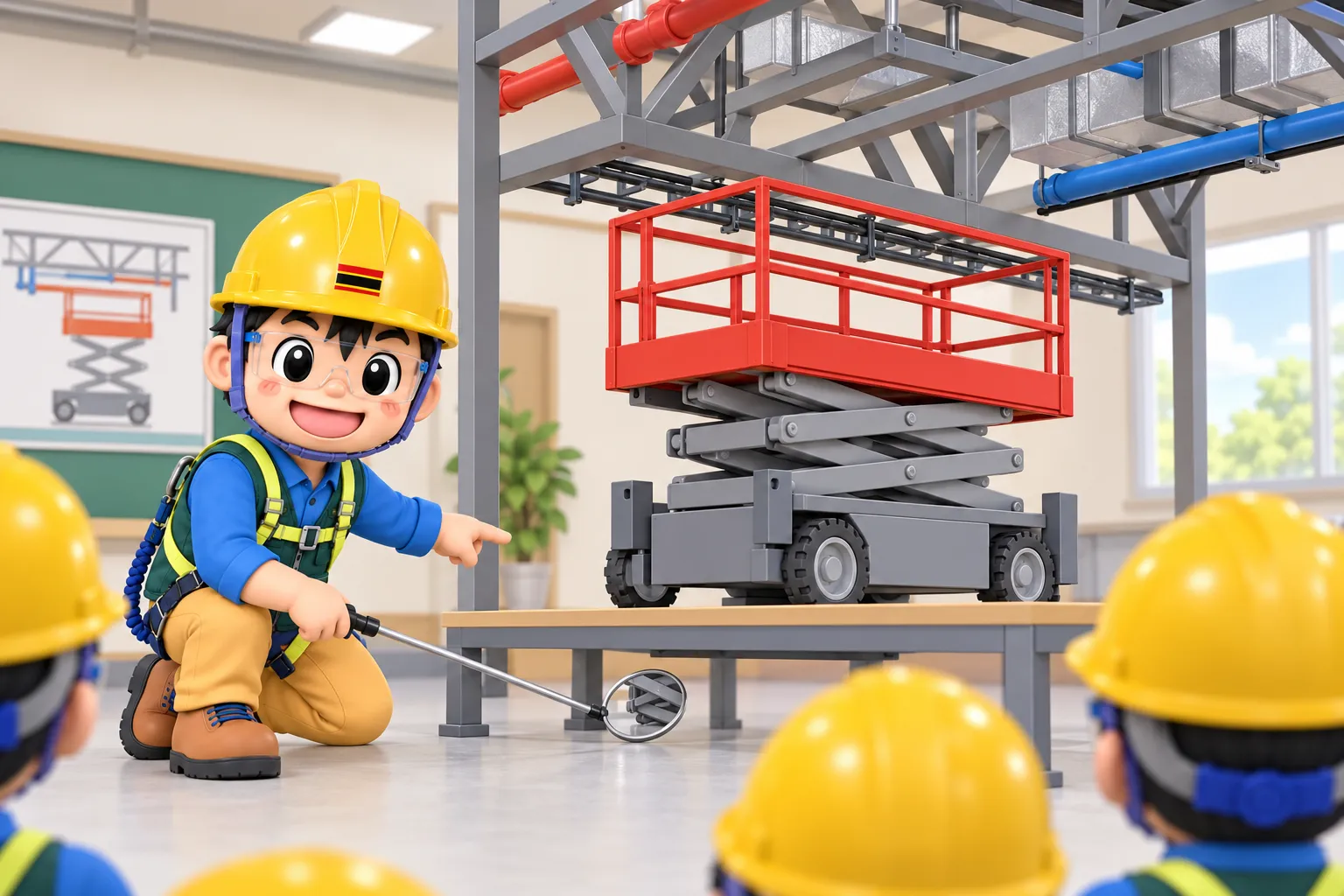
Questions at the work position
| Question | What to examine |
|---|---|
| What can enter between the bars? | Lower truss members, pipes and brackets relative to occupant space |
| Where is the assistant looking? | Whether lead handling can be separated from raising |
| Does protection cover this geometry? | Manufacturer criteria, function checks and actual clearance |
| Is another machine needed? | Suitability of approach and guarding, not height alone |
| Are ground rescue controls usable? | Emergency lowering controls, access and obstructions |
Korean legal references
Article 186 of the safety rules addresses guards or secondary guarding against entrapment and collision and measures during use. The work plan under Article 38 must reflect the actual method and preventive measures. Rather than only listing a device name, identify where it can interact with structures.
The accident occurred on 23 January 2024, shortly before SAPA coverage expanded to smaller businesses. The white paper does not establish the demolition-contract value or workforce needed for that applicability assessment, so no additional Enforcement Decree finding is made. Current machine and work-plan suitability is addressed through the safety rules above.
Occupational Safety and Health Act (Korean) · Rules on Occupational Safety and Health Standards (Korean)
Sources
MOEL and KOSHA, 2025 Serious Accident White Paper, Part 3, 34–63 pages. Official publication (Korean)