English names and summaries of Korean laws are unofficial translations. The Korean text on the Korean Law Information Center (law.go.kr) prevails.
Has another trade changed the route?: entrapment during platform travel
Key terms in Korean and English
- serious accident (중대재해, OSH Act)
- caught in or between (끼임)
- guardrail (안전난간 / 난간)
- mobile elevating work platform (MEWP) (고소작업대)
- secondary guarding (anti-entrapment device) (과상승 방지장치)
At a glance
On 21 March 2023, 1 worker travelling on a mobile elevating work platform (MEWP) at a warehouse construction site was trapped between a structure and the guardrail and died.
Support steelwork had been installed along a route that was clear during earlier work.
From preparation to the aftermath
Several subcontractors were carrying out internal finishing work at a warehouse construction site. When the duct team returned for follow-up work, support steelwork for a fire wall had been installed across the route. Work requiring mobile elevating work platforms remained, but the travel space had already changed.
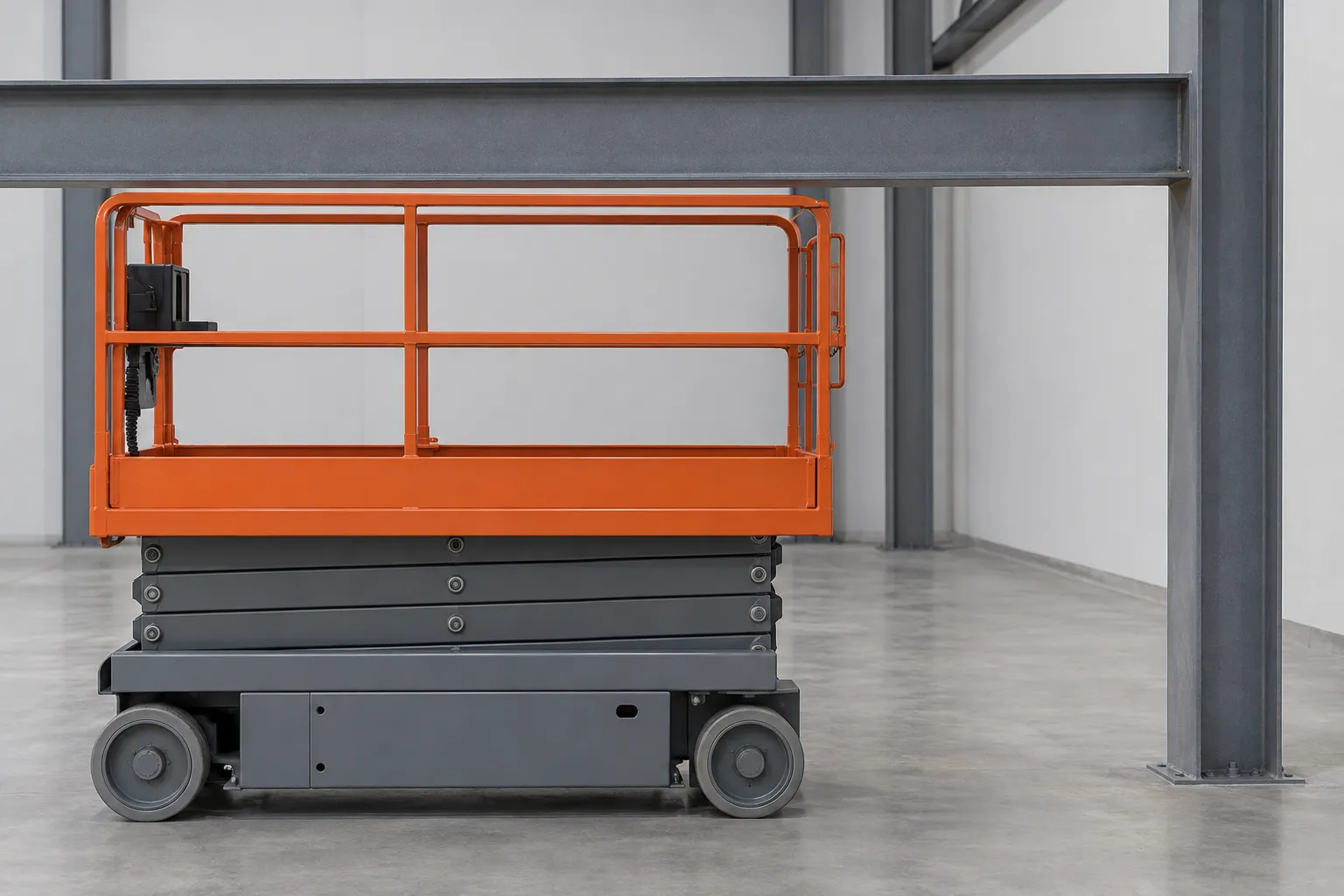
On 21 March 2023, the team removed the secondary guarding bars and decided to travel beneath the steelwork. The steelwork was 2.50 m high and the guardrail 2.36 m high, leaving 14 cm. Occupants had to lower their bodies to pass, while one guide watched two platforms.
At about 16:50, while travelling back to work, the operator stopped after feeling something at a wheel. When movement resumed, the other occupant’s head was trapped between the steelwork and guardrail. A colleague moved the platform backwards to release the worker and emergency responders attended, but the worker died after being taken to hospital.
The steelwork installation plan had been shared at coordination meetings, but its height and effect on safe travel were not discussed. The work plan did not address entrapment during travel. After the accident, the obstruction height was adjusted and construction resumed.
Clearance for a guardrail is not clearance for its occupants
Passage of the machine’s outline differs from passage with people aboard. Measuring only the gap between the guardrail and obstruction omits the occupants’ bodies. If protection must be removed to pass, the route is incompatible with the existing operating conditions. Repeated practice at squeezing through does not resolve that incompatibility.
Entrapment can occur during horizontal travel as well as elevation. The guardrail moves with the platform while the steelwork remains fixed, closing the space around a body between them. Low speed does not provide escape from sustained machine force in a narrow gap. Overhead clearance remains important when the operator’s attention shifts to an obstacle at a wheel.
Another trade’s installation can turn the same route into a different workplace. Assessing duct work alone can miss clearance lost to the new steelwork. Coordination needs to cover platform height, route and occupant position, not only dates. If the earlier installation cannot change, reconsider the subsequent equipment, route or sequence.
A guide watching multiple machines can miss one starting while attending to another. Allocation requires more than recording a headcount: define the machine and section covered and what stops movement when visibility or attention is lost. After even a brief stop, recheck the relative positions of people and obstructions before restarting.
Hearing an installation schedule does not complete impact assessment. Knowing when steelwork arrives is insufficient without its height and the actual space needed by the platform. Overlaying the later travel route on drawings or site photographs exposes conflicts. Coordination should resolve passage before leaving workers to find a way through on arrival.
Ducking below an obstruction reduces the view available in a normal posture. An operator facing forward and an occupant facing back also have different head positions. The operator may have passed while the person behind remains under the obstruction. Assess the whole platform and occupant positions, not just the operator’s own clearance.
Pipes or debris on the floor compete for attention with overhead hazards. An occupant may change posture while the operator stops to check a wheel. Do not assume the previous clearance remains valid at restart. A route with obstacles in several directions needs correction or rerouting before movement, rather than continuous improvised responses while driving.
A work plan copied from another site may omit this steelwork entirely. Equipment names and training records do not describe the travel conditions. Mark access points and low-clearance areas on site photographs and make them recognisable to the team. The important point is where this move must stop, not the length of a generic hazard list.
Consider separating pedestrian travel from platform movement where the work conditions allow. Removing occupants does not make every route suitable for the machine: height, width, ground condition and nearby work still matter. Separate travel from the task while checking the hazards introduced at each stage.
A guide’s initial position may not provide a view of the next section after the platform passes. Decide whether the platform waits while the guide moves and what happens when visual contact is lost. Attending to another machine can leave the first without guidance. Coverage must fit the actual workload rather than exist only as a name on a plan.
The later height adjustment demonstrates that the physical space could be changed. Other sites may not permit that adjustment, so no universal dimension follows. The transferable point is linking the known need for later platform work to the earlier installation. Review layout and sequence instead of retaining the obstruction and asking occupants to duck.
The white paper explains that another route was unpaved, contributing to the decision to pass beneath the steelwork. Merely showing a detour does not provide an alternative: its ground and width must suit the equipment. Blocking the original route without verifying a usable replacement can push the team towards removing protection.
The team had 6 people: 4 occupied the two platforms while the others provided signalling and assistance. Dividing roles is not proof that every hazardous section had adequate guidance. Simultaneous moves require reassessment of whether one guide can cover different views. Check that the roster addresses the actual concurrent movements.
The white paper records that the steelwork contractor also borrowed another contractor’s platform to pass that area. This was a site-wide access problem, not a matter for only one team to handle carefully. When equipment is shared, distinguish dimensional fit from safe operating conditions. Borrowing must not become an improvised way to conceal an unsuitable route.
What the comparison shows
In the die-casting entrapment case 2022-13, defeated door switches made dangerous access routine. Here, secondary guarding was removed to pass through a route. The devices and tasks differ, but both involved removing protection to continue work and then accepting the altered state as normal.
The die-casting machine needs restored safeguarding and stopping conditions for access. The platform needs its protection retained and changes to the route or installation sequence. Restoring the bars but sending the platform beneath the same low steelwork leaves the travel conflict unresolved.
Causes and protective layers
| Layer | At the time | Workplace action |
|---|---|---|
| Trade coordination | Height and route effects omitted | Review subsequent equipment clearance before installation |
| Platform protection | Bars removed for passage | Change the route, structure or sequence instead |
| Guidance | One person watched two machines | Define coverage and stopping conditions |
| Work plan | Travel entrapment omitted | Include actual obstacles and occupant positions |
Investigation and proceedings
The labor inspector examined the work plan’s omission of travel entrapment and the coordination of trades. Construction resumed after the obstruction height was adjusted; the white paper does not follow the case through prosecution or judgment.
Why the consequences were severe
The worker’s head was compressed between fixed steelwork and the moving guardrail. Familiarity with the route and earlier successful passes did not make the afternoon restart safe. A route with hazards both at ground level and overhead cannot depend solely on the operator’s attention.
Questions at the work position
| Question | What to examine |
|---|---|
| What did the earlier trade change? | Recheck machine and occupant space after steelwork, pipe or cable installation |
| Is removal of protection proposed? | Stop pending a safe route or sequence change |
| Who guides each platform? | Allocate coverage that can verify each departure |
| What is checked after a brief stop? | Check the occupant and overhead obstruction, not only the wheel |
Korean legal references
Article 186 of the Rules on Occupational Safety and Health Standards requires lowering the platform to its lowest position and checking the route for unevenness and obstructions. Travel with workers aboard is generally prohibited, with the stated exception involving a guide, a short distance and the lowest position. The exception does not justify leaving an entrapment hazard unresolved.
The white paper gives a total construction value of KRW 50 billion and an accident date of 21 March 2023. This was outside the deferred commencement category for construction below KRW 5 billion at that time. Article 4 subparagraph 9 of the SAPA Enforcement Decree can be considered as a preventive reference for contracting criteria and procedures.
Occupational Safety and Health Act (Korean) · Rules on Occupational Safety and Health Standards (Korean) · SAPA Enforcement Decree (Korean)
Field practitioner note
Sources
MOEL and KOSHA, 2025 Serious Accident White Paper, Part 2, 77–99 pages. Official publication (Korean)
Comparison: 2024 Serious Accident White Paper, pages 36–63 (Korean)