English names and summaries of Korean laws are unofficial translations. The Korean text on the Korean Law Information Center (law.go.kr) prevails.
Does opening the safety door stop the machine?: die-casting mould cleaning
Key terms in Korean and English
- serious accident (중대재해, OSH Act)
- supervisor (관리감독자)
- caught in or between (끼임)
- supervisor (관리감독자)
- die-casting machine (다이캐스팅기)
- interlock (인터록)
At a glance
On 14 July 2022, 1 worker died while cleaning the mould of an automatically operating die-casting machine in South Gyeongsang Province.
The interlock intended to prevent operation with the safety door open had been defeated.
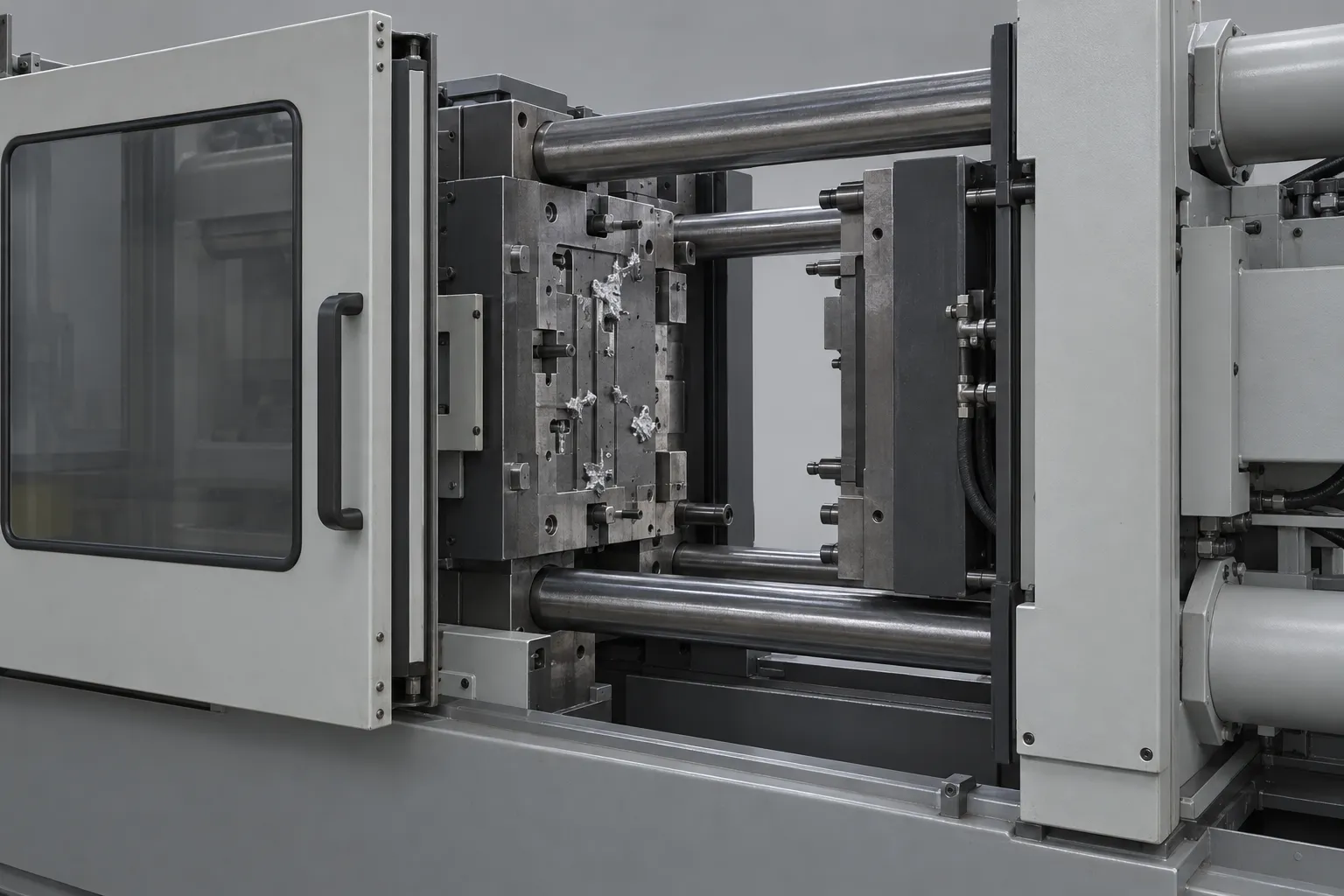
From preparation to the aftermath
Die-casting moulds needed deposits removed to maintain product quality. Instead of stopping the machine, workers repeatedly entered the gap while the mould opened during its automatic cycle. The need for cleaning had not been matched with conditions preventing movement during that task.
At about 10:00 on 14 July 2022, a colleague heard an alarm and found the worker caught between the mould sections. The machine was in automatic mode. Gloves had been inserted at the safety-door switches, allowing mould movement with the door open.
There were 9 die-casting machines, with safeguards defective or defeated on 7. Operators of machines with working protection stopped them before opening the doors; others cleaned during the opening interval. Some workers understood this difference as a model characteristic rather than a safeguarding fault.
The external safety service repeatedly requested improvements during 2022, and defects were also reported from production. Repairs were deferred until the holiday period without stopping use pending restoration. When the inspector returned about 3 months after the accident, switches had been properly installed on every machine and cleaning practices had changed.
An open mould interval is not a stopped machine
Mould opening is a stage of automatic operation. If closure is scheduled as the next stage, movement can occur irrespective of the time a person needs to withdraw. Seeing an open space is different from preventing restart. Cleaning requires hazardous motion to be prevented, not merely a brief pause within the cycle.
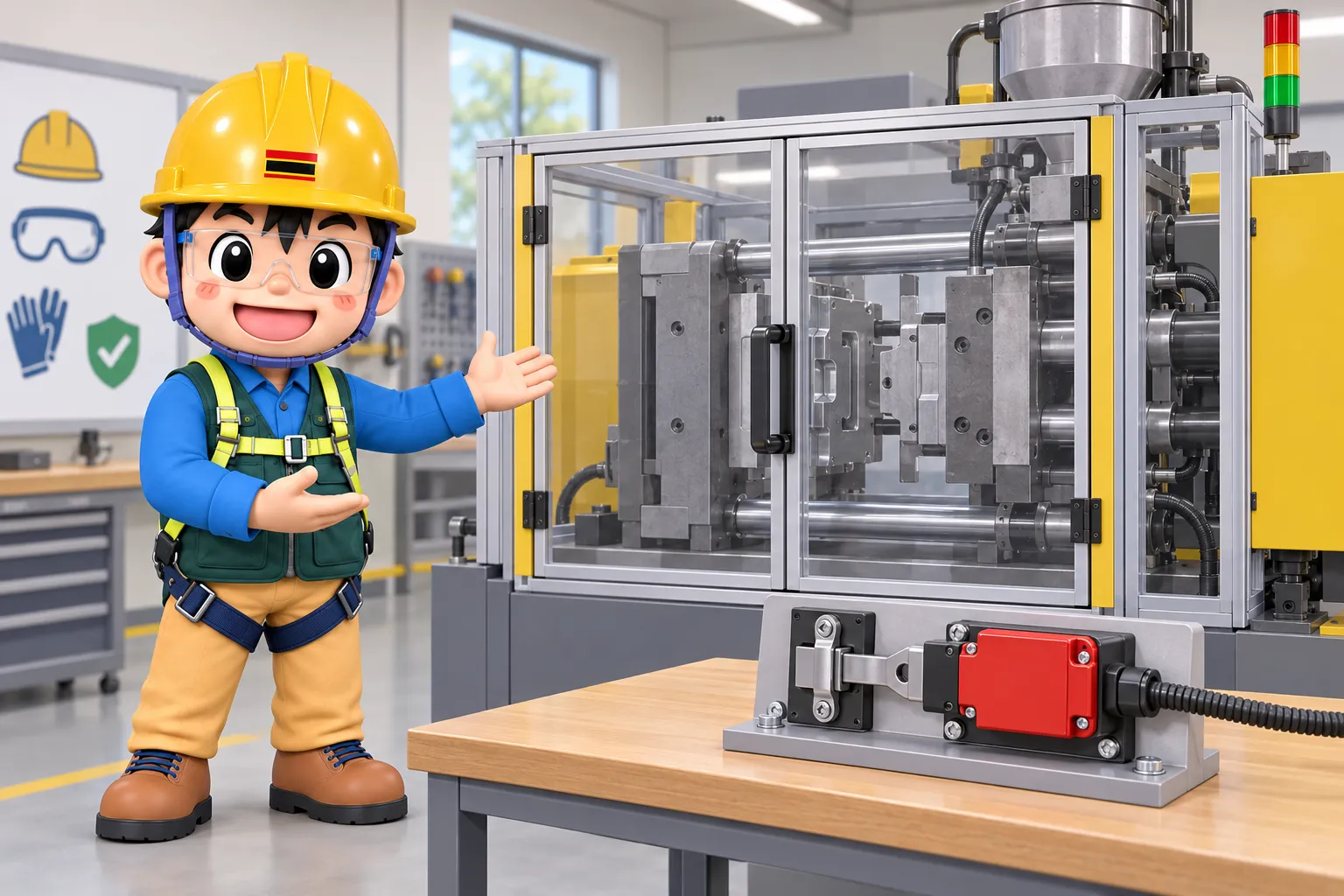
The door is a physical guard; its interlock links door state to machine operation. If the function preventing operation with the door open is defeated, the visible presence of a door offers no assurance of protection. Holding a switch with a glove prevents the control system from properly distinguishing guarded operation from access.
Selecting manual mode alone does not establish every condition needed for cleaning. Consider operation by another person, remaining energy and the reach of cleaning tools. Stop operation and prevent restart in a manner suited to the task before entering. Expecting rapid hand movements to compensate for a failed interlock transfers the safeguard’s function to the worker.
Safeguarding defects need a response distinct from product-quality faults. Continuing because the machine still makes products can hide a safety defect behind production records. Restrictions on use must be decided while repairs are being arranged. After repair, safely verify the stopping function on door opening, rather than checking only that a part was replaced.
The white paper describes different practices around protected and defective machines in the same workplace. Stopping before opening belonged to work on a protected machine, while using the open interval became routine on defective ones. More warnings alone cannot resolve that difference. The movements a machine permits shape the method, so restoration of protection must accompany instruction.
Cleaning is necessary for production and cannot be eliminated by simply telling people not to do it. Establish when deposits arise, how they are removed and the stopped condition allowing tool access. If the production plan omits that time, cleaning can be treated as an exception or delay. Planning for the necessary task helps align protection with quality control.
An external service can identify and explain a hazard, but decisions to stop use and allocate repairs must be made within the business. Delivery of a report to an administrative office is not the same as a production supervisor using it to change work. Connect the identification of defective machines, restrictions pending repair and verification of restored function to the production floor.
Here, actual production authority and the formally designated supervisory role did not align. A newly arrived production lead reported defects, but repairs were deferred without a stop-use instruction. Asking workers to report hazards also requires clarity about what the recipient can decide. Align stopping authority with access to defect information, rather than checking job titles alone.
A delay in obtaining parts does not remove exposure while waiting. Consider changes to production, reduced operation or alternative equipment when a machine cannot be used safely. A repair-pending label leaves the hazard unchanged if the same cleaning continues. Alternatives also need assessment so that risk is not merely transferred to another machine.
The white paper records restored switches on all machines and small openings added to some doors after the accident. The relevant lesson is the combined change in equipment and cleaning method, not an instruction to cut similar openings elsewhere. Review reach to hazardous parts and effects on protection against the manufacturer’s requirements and the actual machine.
Before return to service, producing a part is not sufficient verification. Safely examine hazardous movement with the door open, behaviour after closing following a stop and the requirement for a separate start command. Verify from outside danger and do not resume use if behaviour is unexpected. Keep normal production access separate from the test area while that work is underway.
The white paper describes a 34-second cycle with about 20 seconds of accessible opening. Treating that interval as cleaning time established a practice requiring withdrawal before the next movement. A quick cleaning on one occasion says nothing about deposits or tool movement on the next. The arrangement forcing a variable manual task into a short automatic interval needs to change.
A safety report dated 17 May before the accident called for control of entrapment during cleaning in operation, but it was not shared with the production supervisor. The document recipient and the person expected to act were different. In addition to filing the report, verify what decision reached the team actually using the identified machine.
The recorded first-instance sentence is a legal outcome, not a substitute for deciding controls on another machine. Examine whether defective safeguards remain and the conditions under which repeated cleaning and inspection occur. Training about the earlier judgment should lead to actual restrictions and restoration checks to reduce equivalent exposure.
What the comparison shows
The white paper also describes a fatal entrapment during die-casting-machine inspection at an aluminium-forming workplace in South Chungcheong Province in 2016. Automatic operation continued with a defective safety-door switch. Cleaning in this case and inspection in the earlier one were outside normal production, but both required close access to the machine.
Comparing the incidents highlights access conditions rather than task names. Treating cleaning, inspection and deposit removal as unrelated exceptions can obscure the same interlock defect. Identify every task requiring entry near the mould and examine its stopping and restart-prevention conditions together.
Causes and protective layers
| Layer | At the time | Workplace action |
|---|---|---|
| Safety door | Automatic operation continued while open | Verify interlock function before use |
| Cleaning | Entry during the open interval | Stop and prevent restart before access |
| Repair | Known defects left pending | Restrict use and arrange alternatives pending repair |
| Supervision | Formal roles differed from production authority | Clarify who can stop work and how defects are reported |
Investigation and proceedings
At the first trial, the managing director received 2 years’ imprisonment, not suspended, and the company a criminal fine of KRW 150 million. The white paper does not record whether the director was taken into custody in court.
Why the consequences were severe
Once a person enters between mould sections, closure leaves little escape space. Automatic operation without the interlock turned routine cleaning into repeated exposure to movement. External inspections and internal reports did not lead to restrictions, allowing that exposure to continue.
Questions at the work position
| Question | What to examine |
|---|---|
| What stops when the door opens? | Safely verify hazardous motion and restart conditions |
| In what state is cleaning done? | Distinguish cycle waiting from stopping and isolation |
| What happens while repair is pending? | Set restrictions independently of the repair date |
| Who verifies completion? | Check actual safeguard testing, not just receipt of a report |
Korean legal references
Article 92 of the Rules on Occupational Safety and Health Standards addresses stopping machinery for tasks such as maintenance and cleaning and preventing restart by another person. Check both the physical guard and the function preventing dangerous movement during access.
The white paper records 60 workers at the workplace. On the accident date, 14 July 2022, it was outside the deferred commencement category for workplaces with fewer than 50 workers. Article 4 subparagraph 3 of the SAPA Enforcement Decree is relevant to preventive arrangements for identifying and improving hazards. External inspection needs to be followed by actual workplace action.
Occupational Safety and Health Act (Korean) · Rules on Occupational Safety and Health Standards (Korean) · SAPA Enforcement Decree (Korean)
Sources
MOEL and KOSHA, 2024 Serious Accident White Paper, 36–63 pages. Official publication (Korean)