English names and summaries of Korean laws are unofficial translations. The Korean text on the Korean Law Information Center (law.go.kr) prevails.
Does opening the mixer lid stop its blades?: sauce mixing accident
Key terms in Korean and English
- serious accident (중대재해, OSH Act)
- risk assessment (위험성평가)
- caught in or between (끼임)
- interlock (인터록)
- emergency stop (비상정지)
At a glance
On 15 October 2022, 1 worker mixing sauce at a food factory in Gyeonggi Province became entangled in rotating blades and died.
The mixer could run with its lid open, and reaching inside to clear lumps had become routine.
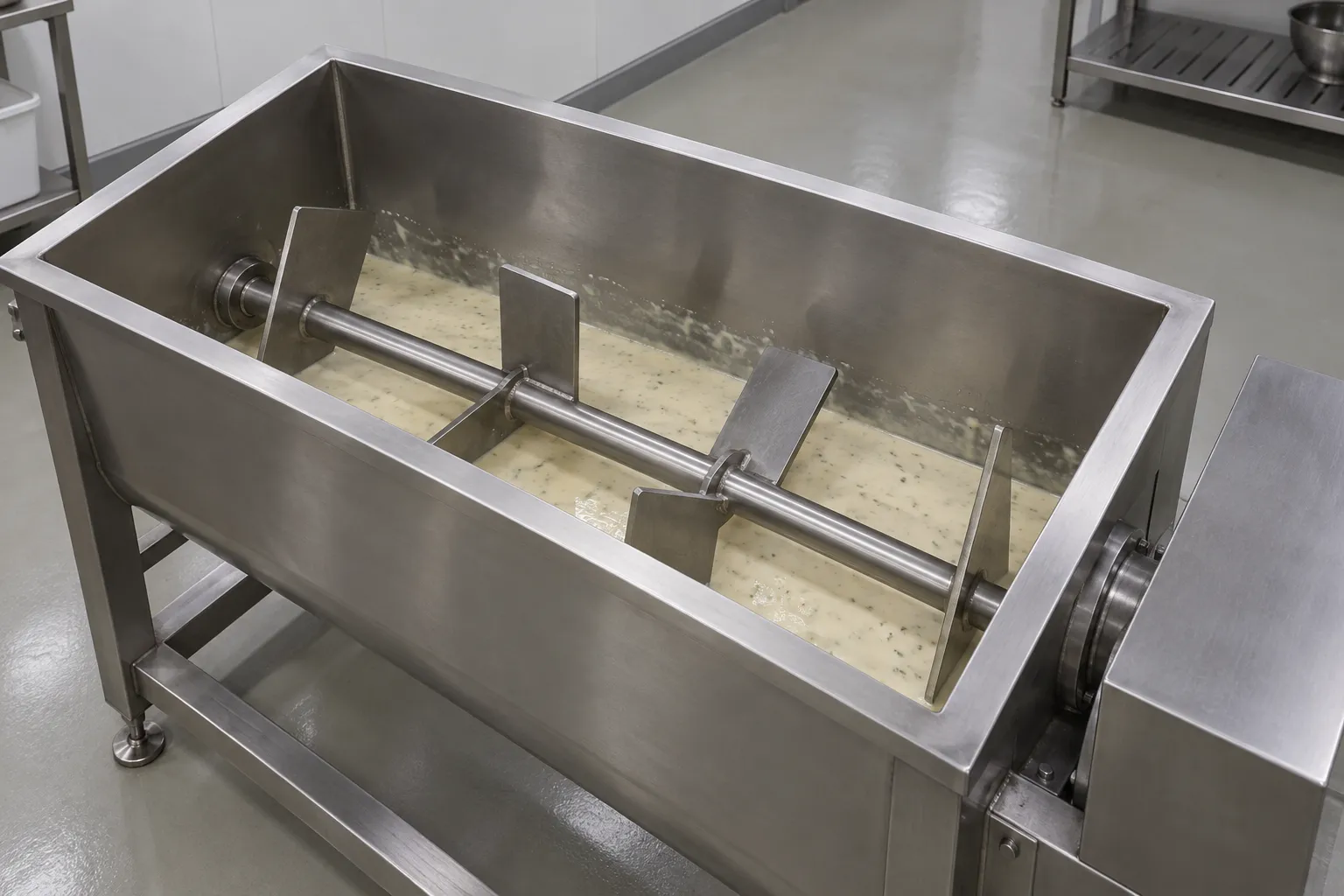
From preparation to the aftermath
This was preparation of sauce for sandwiches. Ingredients were first mixed, transferred into a mixer and combined with additional material. The finished sauce went to the next production stage. Lifting ingredients and intervening to clear lumps repeatedly brought the worker to the same machine.
The night shift beginning on 14 October 2022 continued into the following morning. Opening the lid and using a hand or tool to break up sauce lumps had become established practice. The company's instruction and actual production methods differed.
At about 06:16 on 15 October, a colleague working elsewhere heard an unusual sound and found the worker. This is the time of discovery. The worker was trapped in the blades, and arriving colleagues could not immediately release the body.
Rescuers and maintenance staff arrived. Recovery became possible only after maintenance staff loosened the drive belt, but the worker had died. Entrapment remained after the machine stopped. A stopped drive was not the same as a safe rescue condition.
Open-lid operation had been identified before the accident: in an external assessment in April 2020, an external diagnosis in September 2021 and internal reporting in August 2022. Channels for identifying the danger existed, but the findings did not lead to adequate access safeguards.
Linking the lid position to blade movement
Mixer blades rotate to move the ingredients. A lump creates an incentive to intervene with a hand or tool. Assessment must cover more than uninterrupted mixing: clearing lumps, looking into the opening, cleaning and product recovery reveal the actual routes of access.
The lid blocks access to rotating parts. An interlock links the lid state to operation so that dangerous movement cannot continue with the access open. A lid stored beside the machine or a non-functioning sensor provides no such function. Check stopping and restart conditions using the manufacturer's procedure, not merely the presence of components.
An emergency stop depends on recognition and operation by a person. This machine's controls were on the right, difficult to reach with the right arm trapped. Improving the emergency-stop position would not replace the lid and interlock. Preventing access before contact and stopping after an emergency serve different purposes.
A stop caused by drive overload is not an access safeguard. Injury and entrapment can remain after the drive stops. A condition that interrupts production must not be confused with permission for access. Intervention requires hazardous motion to stop and unexpected restart to be prevented.
Simply prohibiting hand access leaves the lump-removal problem unresolved. Production and maintenance need to review feeding, lump formation, cleaning and product recovery together. The time required to stop and intervene safely must be included in workload and staffing plans.
The earlier findings concerned the specific conditions of open mixer lids and access to rotating parts. When external diagnosis, internal inspection and worker suggestions identify the same problem, they should lead to one verified equipment action. Closing each report separately can multiply paperwork while leaving the machine unchanged.
Cleaning and clearing lumps are not rare exceptions if every production cycle requires them. Safe equipment and time for intervention are then part of production conditions. Walking through the stopped procedure with operators reveals where material remains, where a hand reaches and who can restart the machine.
A control stopping the blades and energy isolation during maintenance serve different purposes. If the machine can restart from another position after a stop signal, intervention remains hazardous. The procedure must identify which energy is isolated and who may restore it before anyone reaches inside.
What the comparison shows
The 2023 white paper describes earlier entanglement incidents and repeated external and internal identification of access hazards at this business. Its interlock discussion also describes other machines where defeated interlocks allowed dangerous access. This mixer lacked an interlock; a machine fitted with one additionally requires assurance that the function remains effective.
The comparison asks what changed after a report, rather than only whether the danger was known. Before closing an action as reviewed or trained, verify the lid's position, the response to opening and whether the actual lump-clearing task can be carried out under the revised procedure.
Causes and protective layers
| Layer | At the time | Workplace action |
|---|---|---|
| Access guarding | Operation with the lid open | Provide a feeding and mixing method using the lid |
| Interlocked stopping | No effective lid interlock | Verify opening, stopping and restart functions |
| Intervention | Routine clearing while rotating | A stopped and restart-secured intervention procedure |
| Improvement management | Reports did not lead to safeguards | Include on-site functional verification in completion criteria |
Investigation and proceedings
Labor inspectors investigated the accident and KOSHA analysed its causes; the account in the white paper does not extend to a court outcome.
Why the consequences were severe
Contact with the rotating part drew the worker into the machine. A colleague at another location responded only after hearing the sound. Release then required work on the drive. Prevention must therefore establish conditions that exclude hand access rather than depend on a colleague reaching an emergency stop in time.
Increasing production and requests for staffing form part of the white paper's background. Fatigue or individual attention must not be used to explain away missing safeguards. The central task is to redesign the equipment and procedure to accommodate foreseeable interventions safely.
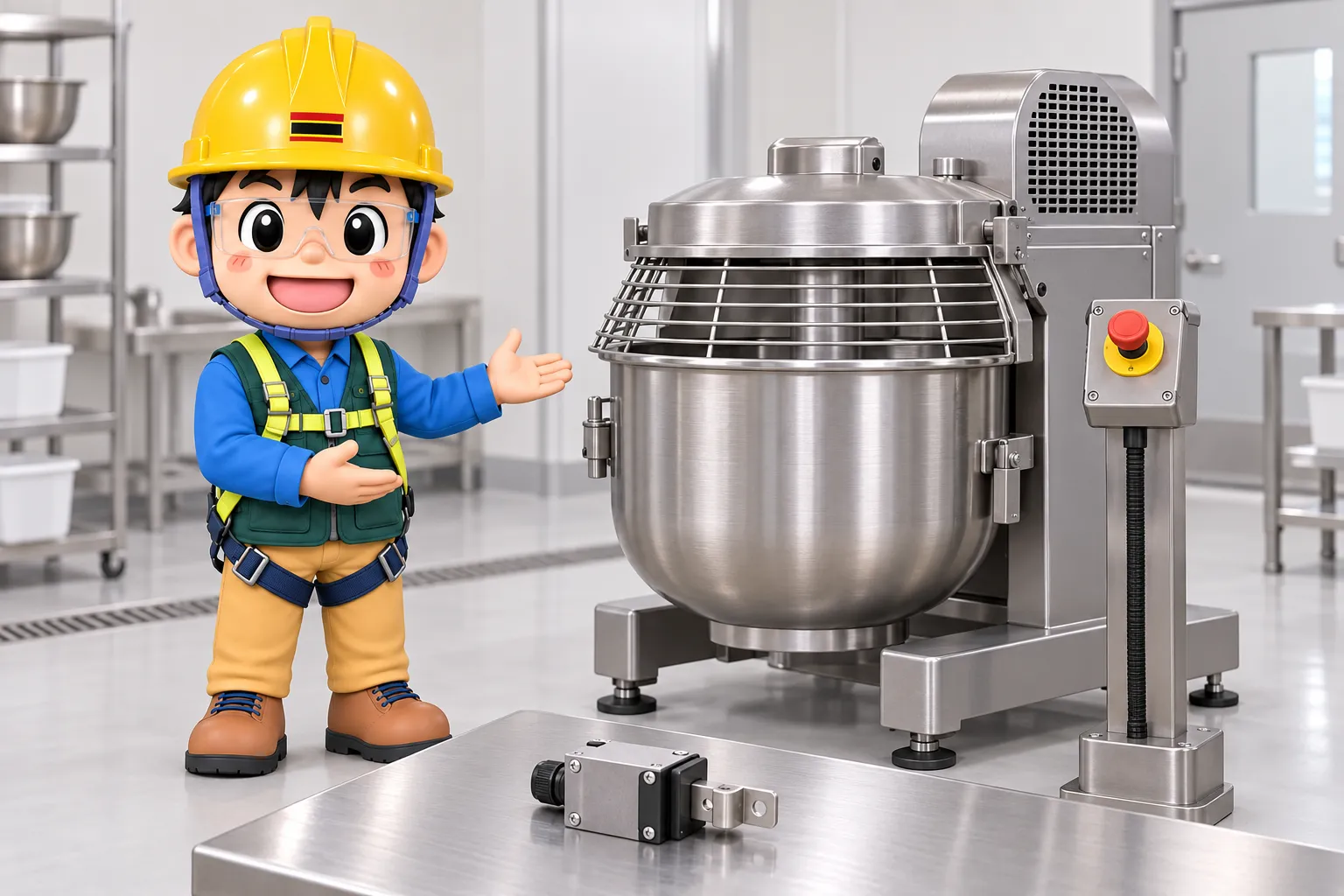
Questions at the work position
| Question | What to examine |
|---|---|
| Which tasks appear to require lid opening? | Observe feeding, clearing and cleaning separately |
| What happens if a start signal occurs with access open? | Verify safeguards under the manufacturer's test procedure |
| Is completion based on a working safeguard? | Check installation and function, not purchase alone |
| Can the stop be reached from a trapped position? | Review control position alongside access prevention |
Korean legal references
Current Rules Article 87(8) addresses necessary covers for mixers and similar machines; Article 111 addresses stopping for product removal, maintenance, cleaning and similar work. Article 92's stopping and restart-prevention provisions should also be checked against the intervention being performed.
Risk assessment under OSH Act Article 36 should address recurring interventions as well as normal production. Apply the current equipment checks separately from the criminal account recorded in the white paper.
Occupational Safety and Health Act (Korean) · Rules on Occupational Safety and Health Standards (Korean)
Field practitioner note
Sources
MOEL and KOSHA, 2023 Serious Accident White Paper, 40–73 pages. Official publication (Korean)