English names and summaries of Korean laws are unofficial translations. The Korean text on the Korean Law Information Center (law.go.kr) prevails.
Could a tool left inside the machine strike someone nearby?: an ejected object during moulding
Key terms in Korean and English
- Occupational Safety and Health Act (산업안전보건법)
- serious accident (중대재해, OSH Act)
- risk assessment (위험성평가)
- struck by object (물체에 맞음)
- compression moulding press (압축성형기·가류 프레스)
At a glance
On 2022-02-09, a tool was ejected from a compression moulding press at an automotive-parts factory and caused 1 fatality nearby.
A tool left near the mould was compressed during operation and then thrown out.
A device detecting a person approaching did not detect an object left inside.
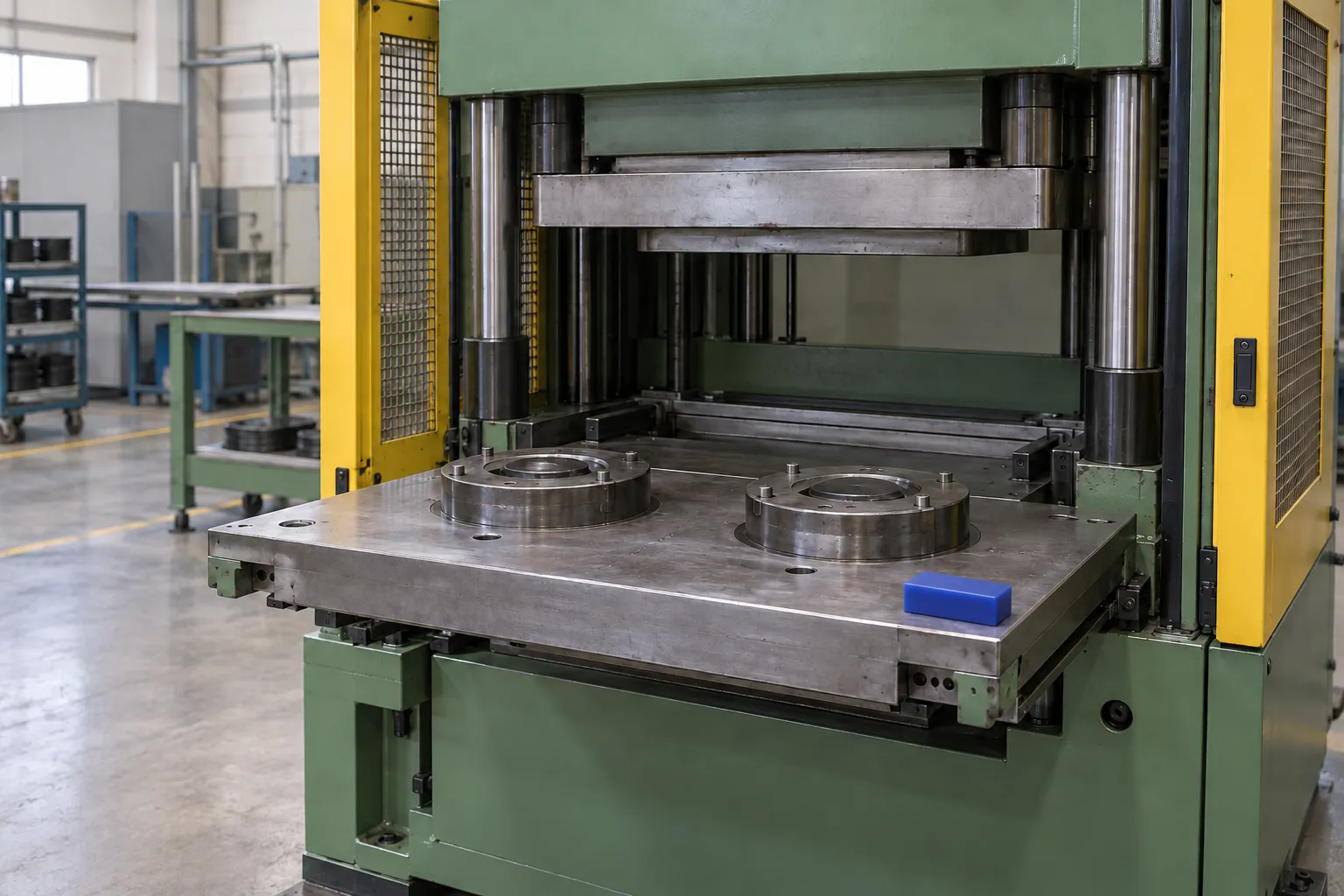
From preparation to the aftermath
On 2022-02-09, a worker started a compression-moulding press at an automotive-parts factory with a hand tool left on its sliding platen. The tool was ejected and struck a worker at another position, who died. The impact occurred away from the tool user's workstation.
The factory produced oil seals by bonding rubber to metal rings. Workers placed rings and raw rubber in the moulds and adjusted their seating by hand. When a ring would not seat, they used a plastic object locally called a jig. It was an improvised aid rather than a tool designed for this operation.
Defective parts had prompted the supervisor to examine the line. At about 10:20, while returning to another work position, the supervisor heard a loud noise. The operator had left the tool on the right side of the lower sliding platen, pressed start and moved to the adjacent machine. That operator was responsible for 3 presses.
After the platen moved inside, pressure ejected the tool. Weighing about 186g, it travelled about 7m, struck and severed another machine's air hose, then reached the victim. The supervisor followed emergency instructions over a 119 video call while waiting for the ambulance and accompanied the transfer to hospital.
The investigation found that the tool had arrived with the machine and managers knew that improvised tools were used. General hand-tool rules existed, but did not define use and storage for the improvised aid used in this moulding task.
How a small tool became a projectile
Compression moulding combines manual loading with force applied inside the machine. This press moved the mould-bearing platen into a vacuum chamber before applying pressure. The arrangement reduced defects caused by trapped air, but also carried anything left on the platen into the chamber. The tool had been placed on a moving surface, not on a fixed shelf outside the machine.
Seating depended on the fit between the ring and its mould, and some material was difficult to position. When pressing by hand became uncomfortable, workers sought an object that transmitted force more easily. A ban on tools alone does not resolve that production problem. Review ring-to-mould fit, defect conditions, the design of any necessary aid and its storage location together.
A light object caught between force-applying machine parts can become a dangerous projectile. Low tool mass did not make this event safe: an escape path from the press led towards another occupied position. A check based only on tool weight misses both the energy imparted by the machine and the route into the surrounding area.
Tool storage should be within a practical reach and distinct from the sliding platen. If the only designated box is distant, a nearby machine surface may become a temporary shelf during repeated cycles. Incorporate a dedicated holder, tool accounting and a platen check into the operating sequence, then test whether operators can follow it in actual use.
Apparent stillness is not the same as safe access. Correcting jammed material or cleaning inside the mould requires the machine's stop and energy-isolation procedure. Treating fault recovery as another normal loading motion can leave hands or tools in the danger zone. Repeated seating problems should trigger a machine or tooling review.
What the comparison shows
In the whitepaper's heat-shield-panel lifting case, a textile sling failed and released the load. A press tool and a lifting sling serve different functions, but both cases highlight the need to manage the aids actually used at work. For the press, examine forgotten tools and ejection paths; for lifting, examine connection damage and the load path.
This site's assessment covered musculoskeletal strain, burns, release agents and fire, but missed the step in which an improvised tool could remain in the press. Following loading, tool use, removal and startup would address this event more directly than simply listing more general hazards.
Causes and protective layers
| Layer | At the time | Workplace action |
|---|---|---|
| Material seating | Improvised aid used for difficult fits | Review fit and any purpose-designed aid |
| Tool storage | No method defined for this tool | Separate fixed storage and tool-return checks |
| Before startup | Tool travelled inside on platen | Include a practical foreign-object check |
| Surrounding exposure | Tool reached another station | Review ejection paths, guarding and layout |
Investigation and proceedings
An investigation took place, but its disposition, indictment and judgment were not published in the whitepaper.
Why the consequences were severe
The victim was not the press operator. Operator vigilance alone therefore cannot protect everyone nearby. Assess guarding and occupied positions against possible ejection directions. The intervening air hose did not stop the tool; incidental objects must not be treated as protective barriers.
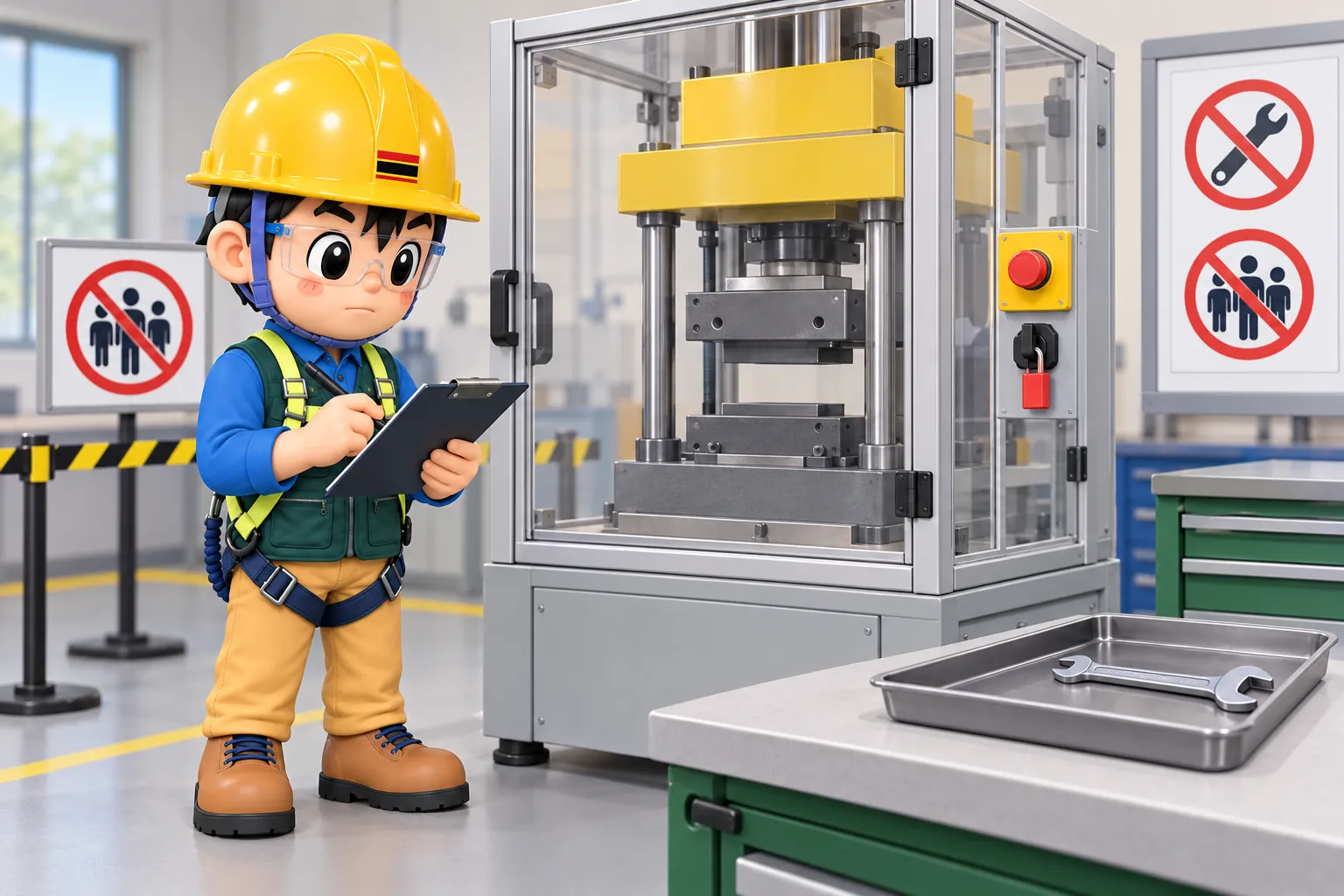
Questions at the work position
| Question | What to examine |
|---|---|
| What is used when a ring will not seat? | Compare authorised tools with objects actually present. |
| Does the resting surface move? | Identify temporary storage on platens, moulds or transfer parts. |
| What is checked before moving to another machine? | Include tool return and readiness checks in multi-machine work. |
| Who occupies an ejection path? | Include inspection, handling and adjacent-machine positions. |
Korean legal references
Risk assessment under OSH Act Article 36 should include actual tool use and machine-starting steps. Rules Article 14 addresses falling or flying objects, while Article 87 concerns hazardous machine components such as drives and shafts. Match detailed provisions to the machine design and guarding arrangement.
Rules Article 92 concerns stopping machinery where maintenance, cleaning or repair creates danger.
Occupational Safety and Health Act (Korean) · Rules on Occupational Safety and Health Standards (Korean)
Sources
MOEL and KOSHA, 2023 Serious Accident White Paper, 192–217 pages. Official publication (Korean)