English names and summaries of Korean laws are unofficial translations. The Korean text on the Korean Law Information Center (law.go.kr) prevails.
Support the load before changing the height: swimming-pool beam formwork accident
At a glance
Unstable support during a height adjustment to swimming-pool beam formwork led to the death of 1 worker.
After a request to change the height, workers adjusted the shoring without supporting the formwork with a crane or additional supports.
Treating the task only as a height adjustment can leave the existing load unsupported.
From preparation to the aftermath
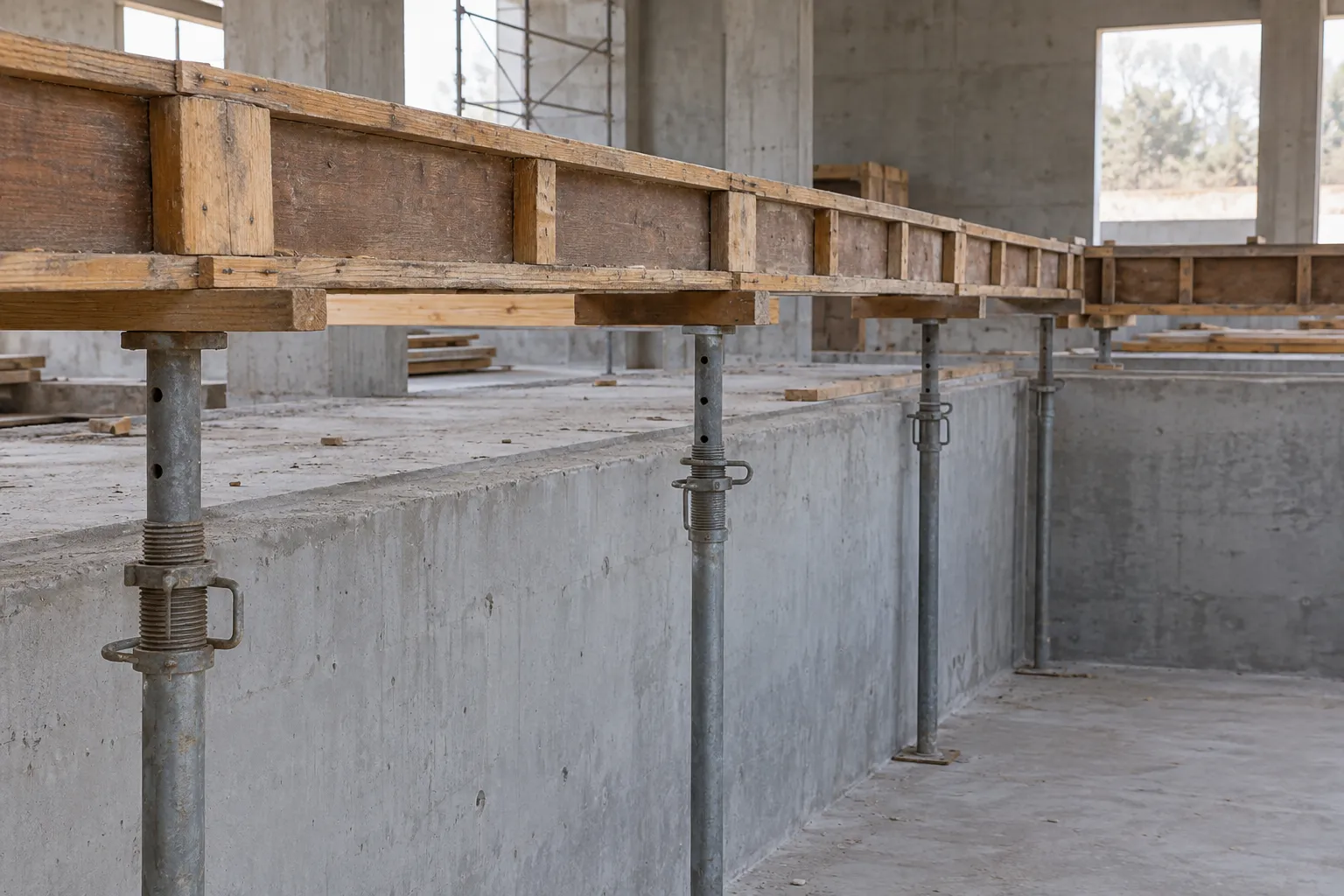
In mid-March 2022, 1 worker died while adjusting swimming-pool beam formwork at a building project. The formwork tilted and a supporting prop was ejected, striking the worker. The task was a modification to formwork installed the previous day, not a concrete pour.
Different drawing information was circulating. The drawing given to the crew had a handwritten height of 600mm; the next day they were asked to match 900mm. The person who changed the drawing was not identified. A beam-level change affecting pool depth reached the crew as a task to adjust the prop screws.
The carpenter foreman and worker began lowering the assembly by turning the prop screws in sequence. Part of the beam formwork overturned and 1 prop came free. The struck worker fell against material on the floor and died during transport.
A tower crane was present but was not used to support the formwork for this task. Managers had not instructed the crew to use it, and the workers did not know whether it was available to them. Investigators found that the work followed drawings and verbal directions without a work plan defining a safe method.
Joists and bearers beneath the formwork were inadequate, and some prop positions were missing. The weakness involved both the original support arrangement and the modification sequence, not just the act of changing height.
Adjusting props changes the load path
Formwork shapes concrete before it hardens; props transfer temporary loads to the structure below. Here, the stability of the formwork itself failed during adjustment. Even before pouring, the formwork and its components have weight. When a support position changes, another part of the arrangement must carry that weight.
Joists receive load from the sheathing, while bearers carry it towards the props. Missing members or mismatched intersections can interrupt that intended path. Counting upright tubes is insufficient; trace the support continuously from the sheathing through each member to the base.
Turning a screw changes length by a small amount but may substantially alter support conditions. If a prop loses contact first, load shifts to neighbouring supports and the formwork may tilt, allowing another prop to escape. An adjustable screw does not by itself establish stability during adjustment.
Before modification, define temporary support and the adjustment sequence. Decide how lifting equipment or additional bracing will carry the load and which props may be adjusted at each stage. A worker standing underneath or trying to catch a moving member is not a support system.
A drawing change communicates more than a dimension. It can affect reuse of members, interference with adjacent formwork and access for equipment. Compare the final drawing with the installed structure, approve the modification method and prevent superseded drawings from returning to the crew.
What the comparison shows
The same whitepaper cites an October 2022 warehouse-project accident in which formwork fell about 13m during pouring, killing 3 workers and seriously injuring 2. The pool event occurred during modification; the comparison occurred during pouring. Both require a stable temporary load path for the particular work stage.
A pre-pour inspection does not automatically resolve modification hazards. A stable completed arrangement may become unstable when some supports are released. Assembly, height adjustment and dismantling each need a support review.
Causes and protective layers
| Layer | At the time | Workplace action |
|---|---|---|
| Drawing control | Handwritten height conflicted with later instruction | Identify approved revisions and superseded copies |
| Initial support | Inadequate joists, bearers and props | Review the load path and installation |
| Adjustment | Height changed without separate beam support | Define temporary support and sequence |
| Work direction | Verbal directions without a plan | Specify equipment availability and hold points |
Investigation and proceedings
On 2023-06-23, the first-instance court imposed a prison term of 1 year, suspended for 3 years, on the employer and a criminal fine of KRW 50 million on the corporation. Both sides appealed; the appeal was pending when the white paper was published.
Why the consequences were severe
A supporting prop became a moving object when the formwork tilted. The worker was immediately below it, with other material in the fall area. Preventing overturning must be combined with control of people and material around the adjustment zone. PPE cannot prevent a prop from being ejected.
Questions at the work position
| Question | What to examine |
|---|---|
| Is this the approved drawing? | Compare the installed level with the approved revision. |
| Where does load go when a screw is released? | Identify temporary supports and lifting equipment. |
| Do members and prop heads align? | Check missing supports, eccentricity and loose contact. |
| From where will adjustment be made? | Review overturning and ejection zones alongside equipment access. |
Korean legal references
The former Rules Article 336 cited by the whitepaper has moved to Article 333. Current Article 333 addresses precautions during formwork and support assembly and dismantling. Review bracing and support by lifting equipment against the actual modification task. Articles 38 and 39 also connect work planning and supervision to heavy-load handling.
OSH Act Article 36 risk assessment should cover intermediate adjustment stages as well as the completed formwork. Current preventive requirements are considered separately from historical investigation and court outcomes.
Occupational Safety and Health Act (Korean) · Rules on Occupational Safety and Health Standards (Korean)
Sources
MOEL and KOSHA, 2023 Serious Accident White Paper, 134–155 pages. Official publication (Korean)