English names and summaries of Korean laws are unofficial translations. The Korean text on the Korean Law Information Center (law.go.kr) prevails.
Where did the load from the upper floor go?: successive floor collapse during construction
Key terms in Korean and English
- Serious Accidents Punishment Act (중대재해 처벌 등에 관한 법률)
- serious accident (중대재해, OSH Act)
- work stoppage (작업중지)
- collapse (무너짐)
- shoring (동바리)
- formwork (거푸집)
- load path (하중 전달 경로)
- service floor (설비층(피트층))
At a glance
On 2022-01-11, an upper floor receiving concrete and the structure below it failed in succession at a high-rise residential and commercial building project, causing 6 fatalities.
Adding a service space changed the load path without the required review and approval of that change.
Early removal of shoring below and insufficient concrete strength were also identified.
From preparation to the aftermath
At about 15:46 on 2022-01-11, upper floors collapsed at a mixed-use residential construction site. Concrete was being poured on level 39 while fire-pipe and window work continued below. 6 workers trapped in the debris died. Recovery operations faced further-collapse hazards; the last victim was recovered on the 29th day after the incident.
That morning, safety-monitoring personnel found a crack about 15cm long near external formwork on level 38 and reported it in a group messenger. The warning did not reach workers below. This measurement was the crack's length, not its width. The report was not translated into an examination of its location, development or implications for continuing the pour.
Snow and rain delayed the pour until after noon. At about 15:40, the placing-equipment operator saw formwork moving and concrete escaping at a corner. A loud noise followed the radio warning to the pump operator on the ground, and fresh concrete collected in the lowered area. The operator informed the concrete-work supervisor and escaped via the stairs.
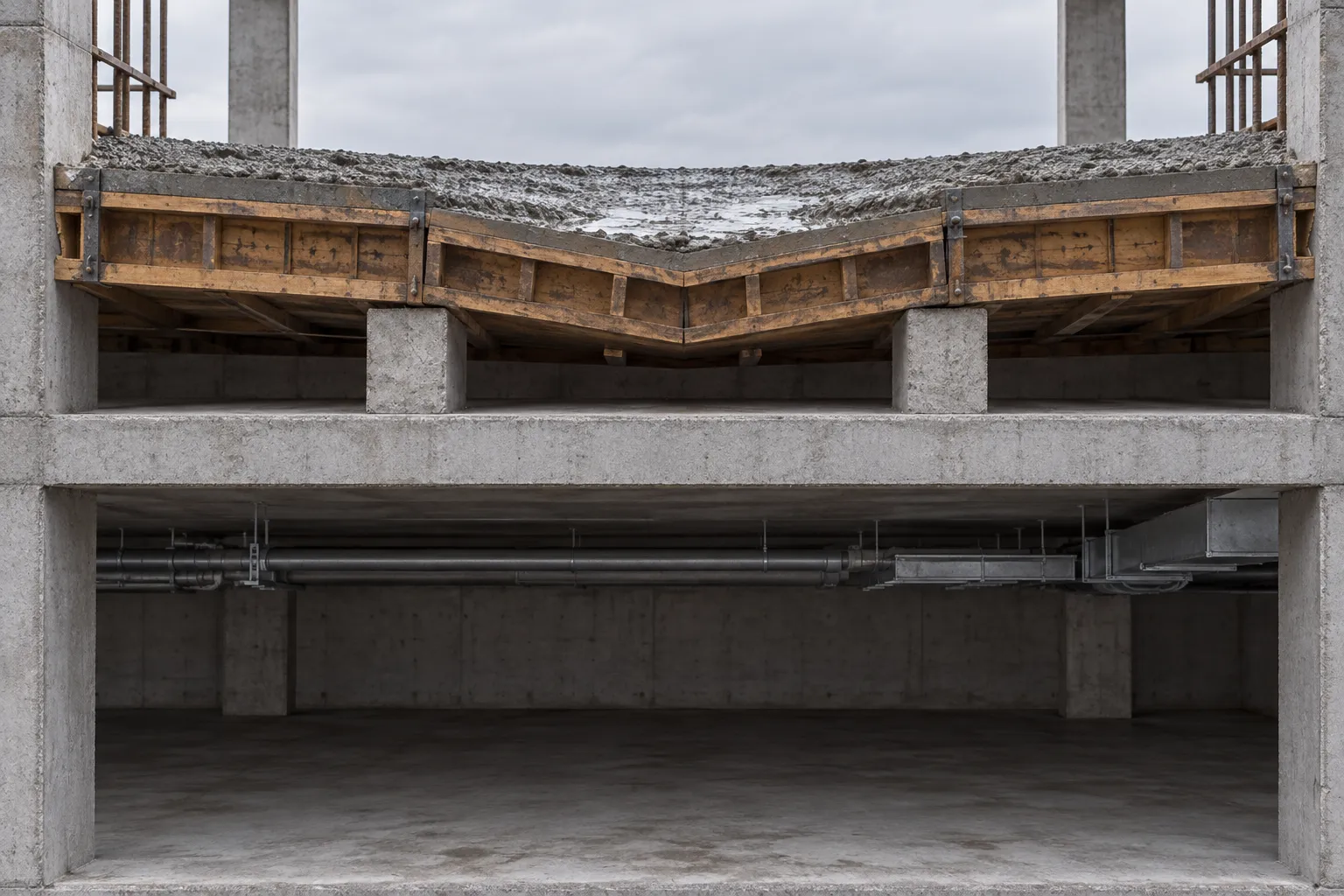
A service void lay immediately below level 39. Instead of installing shoring in the low space, the site built concrete supports without a structural-safety review of the changed method. The supports' own weight and the pour load acted on the void floor, which lacked shoring beneath it.
Investigators described failure of the void floor, loss of support above it and subsequent failure of lower floors under falling concrete and structural material. Collapse extended to level 23. Inadequate concrete strength below and early removal of shoring contributed to the progression.
Tests of samples from 17 floors found 15 below the specified compressive strength of 24MPa. Results included 10.9MPa for level 39, 10.5MPa for the service-void floor and 8.6MPa for level 38. These are results from the damaged structure, not pouring or stripping limits for other projects.
The pour loads floors that are not yet complete
A finished floor and a floor under construction carry loads differently. Fresh concrete is a weight supported by formwork and its support system. Before placing it, establish where those forces will go until the upper floor is complete. A visible slab is not evidence that it has attained its specified strength.
The affected service void was about 1.5–1.8m high. Replacing difficult-to-install shoring with concrete supports changed both construction weight and the points at which forces entered the structure. A review must trace added loads and support below those points across the change. Ease of installation does not demonstrate load-bearing adequacy.
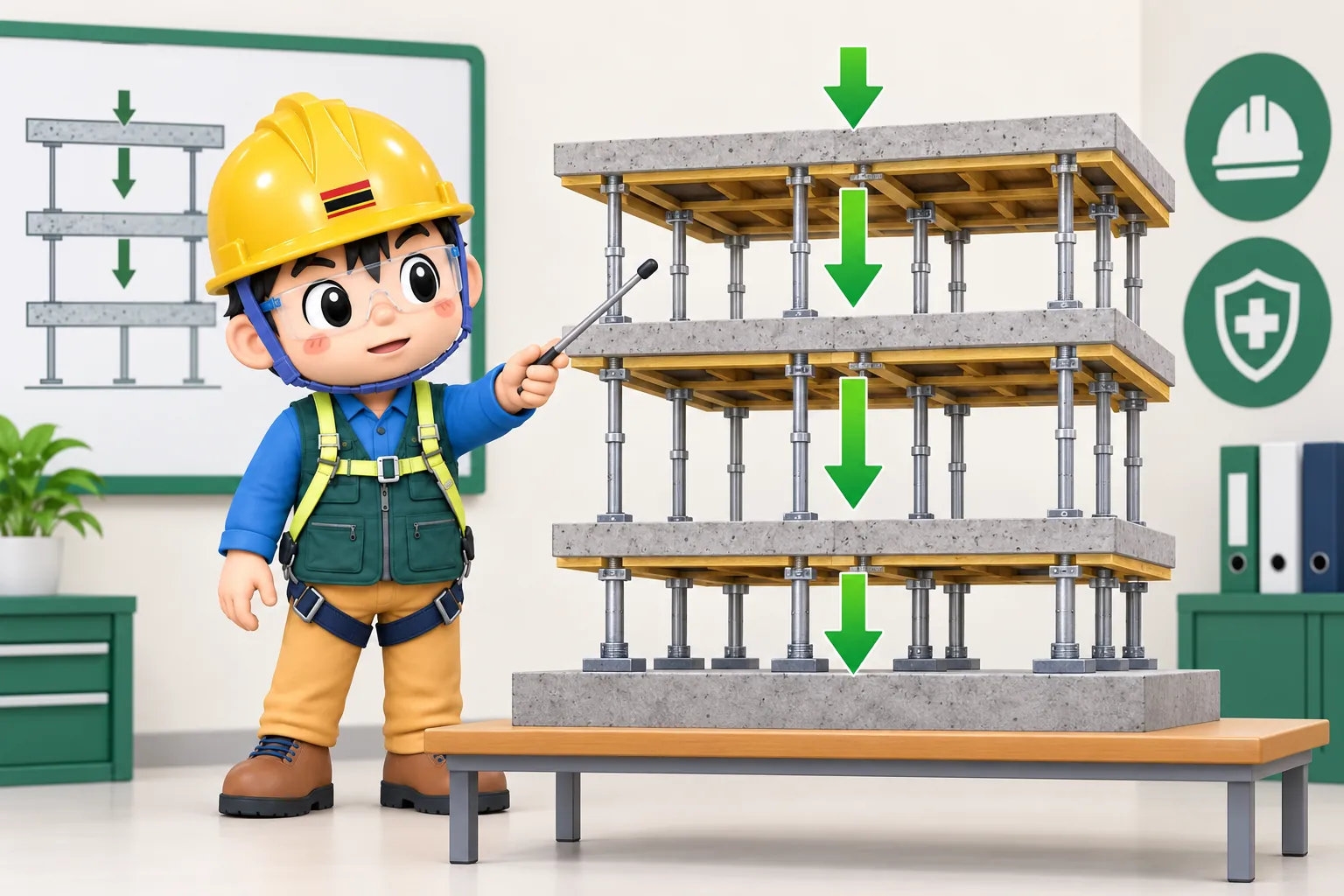
Shoring is a temporary load-support system. Removing it opens space for following trades but also removes a route that distributes loads. Shoring on levels 38, 37 and 36 had been removed. Its removal sequence must reflect actual concrete strength and the next pour above, rather than only access for following work.
Concrete can gain strength more slowly in winter. Define insulation and curing arrangements, then verify strength through testing appropriate to site conditions. Elapsed calendar days alone do not establish adequate curing. In repetitive high-rise work, each floor's test results and retained shoring are inputs to deciding whether the next floor can proceed.
A test record is useful only if the process behind it is reliable. The site had a laboratory and equipment, yet the supplier was seen taking samples off site and bringing them back. Sampling location, specimen storage and curing, witnessing and result review need a traceable connection to the structure being assessed.
Deforming formwork can allow fresh concrete to collect at a low point, concentrating the load. A stop decision therefore needs to protect people below as well as the placing crew. Collapse warnings concern every exposed trade. Define the communication and evacuation scope to include work teams and other personnel on lower floors.
Approval is more than obtaining a signature on a drawing. It must include checking whether the installed system matches the approved support arrangement before the next operation. A document cannot justify pouring if assumed shoring has been removed or supports installed in different positions.
Firms gave differing accounts of the shoring removal. Regardless of who instructed it, the remaining support condition must be verifiable before pouring. If access demands from following trades are not reconciled with structural retention requirements, the installed condition can depart from the drawing.
What the comparison shows
In another tower on the site, part of a service-void floor had collapsed during placing 1–2 months earlier. It was rebuilt without a reported injury, but failure at a similar construction detail did not trigger a site-wide review. The useful comparison is the failed load path, not simply the absence of injury in the earlier event.
The 2022-06 swimming-pool formwork case also involved changing support conditions: adjusting installed shoring destabilised the load above. That case concerns height adjustment during work; this one concerns a changed construction method and removal of support below. Neither temporary condition is explained by the finished-building drawing alone.
Causes and protective layers
| Layer | Working conditions | Workplace action |
|---|---|---|
| Method change | Concrete supports in a low void without structural review | Check added weight, bearing points and support below |
| Strength verification | 15 of 17 tested floors below specification | Connect reliable testing and floor results to work decisions |
| Shoring retention | Early removal below | Check strength and loads from following work before removal |
| Warning communication | Crack report did not reach workers below | Include upper and lower trades in stop and evacuation communication |
Investigation and proceedings
The white paper records that proceedings were ongoing after indictment. It records no judgment. This accident occurred before the Serious Accidents Punishment Act took effect.
Why the consequences were severe
Upper-floor placing and lower-floor finishing remain structurally connected even when different firms perform them. Window and pipe workers cannot directly see deformation of formwork above. Controlling only the placing area leaves them outside the warning system. The floor-by-floor work plan must define which areas can be occupied together and which must remain clear.
Delay does not remove the need to verify strength and review temporary support. The first question is whether the conditions for the next stage are satisfied, rather than which check can be omitted to recover the programme. Resolve schedule changes and the necessary people and materials before pouring.
Questions at the work position
| Question | What to examine |
|---|---|
| Where does the changed support system deliver its load? | Mark paths for support self-weight and pour loads on the revised drawing. |
| Which floor's tests support the stripping decision? | Connect location, sampling, results and the next operation above. |
| Does a crack or deflection warning stop work below too? | Include other trades and their evacuation routes. |
| Did the earlier tower failure change work elsewhere? | Review the same detail and method independently of rebuilding completion. |
Korean legal references
Rules Articles 330 and 331 address formwork and shoring structures, structural review and assembly drawings. The pour load and a changed temporary support method belong in that review. Articles 333 and 334 also connect assembly, removal and concrete placing with installation checks and stopping work when abnormal conditions arise.
The incident predates the initial commencement of the Serious Accidents Punishment Act on 2022-01-27. The whitepaper reports prosecution and ongoing proceedings under the OSH Act and other laws.
Occupational Safety and Health Act (Korean) · Rules on Occupational Safety and Health Standards (Korean)
Sources
MOEL and KOSHA, 2023 Serious Accident White Paper, 12–39 pages. Official publication (Korean)