English names and summaries of Korean laws are unofficial translations. The Korean text on the Korean Law Information Center (law.go.kr) prevails.
Why did work continue below a cracked slope?: burial at a quarry
Key terms in Korean and English
- serious accident (중대재해, OSH Act)
- responsible management officer (경영책임자등)
- work stoppage (작업중지)
- collapse (무너짐)
- aggregate quarrying (골재채취(업))
- quarry (채석장)
At a glance
On 2022-01-29, accumulated material above a quarry collapsed, causing 3 fatalities among people working below.
Waste from aggregate washing and soil had accumulated above the excavation area.
Cracks and a smaller collapse had been reported, but work in the hazardous area was not stopped.
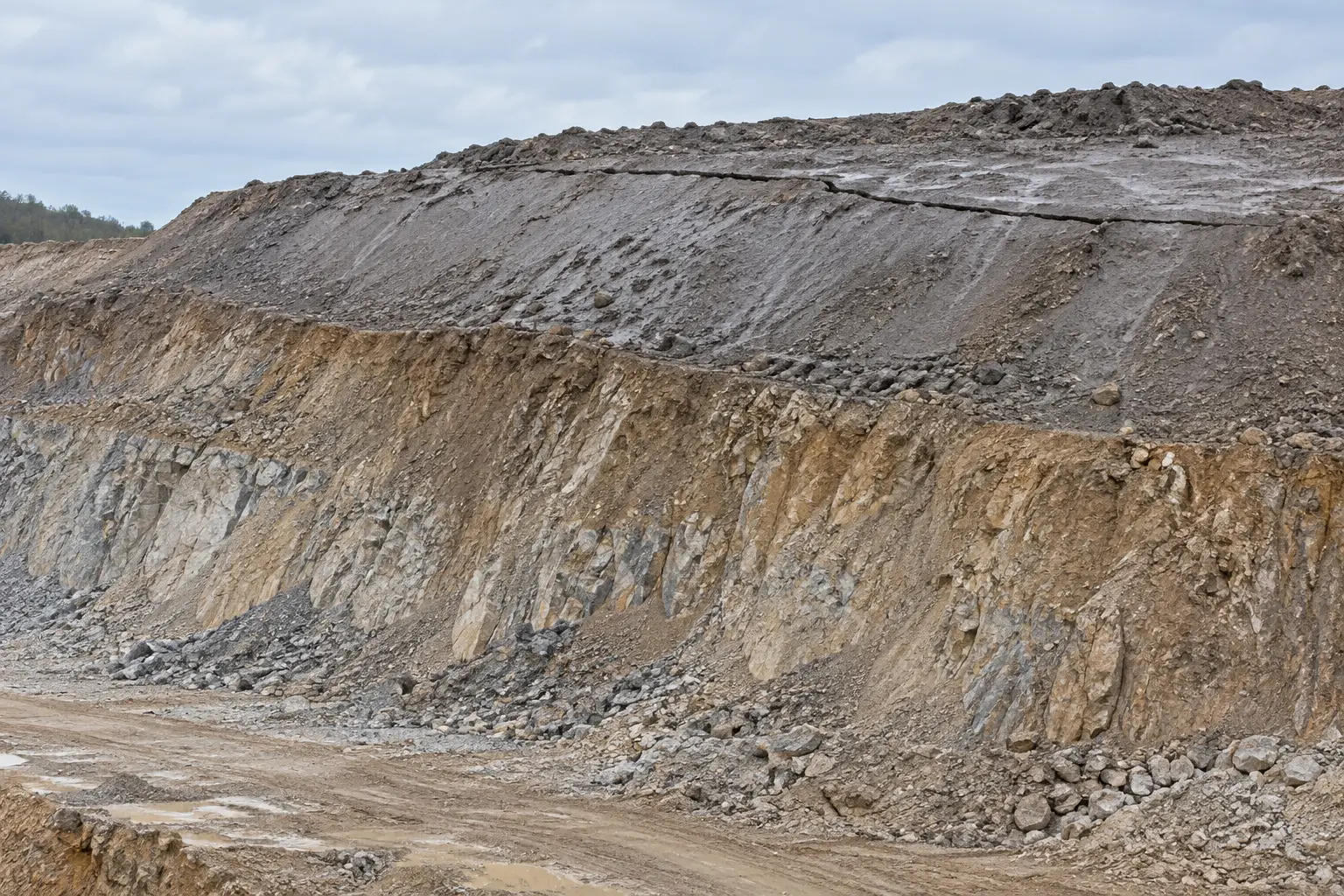
From preparation to the aftermath
At about 09:55 on 2022-01-29, soil accumulated above a quarry slope collapsed. Drilling and rock-breaking work was taking place below. The moving material buried and killed 3 workers.
At about 07:40 on 2022-01-25, four days before the accident, a worker found a crack above the slope, photographed it and notified site management. A smaller failure below was also observed. Inspection records indicated ongoing collapse, but work in the area was not stopped.
Aggregate-washing sludge and soil had accumulated above for a long period, with further deposits increasing before the accident. Excavation below continued for quarrying, combining additional loading above with changes to support below.
The ground remained unstable after collapse, and cold weather and snow complicated the search. Some casualties were recovered that day, but recovery of the final casualty continued until 2022-02-02. The end of the initial collapse did not establish stable access for rescuers and equipment.
Loading above while removing support below
Fine material left after aggregate washing can retain water. A dry-looking surface above wet deposits does not establish the strength of the whole mass. Post-accident analysis found a water content of 20.8% in the failed ground. This is a finding for this ground, not an allowable limit for other slopes.
Slope stability depends on layers, water, deposited weight and excavation position as well as angle. Further loading increases driving forces, while excavation changes support. Managing those as unrelated operations can miss their combined effect on the same ground.
A tension crack above the slope is a sign to investigate movement or changing support. A narrow-looking crack or continued vehicle access is not justification for continuing work. Investigate its position alongside excavation and drainage, and establish access restrictions.
The smaller failure was not merely extra soil to clear away. It required investigation of whether a larger mass had begun moving. Where photographs are reported but work continues, the process must extend to who actually stops work, investigates and decides on restart.
Deposit ratios and slope angles require site-specific ground investigation. Competent geotechnical assessment must use the actual investigation to plan removal, support, drainage and excavation sequence.
A pipeline-excavation comparison in the same white paper describes workers buried while joining pipes beneath a face weakened after rain. The quarry and a narrow trench differ in scale, but both raise the question of whether ground left after excavation can support itself. Creating room to work does not establish stable ground above that room.
Even when separate crews manage upper deposition and lower extraction, they act on connected ground. Deposition planning must account for excavation below, while excavation planning must consider material and water above. Record the work boundaries and stop conditions together so that completing one task does not automatically authorise the other to resume.
A photograph of a crack needs a decision pathway. Without authority to halt production or obtain geotechnical assessment, reporting can stop at documentation. Move people and equipment away from the exposure area and submit the changed conditions for competent assessment rather than informally declaring a crack harmless.
Removing material above the slope also requires a designed method. Sending equipment onto deforming ground or stacking removed material at an edge can introduce new loads. Connect access, disposal positions, water control and observation locations to the geotechnical assessment. The question is not simply whether to remove material, but from where and in what sequence.
What the comparison shows
The same chapter records a worker installing a dust-control screen at a raw-stone stockyard who died when a large stone moved from above. The present accident involved a soil mass; the comparison involved an individual stone. At either scale, work below cannot be assessed separately from material stability above.
Its practical question is what lies above and what could make it move. Before people work below, determine what must be removed or secured and which areas require exclusion.
Causes and protective layers
| Layer | At the time | Workplace action |
|---|---|---|
| Ground assessment | Excavation beneath wet deposits and upper loading | Assess layers, water, deposits and excavation together |
| Warning response | Work continued after cracks and a smaller failure | Stop exposed work, control access and obtain competent assessment |
| Decisions | Photos and inspection findings did not change work | Communicate stop authority, completed measures and restart grounds |
Investigation and proceedings
The site manager and other executives, including the CEO, were indicted under the OSH Act, and prosecutors identified the group chairman as a suspect under SAPA; the white paper does not include a judgment following those indictments.
Why the consequences were severe
Operators were working below a high slope, with limited time to manoeuvre away once the soil mass moved. Telling drivers to watch their surroundings cannot control failure of the ground above.
Rescue remained exposed to the same slope. Approaching without checking remaining material and equipment positions can endanger rescuers. Restrictions after a stop must also account for search and recovery access.
Questions at the work position
| Question | What to examine |
|---|---|
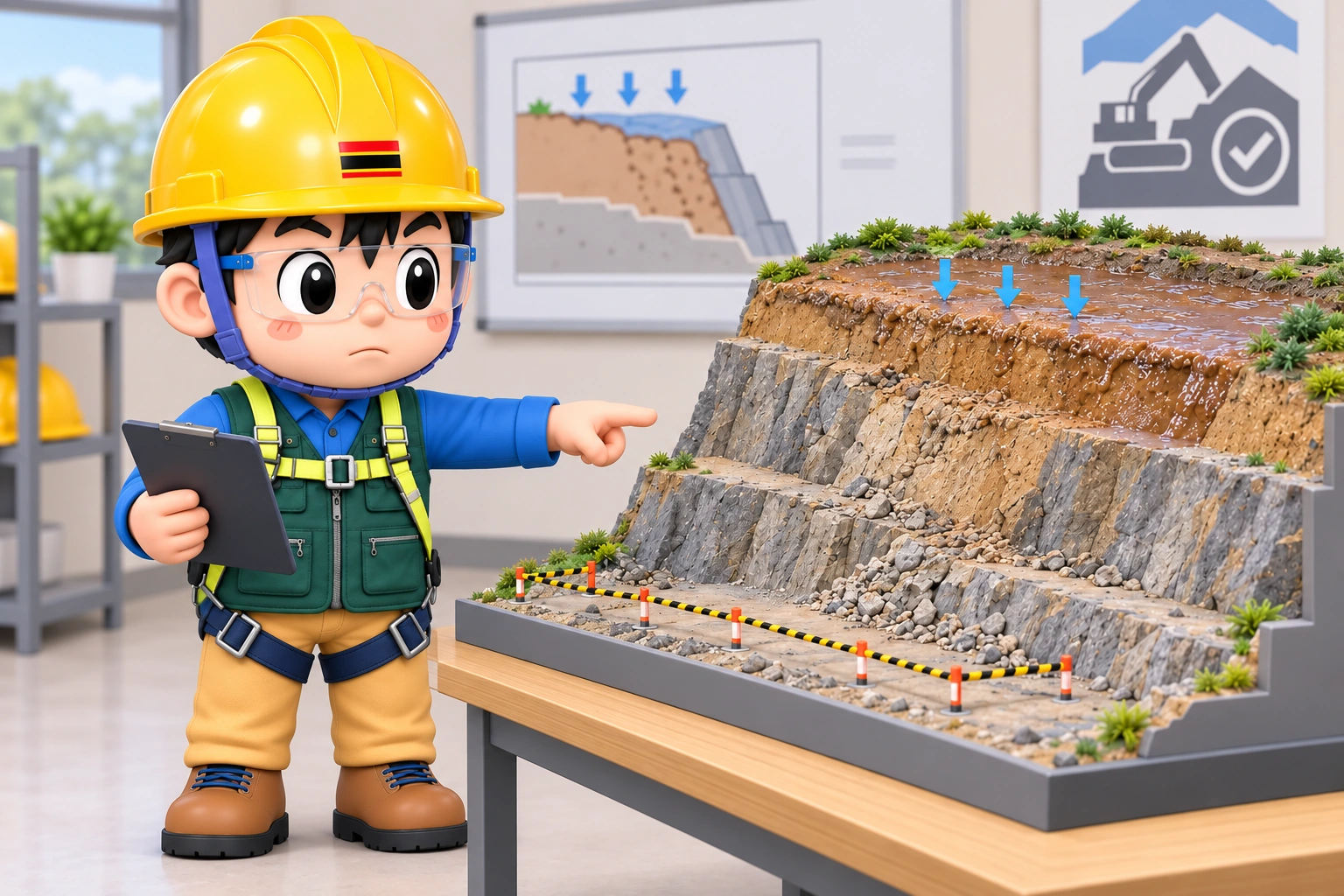
| Are upper loading and lower excavation assessed together? | Added load, water, layers and removal sequence |
| What changes after a crack is photographed? | Closure, equipment withdrawal, investigation and restart decision |
| Do workers know the stopped area? | Communicate boundaries to operators as well as the reporter |
Korean legal references
Rules Article 338 addresses checks including cracks, moisture and water inflow during excavation; Articles 339 and 340 address excavation slopes and collapse prevention. If actual deformation differs from the investigation, reassess the changed ground rather than continuing the old plan.
Occupational Safety and Health Act (Korean) · Rules on Occupational Safety and Health Standards (Korean)
Sources
MOEL and KOSHA, 2023 Serious Accident White Paper, 74–99 pages. Official publication (Korean)