English names and summaries of Korean laws are unofficial translations. The Korean text on the Korean Law Information Center (law.go.kr) prevails.
How are hung-up trees dealt with?: A fatal tree strike
Key terms in Korean and English
- serious accident (중대재해, OSH Act)
- employer (사업주)
- struck by object (물체에 맞음)
- hung-up tree (걸린 나무)
At a glance
On 16 April 2024, 1 worker died while dealing with a pine tree lodged against another tree at a forestry site in South Jeolla Province.
From preparation to the aftermath
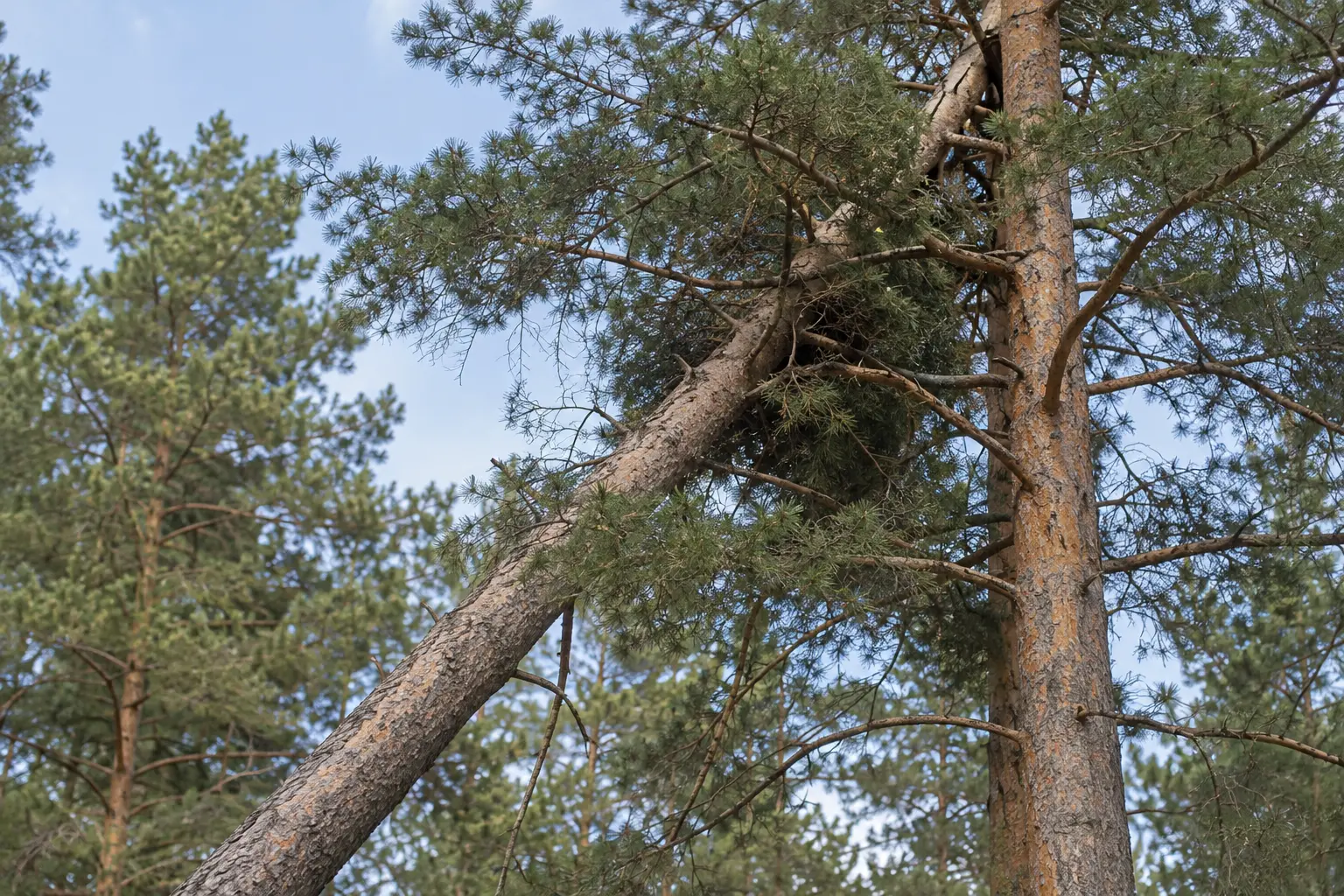
On 16 April 2024, workers at a forestry site in South Jeolla Province were felling trees in areas divided by a ridge. Work had continued for several days and much of the lower area had been cleared. A pine failed to fall in the intended direction and became lodged against a neighbouring tree.
According to the sequence reconstructed in the white paper, the worker attempted to cut the tree supporting the lodged pine. A colleague working elsewhere heard a tree fall followed by the saw continuing to run, approached and found the fallen worker. The worker died after being struck by the tree.
The site investigation found an inadequate felling-notch angle. The notch is cut at the base towards the intended fall direction. The white paper explains that the very narrow notch contributed to the pine deviating and lodging against its neighbour. Cutting continued instead of isolating the area and planning a safe method for the changed condition.
The employer received a call that work was starting but did not direct the method or check safety conditions. Assigning experienced workers did not establish a stop-and-recovery procedure for an abnormal condition such as a hung-up tree. Responsibility for responding to changes needed to extend beyond the initial start notification.
What moves when support beneath a hung-up tree is removed
A hung-up tree differs from timber resting securely on the ground. Its weight remains supported by another trunk or branches, and the inclined stem may rotate or slide if that support moves. Apparent stillness does not prevent the support conditions changing the moment cutting begins. The saw operator is then close to the place where that change occurs.
Preparing the notch and dealing with a hung-up tree are different stages. The notch helps guide normal felling; once the tree is lodged elsewhere, the planned fall path no longer applies. Treat this as a changed work condition requiring a stop, not merely more cutting. First identify a safe position from which the terrain, contact height and stem direction can be assessed.
On a slope, contact with the ground may not end movement. Consider possible rolling or sliding and the position of workers below. Even if the felling operator stops, a colleague continuing downhill may remain within the same tree’s movement area. The boundary dividing work areas must be checked against the area a moving object can reach.
Mentioning a winch or other equipment does not complete a recovery plan. Pull direction, anchorage, equipment capacity and escape positions must be compatible. Applying the equipment-based approach discussed in the white paper requires a competent person to plan for the actual conditions and restrict access. Cutting the supporting tree from beneath the lodged tree is not an acceptable solution.
Planning must consider neighbouring trees and terrain, not only a single fall direction. Even where space appears available, branches can engage another tree and stop the fall. A saw operator concentrating on the cut cannot continuously inspect overhead contacts. Identifying possible lodging points and stop conditions beforehand reduces reliance on improvisation when movement differs from the plan.
Cutting the supporting tree can appear to clear both trees together. From the cutting position, however, it is difficult to control when support is lost or where the lodged tree moves. Removing support itself initiates a new motion. The first decision must concern keeping people outside that movement area, not saving work time.
The fall direction and escape direction should not be treated as the same route. Plan where the stem may move separately from where a person can retreat, and check for branches or previously cut timber blocking escape. On a slope, obstacles can make even a few backward steps difficult. Ground conditions change during work, so the original escape route needs to remain usable.
The cross-cutting example shows that risk continues below timber on a slope. Even after felling, removing a supporting branch or another log can initiate rolling. Before simply assigning uphill and downhill areas to different people, consider whether moving material can cross that boundary. A boundary based only on immediate working reach can omit the effect of the slope.
Here, a colleague approached because the saw continued running unusually. Hearing a saw is not confirmation that work remains safe. Where workers are out of direct sight, agree location checks and the response to a missed reply. Information about the hazardous area is also needed so that a colleague checking on someone does not enter beneath the lodged tree.
An experienced worker may still lack authority to obtain equipment or change the method. The employer needs arrangements for stopping and requesting support, beyond asking whether work has started. If suitable recovery equipment is unavailable, maintain the exclusion area and arrange support rather than press for a way to finish without it.
Rescue beneath a tree can also change support conditions. On discovering an injured colleague, stop surrounding work and tell responders the location and lodged condition. Improvised cutting to move a heavy object can endanger rescuers. Normal felling and emergency access have different purposes and should not be improvised as if the same method necessarily fits both.
The investigation account gives a notch angle below 5 degrees. Current Article 405 specifies notch geometry for trees with a breast-height diameter of at least 20 cm. That provision should not be confused with a method for cutting a tree already hung up. Distinguish the geometry checked before normal felling from the access restrictions and replanning needed after lodging.
The current hung-up-tree provision prohibits work beneath it and felling its support. Signals and confirmation of evacuation under Article 406 provide a separate protection for nearby workers. Where teams work above and below one another, establish who receives the signal and where they withdraw. If the signal is not heard or clearance cannot be confirmed, the conditions for starting have not been established.
Before resuming, do not check only that the lodged tree has been dealt with. Examine damage to its former support and nearby branches, and whether fallen timber blocks the next worker’s route or escape. The site may differ from its condition before the abnormal event. Coordinate equipment recovery and repositioning of people with the point at which exclusion controls can safely end.
What the comparison shows
In the oak-felling accident of 31 March 2023 described in the same chapter, the tree fell in an unintended direction from the outset. The pine incident included an intermediate state in which the deviating tree became lodged against another. Both require attention to the notch and fall direction, but the pine case provided an additional opportunity to stop after the tree became hung up.
Another cross-cutting case concerns timber rolling down a slope onto a person below. That comparison shows why controls cannot end at the felling instant. Fall direction, a hung-up condition and rolling after ground contact are hazards at different stages. Each needs its own access boundaries and criteria for allowing people to approach.
Causes and protective layers
| Layer | At the time | Workplace action |
|---|---|---|
| Felling plan | Tree deviated and lodged against a neighbour | Plan around the tree, terrain, notch and escape position |
| Abnormal condition | Cutting continued after lodging | Stop, isolate and plan recovery |
| Work management | No method or safety check beyond the start call | Establish stop criteria and access to support |
| Other workers | Workers separated across areas | Control access within the movement area and downhill |
Investigation and proceedings
The site investigation examined the notch, handling of the hung-up tree and work management; the white paper’s accident account does not include subsequent enforcement or court outcomes.
Why the consequences were severe
The worker was close to the point where support changed. Once the heavy stem moved, surrounding trees and the slope constrained escape. The separated work arrangement also meant the colleague could not immediately see the accident position. Faster response cannot replace stopping work around the abnormal tree condition.
Questions at the work position
| Question | What to examine |
|---|---|
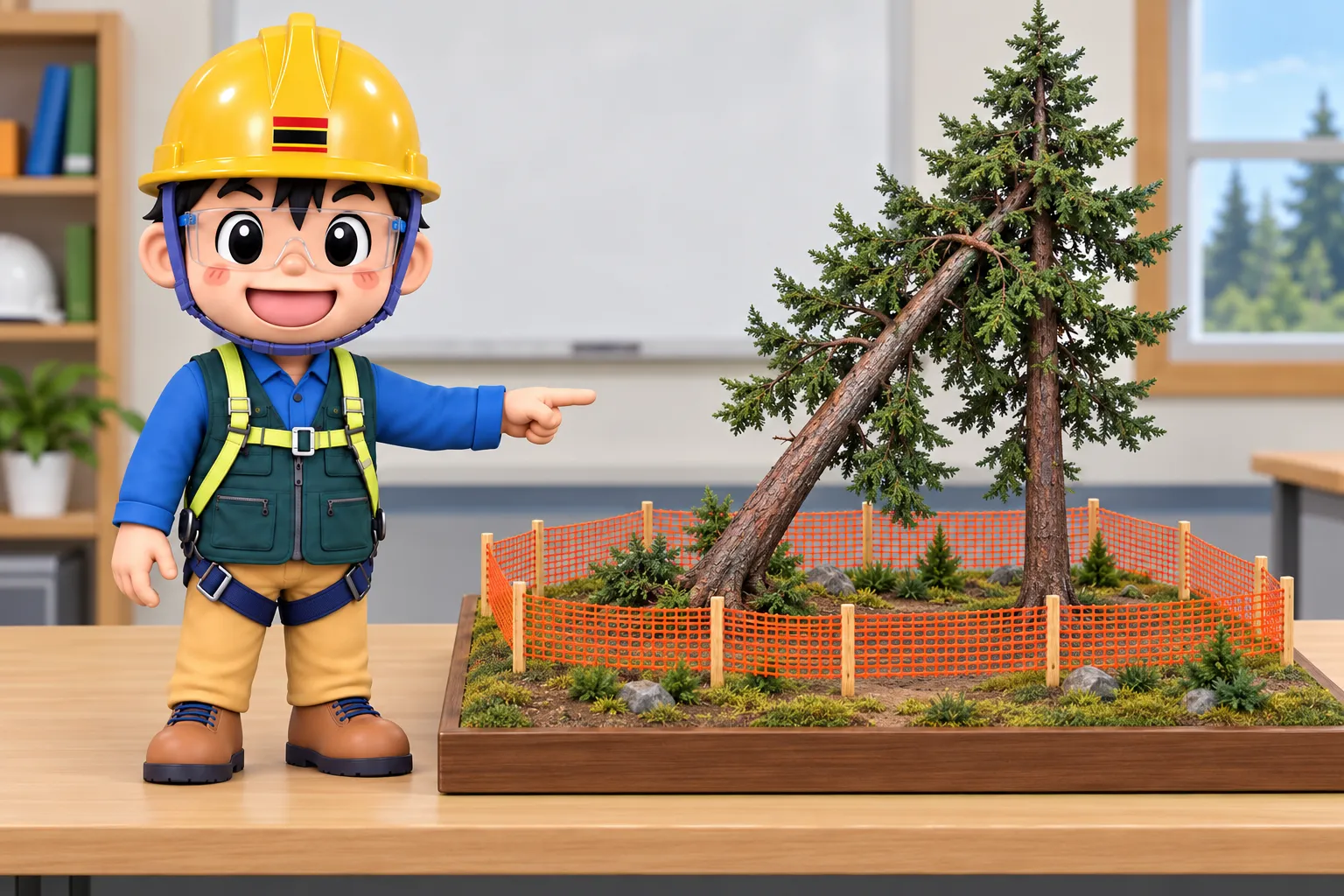
| When does a hung-up tree trigger a stop? | Stop before cutting its support and prevent approach |
| Is anyone downhill? | Check work areas against possible rolling and sliding |
| Is the recovery method planned? | Have a competent person assess capacity, anchorage and force direction |
| What if contact is lost? | Agree location checks and emergency communication before starting |
Korean legal references
Check the felling and hung-up-tree safeguards in Articles 405 and 406 of the Rules on Occupational Safety and Health Standards when planning work. In particular, do not work beneath a lodged tree or fell its support. The work plan needs to cover access control and confirmation that nearby workers have withdrawn.
Occupational Safety and Health Act (Korean) · Rules on Occupational Safety and Health Standards (Korean)
Sources
MOEL and KOSHA, 2025 Serious Accident White Paper, Part 3, 64–89 pages. Official publication (Korean)