Welding equipment: what should you check before work?
 SAFETY KIM
Welding & fire prevention
Welding equipment: what should you check before work?
A KOSHA video from South Korea highlighting gas-cylinder storage and hose connections as key checks for welding equipment.
Key points
- Start with the storage condition of gas cylinders.
- Check hoses and their connections before work.
- Defective welding equipment can create fire and explosion hazards.
Connect equipment checks to the work permit
Equipment condition and fire hazards at the work location are separate checks. Sound cylinders and hoses do not resolve combustibles below the work, behind a wall or in connected equipment.
Link the equipment check to the affected area, surrounding combustibles and stop conditions. Completing the equipment check does not complete the permit review or establish isolation of nearby plant.
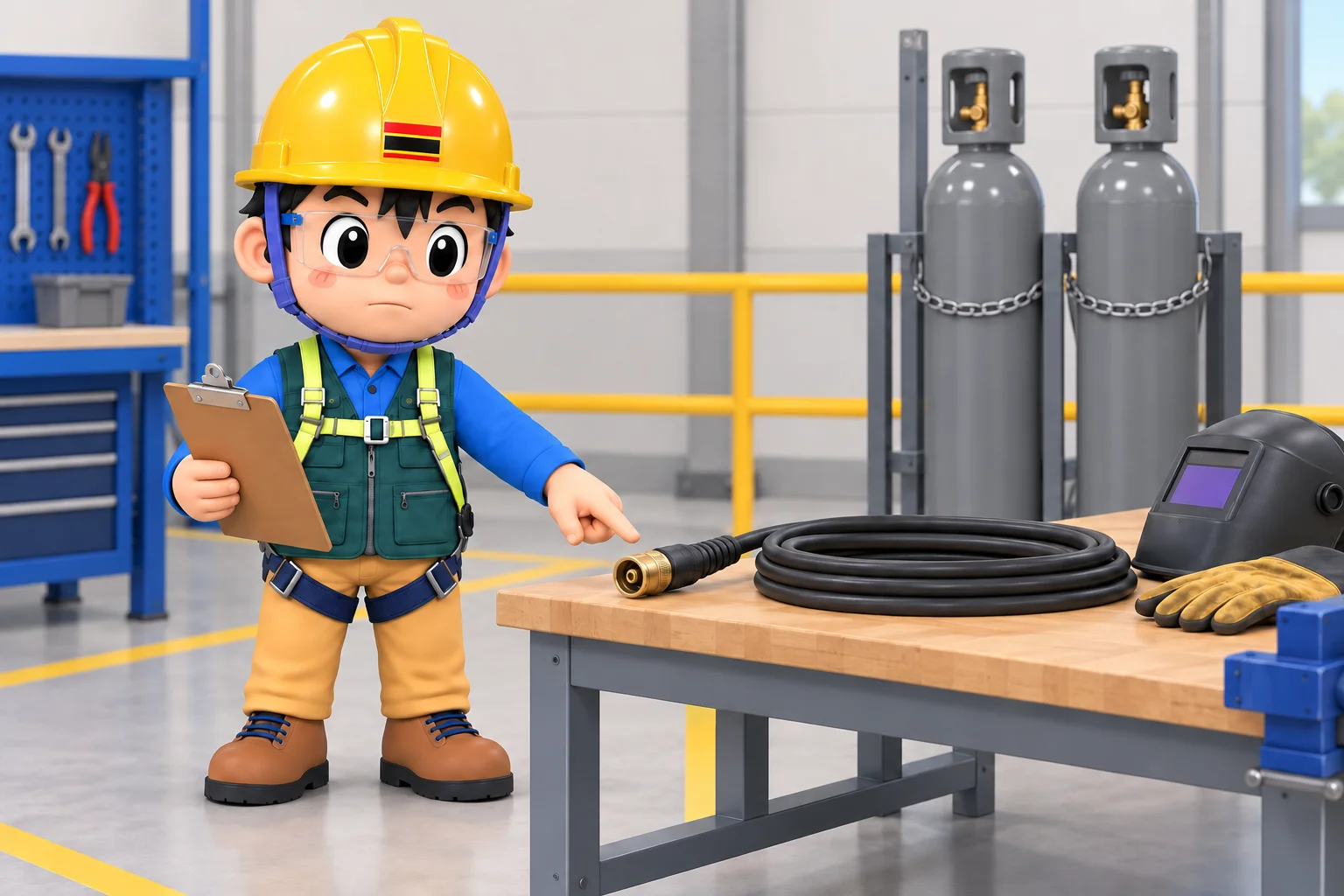
Who checks cylinder storage and hose connections at your workplace, and when?
Source: KOSHA (South Korea) · Korean-language video · 2026-05-19
Safety tips with Cho Chung-hyun · Welding equipment safety ↗
Commentary: Field Safety Briefing · Original video: KOSHA (South Korea) · KOSHA website
If playback is unavailable, open the original video on YouTube.
Apply cylinder storage and hose checks to the actual welding area
Connect the verified cylinder-storage and hose-connection topics with the actual welding position. A storage check does not cover hose routing and connections after relocation and setup. Include routes across walkways and points affected by nearby work.
After viewing, compare the checked cylinders and hoses with the equipment actually used. Reconsider checks after relocation or reconnection. Review equipment condition separately from combustibles and connected spaces around the task.
- Review hose routing and connections after setup at the actual location.
- Recheck equipment and surroundings after the work position changes.
Three different points between cylinder and torch
Inspection is easier to follow when the cylinder, gas connections and hot-work location are treated separately. Article 233 of the Korean Rules on Occupational Safety and Health Standards (산업안전보건기준에 관한 규칙) addresses hoses and torches that could leak, clamps at their connections and measures against gas discharge before supply. A clean cylinder exterior does not establish that its connections are sound.
Article 234 covers cylinder handling, including unsuitable poorly ventilated locations and areas near hot work, protection against overturning and impact, caps during transport, and checks for corrosion, wear and deformation. Its requirement to keep dissolved-acetylene cylinders upright concerns that specific gas. The fuel gas in the video has not been established, so cylinder shape or illustration colour cannot identify an acetylene installation.
At the work location, match the cylinder identification to the equipment actually connected. A checklist may concern a spare cylinder in storage rather than the cylinder feeding the torch. After relocation, examine hose routes exposed to wheels or doors, connections under tension and supply valves obstructed by stored objects. These questions define what needs checking when the installation location changes.
Agreeing which supply point is being shut
Article 233 requires identification to prevent mistaken operation at a gas supply valve or cock, such as a label identifying its user. Where several people are connected, “the valve is closed” may not identify the supply point. Matching its label to the hose destination and naming that point in shutdown communication reduces ambiguity. A label does not establish leak tightness or connection suitability.
The same article requires closure of the supply valve or cock when leaving after an interruption or completion. Confusing the torch control with the supply point can leave upstream supply available after the handheld tool is closed. The valve sequence must follow the actual equipment instructions and site procedure; a brief video action cannot define the complete shutdown sequence.
Before restarting, ask whether a connection was opened, another worker moved the equipment or the supply point changed after the last check. These questions establish whether the earlier sign-off still describes the connections. Smell or sound alone must not replace an appropriate leak check.
Sound equipment does not settle hot-work conditions
Article 241 addresses procedures, hazardous materials, protection of combustibles, extinguishing equipment, spark containment, ventilation against remaining vapours or gases, and emergency measures where hot work is conducted near combustibles. The equipment-inspection entry and the location fire-prevention entry need different evidence. Combining both into one “no defect” box removes that distinction.
Article 241(1) prohibits using oxygen for ventilation in inadequately ventilated hot-work locations. Oxygen supply is not a ventilation measure. Sound equipment cannot justify approval of a location when the condition below the workbench or behind a wall remains unknown. A useful closing question assigns responsibility separately for shutting supply and checking residual fire hazards at the work location.
Checks and records before work
At the welding equipment, identify which cylinders and hoses serve the work. Cylinder color or a diagram can omit the supplier’s actual identification. Check that the labels can be read and the cylinders are secured. Confirm with the work lead that the intended regulator and hose match the verified equipment configuration. Report any suspected handling impact on a cylinder and its connections. Use what the video shows to explain the order of checks.
Follow the accessible hose route as well as checking the working end. Look for unprotected crossings, places where a hose can be pinched, kinks and abrasion. Pause use if something appears wrong at a connection. The person who has verified the equipment type and instructions should select the procedure for handling the gas supply and checking the system. Obtain gas-specific compatibility and ratings from the supplier and manufacturer.
When the work location changes, recheck cylinder restraint, hose routing and the work boundary. Moving loads or a temporary screen can change the available route. During handover, distinguish confirmed gas identification, equipment condition and unresolved concerns. A practical prompt is to read the gas name on the label and stop the connection if the label is unreadable or a connection looks abnormal. Describe visible objects and verified technical information separately.