Lifting operations: secure, exclude, protect
 SAFETY KIM
Lifting & falling objects
Lifting operations: secure, exclude, protect
This short KOSHA video from South Korea covers load securing, keeping people out of the lifting route, and helmet use.
Key points
- The video illustrates cross-lashing with two sling belts.
- Keep people away from suspended loads and their travel path.
- Wear a safety helmet where falling objects present a hazard.
The illustrated sling arrangement is not suitable for every load. Select the rigging method for the load, centre of gravity, sling limitations and lifting plan; apply local requirements.
Three questions before copying a sling arrangement
Establish the load and its centre of gravity, check the sling markings and conditions of use, and compare the load movement envelope with pedestrian routes. The same visible arrangement is not the same lifting plan when weight or geometry changes.
Head protection and exclusion controls perform different roles. Wearing a helmet does not justify standing below a suspended load. Ask how people will be kept outside the load movement area, as well as whether the required PPE is worn.
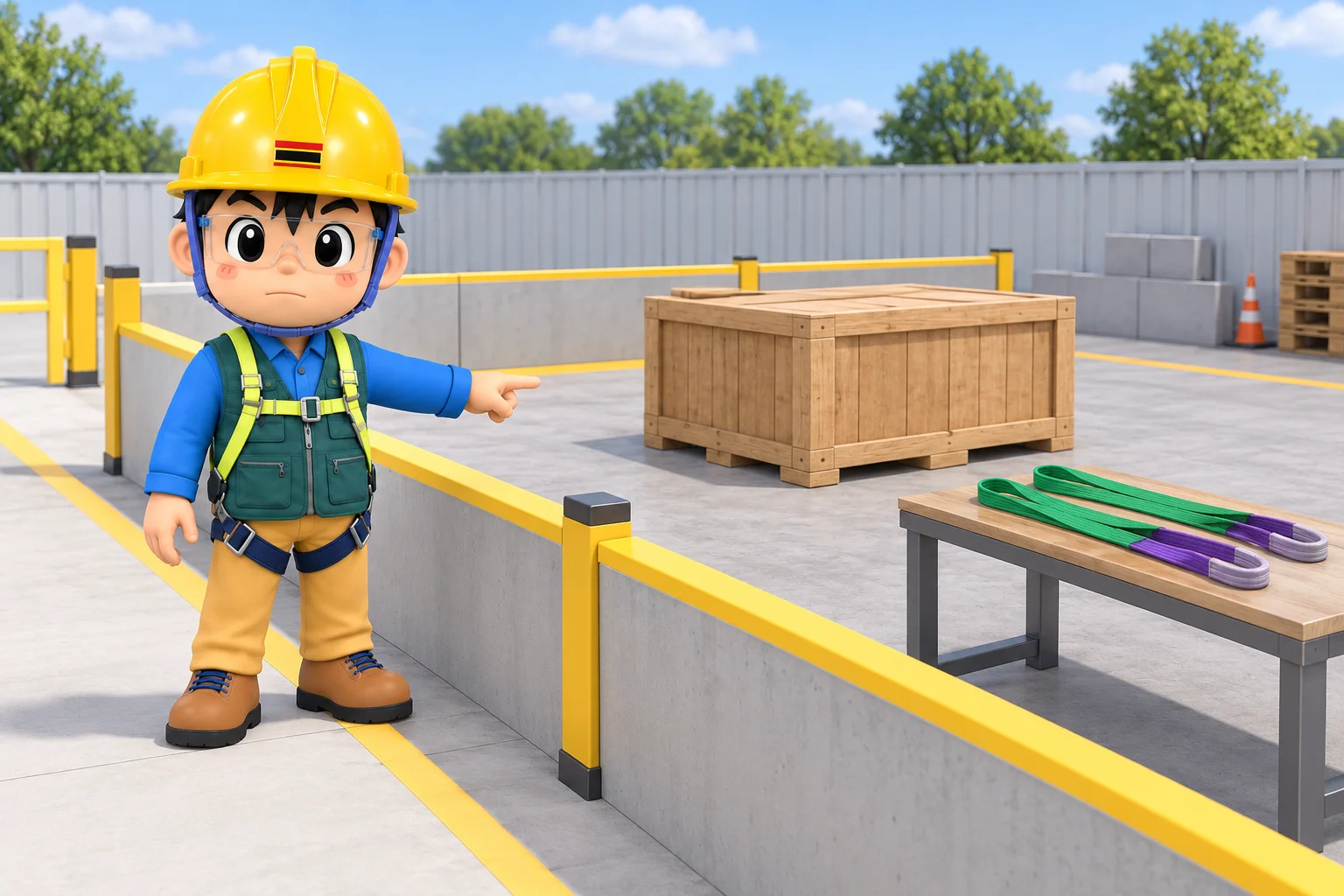
Before lifting, do you check both load securing and access control along the lifting route?
Source: KOSHA (South Korea) · Korean-language video · 2026-09-15
Golden Time in CCTV · Three lifting safety rules ↗
Commentary: Field Safety Briefing · Original video: KOSHA (South Korea) · KOSHA website
If playback is unavailable, open the original video on YouTube.
Compare the illustrated lashing with our load’s centre of gravity
Use the illustrated cross-lashing as a starting point for reviewing load shape and centre of gravity. An arrangement that looks similar still needs comparison with the actual load and sling conditions. Include loading directions when the cargo tilts or rotates.
The video’s access-control and helmet topics are not interchangeable measures. After viewing, mark waiting and landing positions along the route. Wearing protection is not a reason to permit positioning work close to a suspended load.
- Compare the illustrated lashing with the actual load shape and centre of gravity.
- Check separation between waiting positions and the load’s route.
Information needed before choosing a crossed arrangement
A rectangular outside shape does not establish uniform weight distribution inside a load. Cavities or attached items can make its centre of gravity difficult to judge from appearance. Weight information, centre-of-gravity location and structurally suitable support points are needed before a demonstration arrangement can become an actual lifting plan. Feeling that a load is stable when moved by hand is not a substitute for weight information.
Article 38(1)11 of the Korean Rules on Occupational Safety and Health Standards (산업안전보건기준에 관한 규칙) includes heavy-load handling among work requiring a plan. Paragraph 2 requires its contents to be communicated to the workers concerned. Knowledge held only by the planner is different from understanding by the riggers. The explanation should cover the destination, landing area and support method as well as attachment points, reducing improvised changes during the lift.
Ask whether accessories and remaining contents are included in the weight information. Transport packaging or a handle must not automatically become a lifting point. Suitability to carry the load requires the relevant load specifications and lifting information. Experience with a similar-looking item does not establish an unverified lifting point's suitability.
Crane capacity and accessory markings are separate checks
Article 135 prohibits loading lifting equipment beyond its rated load. Article 163(2) requires firmly attached markings such as the maximum permitted load on lifting accessories. Adequate crane capacity does not establish that slings and shackles are suitable for the intended arrangement; the two checks cannot replace one another.
Compare a sling's marked capacity with the actual attachment method. Do not invent angle-based capacities or reduction factors without manufacturer information. Where different accessories are joined, consider whether a connection loads one side or restricts movement. Individual component markings do not automatically approve the assembled arrangement.
An unreadable marking cannot be replaced by the rating of a similarly coloured item nearby. Even an existing tag needs to match the product, and rejected items must not re-enter the usable stock. Separating held items from available equipment helps prevent the next worker from taking them based on appearance alone.
Agreed signals do not permit people beneath a load
Article 40 requires an established signalling method for lifting work and compliance with it. Signals are more than memorised hand gestures. The lifting plan must identify who can see the load in obscured areas and how that person and the operator confirm conditions. Guessing the next movement after a missed signal is not a workable plan.
Article 146(1), concerning crane work, prohibits dragging or pushing a load along the floor and directly separating fixed objects. It also requires advance access control to keep suspended loads from passing over workers' heads. Even a well-attached load requires people to be repositioned when its route crosses a walkway. Wearing a helmet does not remove that requirement.
Useful questions extend beyond attachment: who cannot see the load, where will it land, and is there space to withdraw hands and stand clear? Rechecking the sling arrangement cannot compensate for missing landing supports or an unsafe hand position during landing.