Forklift work: are the load and blind spots under control?
 SAFETY KIM
Forklifts & collision prevention
Forklift work: are the load and blind spots under control?
A South Korean KOSHA video addressing load placement and securing, driver visibility and the risk of contact with nearby workers.
Key points
- Check load placement so that it does not obstruct the driver’s view.
- Secure the load against movement during travel.
- Manage blind spots and nearby workers, and follow speed, seat-belt and ignition-key controls.
Review driver visibility alongside pedestrian movements
Forklift safety depends on more than the driver’s attention. Review how the load affects visibility and how other workers move through the area.
Recheck visibility and load security when either the load or the route changes. Where a guide is needed, establish positions, signals and responsibilities that everyone involved understands.
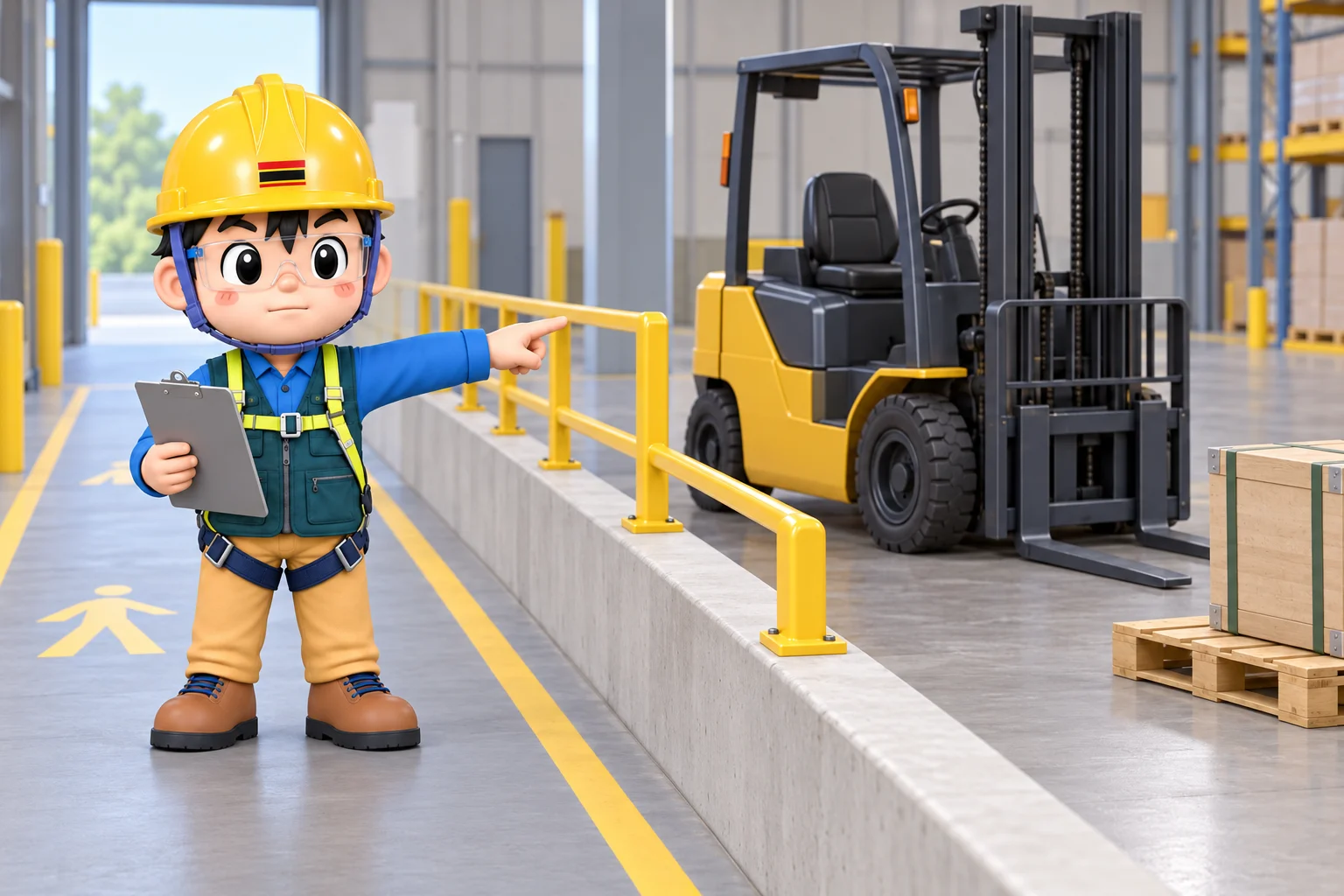
Which areas are hidden from the driver with this load? How is pedestrian access managed, and do the driver and guide share the same positions, signals and stopping criteria?
Source: KOSHA (South Korea) · Korean-language video · 2026-08-20
Forklift safety ([위기탈출 넘버원 비상구를 열어라] 지게차 편) ↗
Commentary: Field Safety Briefing · Original video: KOSHA (South Korea) · KOSHA website
If playback is unavailable, open the original video on YouTube.
Overlay the load and blind spots with pedestrian positions
Connect the load and blind-spot topics with the view from the operator’s seat and pedestrian positions. Distinguish visibility on an unloaded machine from visibility with the actual load. Mark corners, spaces between stacks and material-sorting positions on the route.
After viewing, identify periods when movement and pedestrian work overlap and compare ways to separate them. Before relying on driver attention, establish sorting and waiting positions usable without entering the vehicle route.
- Review visibility with the actual load in place.
- Choose positions that reduce overlap between pedestrian work and transport.
The same weight at a different position on the forks
Article 178 of the Korean Rules on Occupational Safety and Health Standards (산업안전보건기준에 관한 규칙) defines forklift permitted load in relation to its structure, materials and load-centre position. One prominent capacity number cannot describe every long-load or attachment configuration. Use manufacturer criteria for the actual load centre and equipment configuration.
Article 173 requires balanced loading, an unobstructed driver's view and compliance with maximum loading limits. A calculation within the weight limit does not settle visibility. Areas obscured by load height and areas swept by its ends during turns both belong in the travel assessment.
Ask how weight was established, whether contents can shift and whether unlike items share a pallet. A tentative lift must not become the method of discovering an unknown weight. Obtain the information needed to compare the actual load arrangement with the equipment instructions before proceeding.
Where pedestrian routes meet handling work
Article 172 prohibits workers from entering areas where contact with handling machinery or its load could endanger them. Its exception involves guidance by a work supervisor or guide; simply assigning a person does not complete contact-risk control. The driver must follow the guidance, and the applicable signalling method under Article 40 must be established.
A guide's position needs both visibility to the driver and clearance from trapping by the load or vehicle. Standing between a vehicle and a wall to become visible can create another hazard. Establish which movement stops when signals are lost or someone enters the signalling area, and who clears the route again.
Even a separated walkway may meet the vehicle route at a door or pallet handover point. Examine the moment someone receives goods or opens a door rather than just the length of painted line. Consider separating handling in time or permitting pedestrian approach only after the load is landed. This creates a work sequence that does not rely solely on driver attention.
Recheck the plan when the route changes
Article 38 includes work with vehicle-type handling machinery in the prior-survey and work-plan requirements and requires the plan to be communicated. Even with the same driver and vehicle, additional storage or changed floor conditions can invalidate assumptions about clearance and working positions. A familiar route is not evidence of its present condition.
A useful change record identifies the route, handover point, visual obstructions and revised handling method. Listing hazards without changing the movement sequence leaves the worker with the same choices. Separate obstacle removal from vehicle movement so that clearing an obstruction does not bring someone under a load or close to the vehicle.
After viewing, a driver and pedestrian can mark locations where they cannot see one another on the same plan. Overlapping marks identify candidates for route or sequencing changes rather than another warning notice. Check that the revised method works with the actual load so that the training discussion connects to handling on site.
Checks and records before work
Before a forklift moves with a raised load, check load stability and the operator’s view as separate conditions. A tall or wide load may hide part of the path even when it is stable. Packaging or a support that can shift may make the load unstable at a corner or stop even when visibility is good. In the video, identify the visible load edges and line of sight. At work, check the planned route, load condition and pedestrian separation.
At a crossing or while reversing, the operator looking back provides limited information. Pedestrians can step from behind a rack or doorway, and other traffic may draw attention away. If the site uses a guide, agree on the designated guide, communication method and stopping point. Stop if the guide disappears from view, the signal is lost or someone enters the travel lane. Confirm that the path is clear before resuming.
The person checking the aisle and the operator may describe directions from different positions. During unloading preparation, tie the controlled doorway and turnaround direction to actual area markings. If the rear of the load blocks the view, use the agreed safe location to restore signals. Report any direction that remains unchecked and wait. A practical reminder is to stop on lost communication and confirm separation before moving again. Treat the loading and reversing scenes as separate points when recording a verified video timestamp.