Confined spaces: have you checked testing, ventilation and respiratory protection?
 SAFETY KIM
Confined spaces & asphyxiation prevention
Confined spaces: have you checked testing, ventilation and respiratory protection?
A South Korean KOSHA video introducing oxygen-deficiency and hazardous-gas risks and the basics of atmospheric testing, ventilation and respiratory protection.
Key points
- Test oxygen and relevant hazardous gases before entry.
- Maintain ventilation before and during the work.
- Check respiratory protection appropriate to the conditions, including supplied-air equipment or self-contained breathing apparatus where required.
Testing, ventilation and respiratory protection are parts of confined-space management. Also review the site plan for entry procedures, monitoring and communication, and emergency rescue arrangements.
Connect pre-entry readings to conditions during work
A space’s name alone does not describe its atmosphere. Consider stored materials, residues and processes such as fermentation or decomposition when deciding what the assessment and measurements must cover.
Testing, ventilation and respiratory protection are separate controls. A pre-entry reading does not establish the conditions for the rest of the task; define who responds to changing conditions and when work must stop.
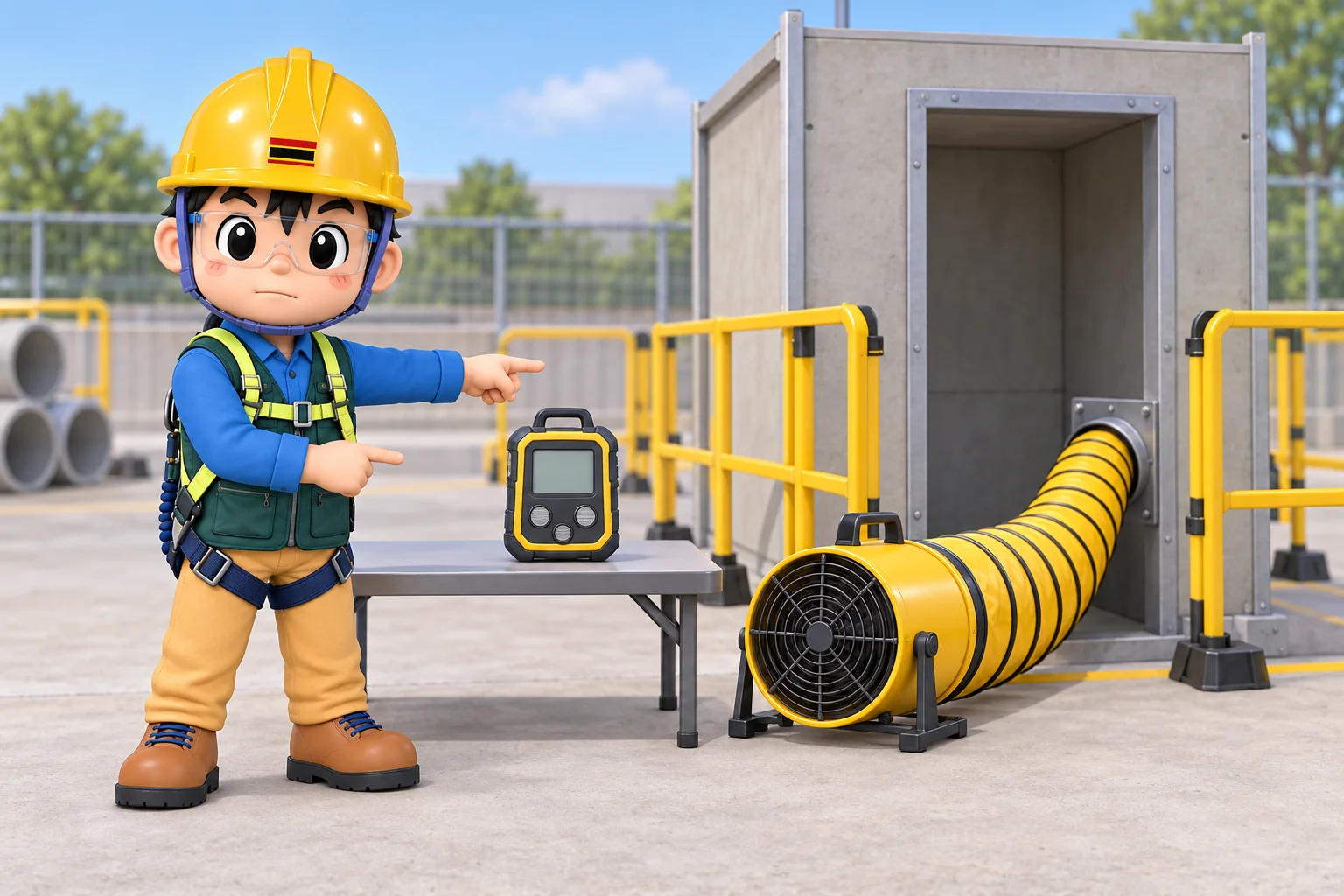
Which gases, in addition to oxygen, must be assessed? How is continued ventilation checked, and who stops the task if readings or conditions change?
Source: KOSHA (South Korea) · Korean-language video · 2026-08-26
Confined-space asphyxiation ([위기탈출 넘버원 비상구를 열어라] 밀폐공간 질식사고 편) ↗
Commentary: Field Safety Briefing · Original video: KOSHA (South Korea) · KOSHA website
If playback is unavailable, open the original video on YouTube.
Connect measurement and ventilation with entry position and task changes
Compare the video’s pre-entry measurement, ventilation and protection topics with the actual entrance and work position. Distinguish conditions established at the opening from those at the task location. Include tasks that disturb contents, such as blockage clearing, in the scope reviewed.
After viewing, compare an outside method with one requiring entry. For planned entry, check that attendance and rescue preparation suit the location, and explain emergency actions that prevent colleagues following inside without preparation.
- Distinguish conditions at the entrance from the internal work position.
- Explain the actions to take from outside when an abnormal condition arises.
Returning after a break is another start
After leaving a confined space, it is easy to rely on the morning's measurement sheet for re-entry. Article 619-2(1) of the Korean Rules on Occupational Safety and Health Standards (산업안전보건기준에 관한 규칙) explicitly includes restarting after a temporary interruption. It requires a designated person with measurement and evaluation knowledge and practical experience, supplied with equipment, to assess whether suitable air is maintained. A short break does not remove the pre-entry check.
Recording numbers and judging what they represent are different tasks. Paragraph 2 requires confirmation of the assessor's understanding of confined-space hazards, equipment condition and operation, measurement methods, and suitable-air criteria and evaluation, with necessary training. A number on a screen is not a completed assessment if the gas, unit or equipment condition is unknown.
Article 619(2) covers work and personnel information, measurements and follow-up, possible gas leakage, ingress or generation during work, protective equipment and emergency communications. A reading at the entrance must not be assumed to represent every internal location and later stage. Moving contents or connections to an external process can change the conditions. Ask which locations and work stages the measurement represents.
A running fan does not describe the air at the work position
Article 620 generally requires ventilation before and during work to maintain suitable air. Fan power and air delivery at the working position are different conditions. Changes such as a kinked duct or relocated intake or outlet require reconsideration rather than reliance on the power indicator.
The exception concerns circumstances where ventilation is impossible because of explosion or oxidation hazards, or very difficult because of the nature of the work. It includes provision and use of self-contained breathing apparatus or supplied-air respirators. Failure to prepare a fan does not itself create that exception. A gas-filtering mask must not be treated as satisfying the conditions for air-supplying respiratory protection.
Feeling cool or noticing no smell does not replace oxygen and harmful-gas measurements. If an alarm occurs or conditions change, follow the established evacuation and communication procedure rather than continuing work while investigating inside. Re-entry requires renewed preparation. Ventilation equipment and gas detectors do not perform all of each other's functions.
The person outside needs an actionable procedure
Article 623 requires an outside attendant during work and equipment enabling continuous communication between inside and outside. It also specifies the attendant's fire-service notification and follow-up communication when a worker is in difficulty. Establish whether the person can actually monitor and communicate, rather than merely counting someone at the entrance. Leaving to perform another task changes those conditions.
Article 625 requires equipment for evacuation or rescue, including breathing apparatus or supplied-air respirators, ladders and fibre ropes. An inventory alone does not establish whether rescue equipment can be used through the actual opening and at the worker's location. Unprepared entry after a collapsed colleague cannot serve as the emergency rescue plan.
After training, ask the assessor to explain measurement locations and restart conditions, the worker to identify the exit route, and the attendant to describe notification and communication. Role-specific explanations reveal gaps more clearly than everyone answering “checked” to the same question. Establish what happens if one of these functions becomes unavailable.