Formwork shoring: does the installation match the plan?
 SAFETY KIM
Formwork shoring & collapse prevention
Formwork shoring: does the installation match the plan?
A KOSHA training video from South Korea explaining the role of formwork shoring and hazards during assembly and dismantling.
Key points
- Check the assembly drawing, supporting ground and the specification and condition of components.
- Before concrete placement, check for deformation, displacement and settlement.
- Control access during assembly and dismantling, and review work platforms and fall protection at height.
Use this as educational reference. Follow the design review, assembly drawings and work plan for the actual structure. Watching this video alone does not establish completion of required training; apply local requirements.
Technical principles and management judgement: follow the load path
Shoring transfers loads from concrete and formwork to the supporting surface. Sound individual components do not ensure a sound system if the ground settles or connections differ from the design; review components, connections and foundations together.
Changes in placement sequence, concentrated loads or height warrant review of the plan. Dismantling decisions need the specified engineering and concrete-strength evidence, not appearance alone.
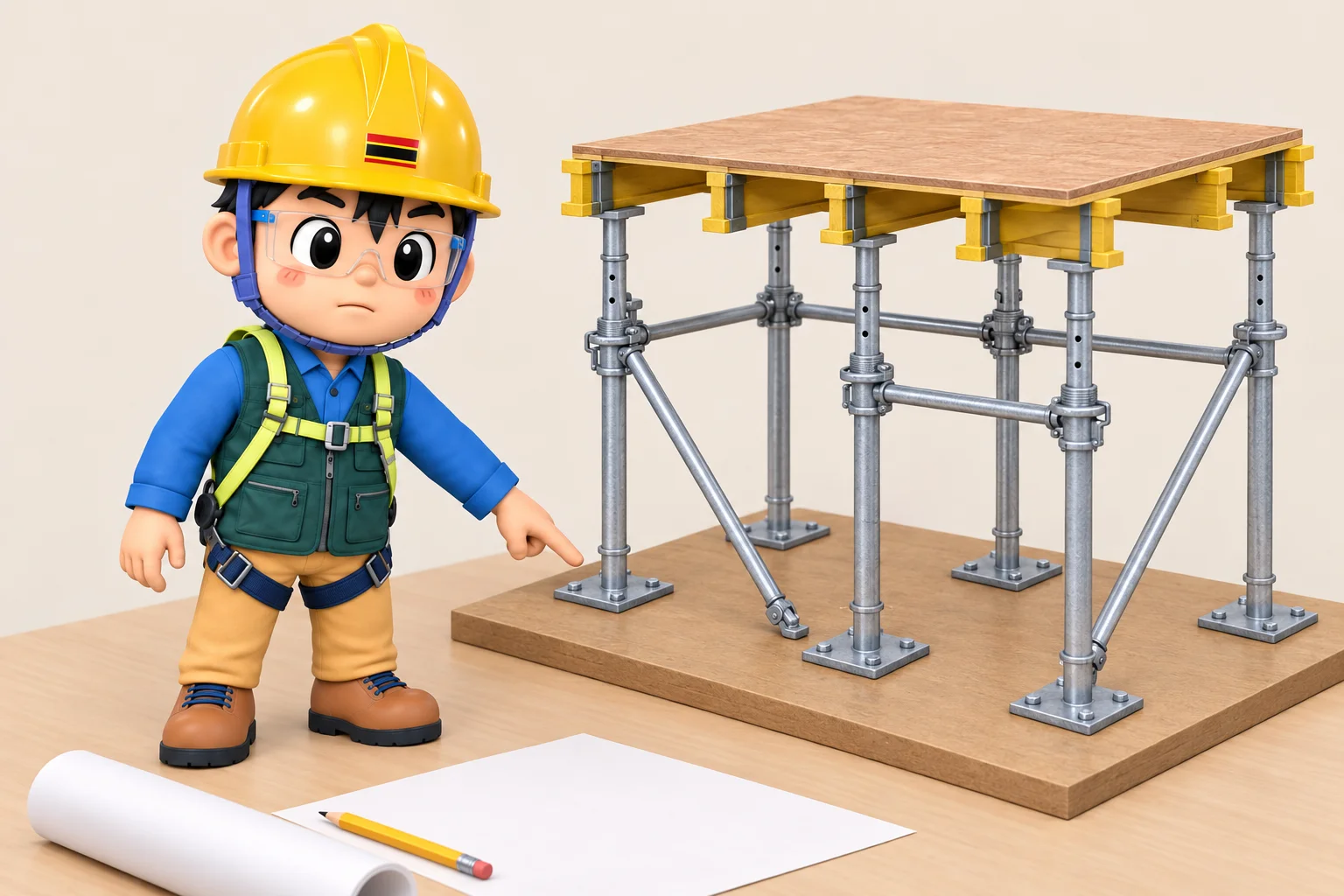
Where does the installation differ from the drawing? Who checks the supports before concrete placement, and what happens if movement or settlement is found?
Source: KOSHA (South Korea) · Korean-language video · 2026-09-24
Formwork shoring (⚠ 김민정의 특별교육 ⚠ 거푸집 동바리의 조립 또는 해체작업) ↗
Commentary: Field Safety Briefing · Original video: KOSHA (South Korea) · KOSHA website
If playback is unavailable, open the original video on YouTube.
Start drawing checks at the actual support positions
Turn the video’s drawing and support checks into identifying each drawing member against the installed member. Similar-looking materials do not establish assembly to the drawing. Compare the pouring area with the support positions below.
After viewing, assign the check of changed positions or missing members and review deviations before starting the next task. Distinguish an assembly-complete record from confirmation of readiness for use so the placing team knows the preparation status.
- Compare the drawing’s support positions directly with the installation.
Find departures from the drawing instead of memorising spacing
Regularly spaced components alone do not establish the structural adequacy of formwork and shoring. Article 331(1) of the Korean Rules on Occupational Safety and Health Standards (산업안전보건기준에 관한 규칙) requires structural review, an assembly drawing and assembly in accordance with it. Paragraph 2 specifies material, section dimensions, spacing and joint methods. Equal spacing does not make a different component or connection equivalent to the drawing.
Compare specifications and connections rather than brand or appearance. Substituting another component because stock is short, or moving a support to avoid equipment, is more than housekeeping. Determine whether the drawing's load path changes before selecting the next operation. An apparently similar component chosen on site does not replace structural review.
The video does not supply every site's slab thickness, imposed loads or inter-storey support conditions. Its visible number and spacing of supports must not become construction dimensions for another building. A more useful exercise selects part of the current drawing and asks for the components, connections and upper load locations to be explained; unresolved details return to structural review.
Following the load down to the supporting surface
Article 332 addresses settlement prevention through measures such as sole plates or pads, upper and lower restraint and slip prevention, and vertical alignment of upper and lower supports. Straight upper members do not establish the support condition if the bearing surface below is unverified. Ponding, changes in floor level and supports spanning openings are locations to compare with the drawing.
The article requires a robust bearing support capable of carrying the upper load where shoring is installed over an opening. Distinguish a pedestrian opening cover from a structural bearing member. Concealing a hole does not establish that a support can be placed over it. If the space beneath is hidden, reviewing only the materials above the cover is insufficient.
Article 332 also addresses restraint against top members overturning or slipping out and connections using dedicated fittings. Missing connections cannot be declared equivalent after improvising with wire or unrelated parts. Unverified materials or joints must be separated from readiness for concrete placement. Assembly progress and structural readiness are different decisions.
Pre-placement inspection and monitoring during placement
Article 334 requires checks for deformation, displacement and ground settlement before the day's work, with defects repaired. It separately requires monitoring during placement and stopping work and evacuating workers when abnormalities appear. A morning checklist cannot classify a newly observed change as acceptable.
The article also requires distributed placement without eccentric loading. Stockpiling materials at a different point or changing the placement sequence can change load concentration. A sequencing change intended to increase output still needs to be considered against the support structure. The response must make stopping and evacuation practicable when an abnormality is observed, not merely identify a person to notify.
Striking cannot be decided because the surface looks hardened. Article 334(4) requires compliance with the curing period in the design documents. A closing exercise can separately identify today's drawing, departures on site, monitoring positions and the information used for striking decisions. Identifying missing information is more useful to the next operation than a routine completion signature.