Before maintenance or cleaning, can the machine restart?
 SAFETY KIM
Machinery entanglement & unexpected startup
Before maintenance or cleaning, can the machine restart?
A South Korean KOSHA video about preventing unexpected machine startup during non-routine maintenance, cleaning and repair.
Key points
- Stop the machine before maintenance, cleaning or repair.
- Review startup controls, locks, key management and warning tags.
- Check supervision and responsibilities where unexpected startup remains a concern.
Apply machine-specific isolation procedures and local requirements. A warning tag or supervisor is not a substitute for energy isolation and control of stored energy.
Technical principles and management judgement: stopping is not isolation
A stopped machine is not necessarily isolated from hazardous energy. Equipment-specific procedures also need to consider stored pressure, gravity and springs as well as electrical supplies.
Define isolation points, lock control and verification before work. Before restart, confirm people and tools are clear and guards restored. Handover must account for everyone still working, including across shifts and overlapping tasks.
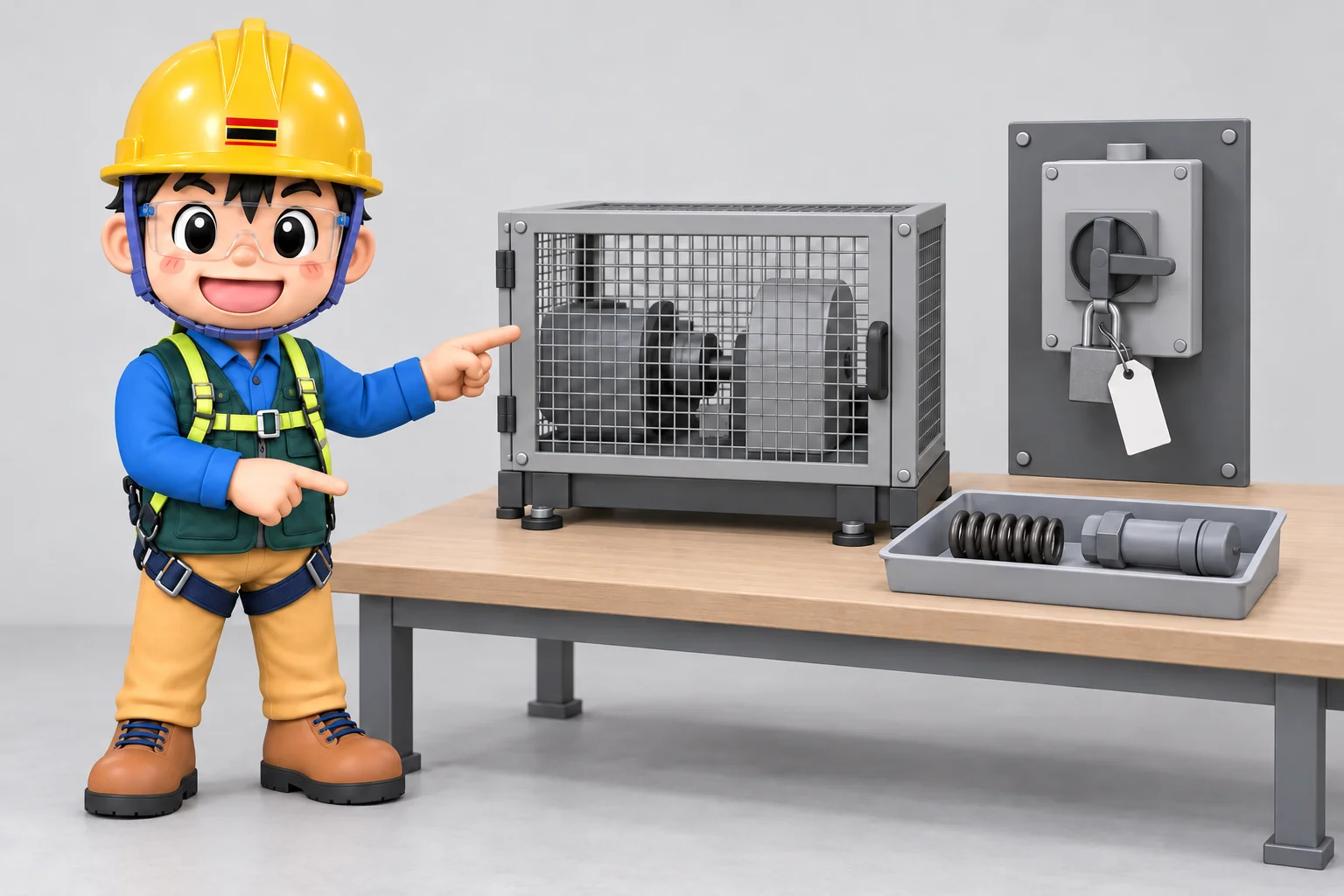
Can someone restart the machine after the stop button is pressed? Which energy sources need isolation, and who checks that restart is safe after the work?
Source: KOSHA (South Korea) · Korean-language video · 2026-09-14
Entanglement prevention ([위기탈출 넘버원 비상구를 열어라] 위기탈출 리플레이 끼임편) ↗
Commentary: Field Safety Briefing · Original video: KOSHA (South Korea) · KOSHA website
If playback is unavailable, open the original video on YouTube.
Put stopping and restart prevention into the actual maintenance sequence
Connect the video’s restart-prevention topic with the positions workers approach for maintenance or cleaning. Distinguish a stop at the control panel from preparation that prevents another person restarting the machine. Reconsider affected equipment if the maintenance scope expands.
After viewing, explain the pre-access actions and end-of-work restart sequence in order. Define what must be checked so a completion message does not start operation while people remain or tools have not been recovered.
- Check stopped status separately from restart prevention.
- Review access conditions again if maintenance scope changes.
Ask what energy remains after pressing stop
Article 92(1) of the Korean Rules on Occupational Safety and Health Standards (산업안전보건기준에 관한 규칙) requires stopping powered machinery where maintenance, cleaning, lubrication, inspection, repair, replacement, adjustment or similar work may endanger workers. A short duration or work on only one component does not remove that requirement. Consider the dangerous part being approached rather than the task's name.
Compressed gas or liquid can remain after motion stops. Article 92(4) requires necessary measures such as advance release where discharge could endanger workers, in addition to the stopping and protective measures. A gap can arise when the person seeing a stopped indication is different from the person opening the pressurised section.
Review the discharge path in relation to worker position. A falling gauge reading is different from confirmation that the complete work section is isolated. Match isolation points to the work boundary and examine paths by which another system could restore pressure. An equipment-specific draining sequence or valve operation cannot be invented from a general video.
Do not expand the exception to stopping
The exception in Article 92(1) concerns situations where the machine's structure, such as installed guards, means there is no risk to workers. A guard present during automatic operation is different from maintenance requiring it to be opened and a hand inserted. Normal operating protection cannot justify an exception after that protection is removed for the task.
Paragraph 2 addresses preventing operation by another person after stopping. Its wording on locking the starting device and separately controlling keys, or installing signs and other necessary protective measures, must not become a claim that one paper tag is sufficient for every task. The actual prevention method, key control and identity of people still exposed need to be clear for that work.
Paragraph 3 separately addresses measures such as a work supervisor where an unsuitable work method could cause sudden operation. A supervisor's presence does not remove the need to address pressure or the starting device. Hazards covered by different provisions can require measures together; assigning one role must not leave another hazard unresolved.
Hand maintenance completion over separately from restart readiness
Access conditions change if a trial run requires an open guard or further adjustment will require reaching inside again. Article 87 concerns guarding dangerous parts, while Article 92 addresses stopping and protection during maintenance tasks. Alternating production and adjustment by changing the task's label can obscure which protective conditions apply at each stage.
Restart checks can be based on the work boundary: restored guards, retrieved tools, withdrawal of exposed people and remaining adjustments. Communicate what remains prohibited while work is unfinished. Set these checks for the actual transition between access work and return to operation.
Where tasks overlap, one team's completion message is different from readiness of the whole machine. Confirm separately whether “our work is finished” includes other teams' withdrawal. An exercise can mark people and possible starting controls on a drawing and ask which confirmation is needed before each access restriction can be released.
Checks and records before work
Before maintenance or cleaning, distinguish a machine that is visibly stopped from one that cannot move during the work. A dark panel or a pressed stop button may still leave a remote start or a restart from process control possible. Identify the exact machine and repair boundary, then match the isolation reported by the equipment owner with the permit. When machine names are similar, read the local identifier and work location back to the team. Use the record for that exact machine.
Electric supply is only one potential source of movement. A part may still be turning, a raised component may retain load, or a fluid may remain pressurized after power is off. When reviewing the video, list stopping and restart prevention separately from residual energy. Before anyone enters the equipment or reaches into it, ask whether an authorized person verified the safe state under the equipment procedure. Confirm the control conditions and verification owner before any test.
An interruption or handover can change equipment status and access boundaries. Record which department confirmed the isolation and which checks remain. A still machine is an observation. A practical prompt for the handover is to point out where the machine was stopped and where restart was prevented, then read the equipment identifier back. Keep video observations separate from the work guidance supported by the legal source.