Portable grinders: are the side handle and guard in place?
 SAFETY KIM
Grinder kickback & contact injuries
Portable grinders: are the side handle and guard in place?
A KOSHA reconstruction of a railway grinding accident involving a rebounding tool. Review the side handle, guard and working position together.
Key points
- The narration identifies a missing side handle and guard.
- It describes unstable posture and strong contact with the rail before the grinder rebounds.
- It discusses nearby people and trains, equipment configuration and suitable protective equipment.
This is a reconstruction. Match the wheel, speed, guarding and PPE to the actual tool and assessment. Do not generalize a glove recommendation to every rotating machine.
Technical principles and management judgement: retain control and guarding
When a rotating grinder binds or contacts a workpiece forcefully, reaction forces can reach the operator. Review the handle, posture and workpiece together when assessing tool control.
Removing a guard to improve access removes protection. Reassess the tool or method if access is unsuitable, and follow the tool’s safe isolation procedure for wheel changes and inspection.
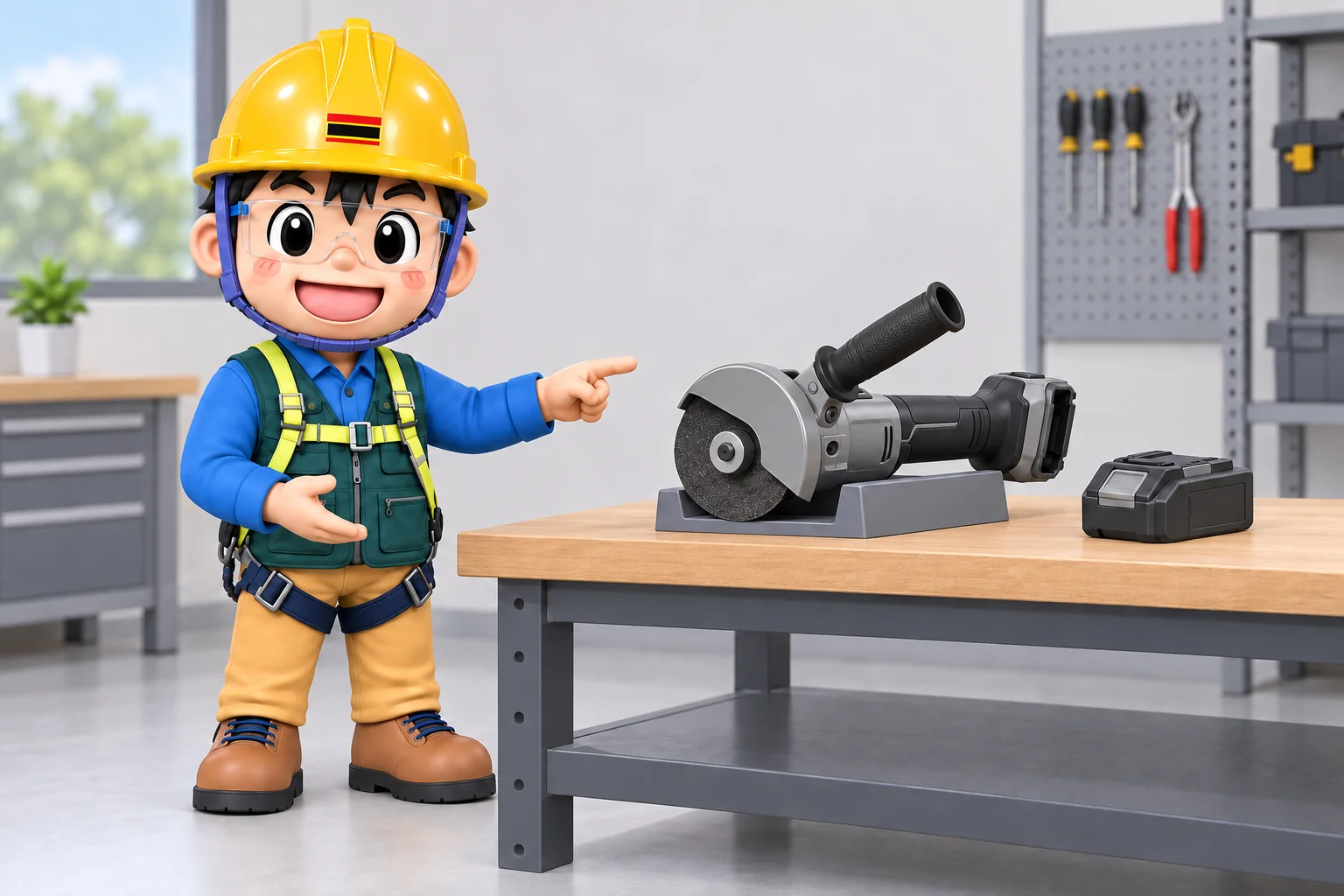
Are the handle and guard fitted as specified? Can the operator retain control when changing position, and can others be kept away?
Source: KOSHA (South Korea) · Korean-language video · 2026-09-03
Portable grinder reconstruction ([그날의 CCTV] 튕겨 나간 연삭기 |철도업 휴대용연삭기 재해 편) ↗
Commentary: Field Safety Briefing · Original video: KOSHA (South Korea) · KOSHA website
If playback is unavailable, open the original video on YouTube.
Connect the handle and guard lesson with working posture
Connect the verified handle and guard topics with the actual grinding direction and grip. A fitted handle does not establish the same working conditions if nearby structures prevent its use. Review workpiece positioning together with possible binding locations.
After viewing, establish whether the task can be reached with the guard retained. Compare the tool choice and workpiece layout rather than removing protection for access. Separate wheel changes and inspection from production in accordance with the tool’s safe procedure.
- Check that the auxiliary handle is usable in the actual posture.
- Compare methods and tools that retain the guard.
Fitting a wheel does not establish suitability
Being able to fit an abrasive wheel onto the spindle does not establish suitability for the tool or task. Article 122(4) of the Korean Rules on Occupational Safety and Health Standards (산업안전보건기준에 관한 규칙) prohibits exceeding the wheel's maximum operating speed. Check both tool speed and wheel markings; numbers in different units cannot be compared by magnitude alone. Another product's specifications cannot replace an unreadable marking.
Paragraph 5 prohibits side use of a wheel not intended for that purpose. A cutting product and a side-grinding product are not interchangeable merely because they look similar. Difficulty reaching a surface does not justify tilting the tool to apply force in an unintended direction. Suitability of the wheel and process needs evidence, not success on a different job.
An auxiliary handle contributes to control only where it can actually be gripped. If surrounding structures prevent its use and force a twisted posture, a record that the handle exists does not describe the task. Consider repositioning the workpiece or selecting another suitable tool. A demonstrated posture must not be copied to every rail, metalwork or equipment task.
A trial run does not replace checking for defects
Article 122(2) requires a trial run of at least one minute before work and at least three minutes after wheel replacement, checking the machine for abnormalities. Paragraph 3 requires checking the trial-run wheel for defects before work. It must not be interpreted as permission to spin a suspected damaged wheel to find out whether it is sound. Defect checks and trial running are separate stages.
Paragraph 1 requires a guard where a rotating wheel at least five centimetres in diameter could endanger workers. Do not convert that scope into one specification for every size and type of rotary tool. Use manufacturer information for the actual guard and its orientation. Removing it for better access does not create a normal configuration.
Prepare a trial-run position that prevents others approaching dangerous parts. Merely completing the stated duration while ignoring changes in vibration or sound defeats the purpose. Stop and inspect under the equipment procedure rather than continuing to grind to diagnose an abnormality. Power isolation during wheel replacement can be considered alongside Article 92's maintenance requirements.
The spark destination and nearby people belong in the work boundary
Attention to the workpiece can obscure people or combustibles in the spark direction. Article 241 addresses combustible protection, extinguishing equipment, spark containment and emergency measures for hot work near combustibles. A tool guard and location fire prevention perform different functions. The presence of a guard does not remove the location assessment.
Article 32 requires protective equipment suitable for the work conditions, including safety glasses where material may fly. Consider the direction of passing non-workers as well as the protected operator. If sparks face a walkway, compare separation of traffic and work with changes to working direction or workpiece position.
After viewing, separately explain compatibility of tool, wheel and guard, a position permitting two-handed control, and the area affected by sparks. If one answer is missing, trial-run time or protective equipment alone does not complete preparation. Site-specific hazards, such as train movements and pedestrians in rail work, also need the relevant local procedures.