After stopping high-pressure water jetting: checks before handling hoses and nozzles
Once the water jet stops, what must be checked before anyone loosens a hose connection?
Distinguish a brief pause from hands-on intervention
Pausing jetting and disconnecting a hose, removing a nozzle or clearing a blockage require different preparation. The latter puts a person close to components that may retain pressure. Before handling a connection, the responsible people should establish how far shutdown, restart prevention and pressure release have been completed.
The scope is high-pressure water-jetting equipment used in plant maintenance. Initial opening of process pipework is linked separately. Check the equipment-specific method of releasing pressure in its instructions, and treat blockage clearance or dismantling as an intervention rather than an automatic continuation of cleaning.
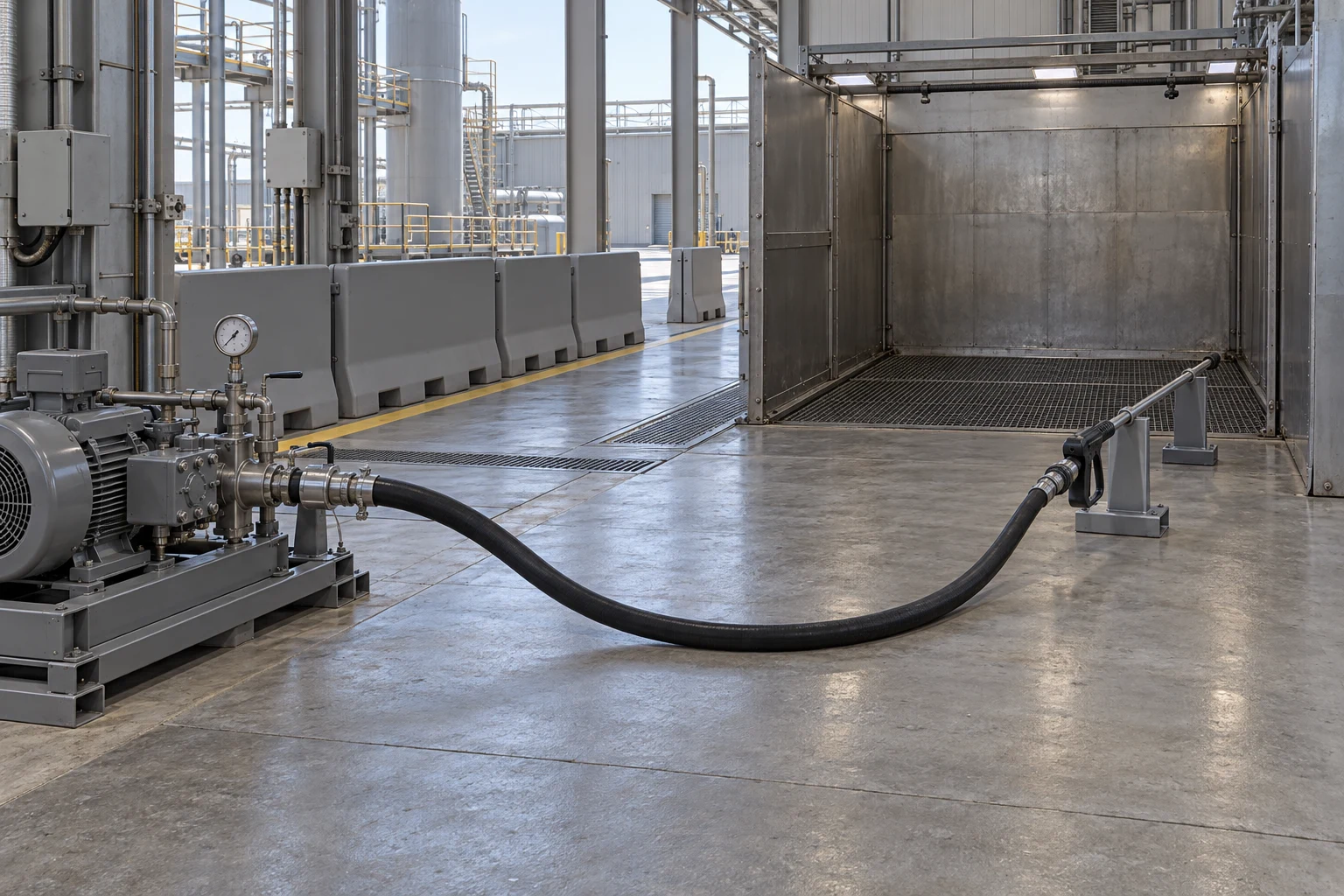
- Pump: Before touching components, confirm completion of shutdown and restart prevention.
- Hose coupling: Before disconnecting, verify pressure release by the designated method.
- Lance support: Before moving it, confirm pressure release and decide its direction and support position.
- Work boundary: Before restarting, check separation of the walkway and jetting area.
The legal requirement extends beyond stopping the machine
Article 92(1) of Korea’s safety and health standards requires stopping powered machinery for maintenance, cleaning, inspection and similar tasks where workers could be endangered. It also contains an exception where the machine’s construction, such as a cover, removes that risk. Paragraph 2 requires protective measures against operation by another person, such as locking the starting device and separately managing the key, or installing a sign.
Paragraph 4 adds measures such as prior release where compressed gas or liquid inside equipment could escape and endanger workers, in addition to paragraphs 1–3. Application therefore calls for checking both the stopped state and the treatment of compressed fluid. The discharge direction and receiving location need an equipment-appropriate safe procedure.
Match the verification point to the connection
First identify whether the indication at the pump represents the pressure section containing the connection to be handled. A valve or blockage in between can change what a verification point tells you. Match the equipment instructions to the actual connections and use the specified verification method. Prepare a safe pressure check rather than loosening a coupling as a test for residual pressure.
Before intervention, separate the questions: who stopped the equipment, who controls restart, where pressure release is verified, and who communicates clearance to handle it? These practical questions make an equipment-specific procedure concrete. Valve sequences and waiting periods must be established for the equipment and conditions rather than assumed universal.
- ShutdownConfirm the stopped state
- Restart preventionConfirm who controls starting and by what means
- Pressure releaseCheck the designated verification point and discharge route
- Component handlingReceive the verification result before the planned intervention
Inspect the hose, coupling and nozzle together
Safe Work Australia’s water-jetting guidance addresses hose and coupling compatibility and checks for wear or damage. After stopping, isolation and pressure release, inspect hose damage and tight bends, and loose or damaged connections. Check replacement parts against the equipment instructions and part information instead of relying on a similar appearance.
Before placing or moving a nozzle, establish its direction and secure support. A person arriving next could mistake its resting position for clearance to service the equipment. Hand over the verified shutdown and pressure-release status together with the scope of the next task.
Separate the jetting area from pedestrian access
The same Australian guide recommends a physical boundary for the work area, considering hazards such as flying debris. Before restarting, check for other workers’ access routes and adjust routes where hoses cross pedestrian movement. This is practical guidance, not an Australian distance being presented as a Korean legal limit.
If another team has moved materials or a barrier during the pause, compare the original work area with the area now needed for jetting. Where the pump and nozzle operators cannot see each other, settle how the restart signal will be communicated. Distinguish completion of inspection from confirmation of people’s positions in the restart handover.
Tell clinicians about the high-pressure exposure
A fluid-injection injury can be more serious than its surface appearance suggests. HSE’s hydraulic-injection alert emphasizes immediate professional medical treatment. If such an injury is suspected, stop the task, seek medical assistance and explain that the work involved exposure to a high-pressure fluid.
Select jetting pressure and nozzle performance for the equipment and task conditions. Finalize the task procedure using the equipment instructions, residues on the item being cleaned, waste handling and the work environment. Cleaning involving entry inside equipment also requires a separate check of confined-space preparations.
Inspect hose restraints alongside the connections
At a hose connection, inspect both the coupling and the means of limiting movement if it separates. Queensland’s RSHQ water-jetting alert addresses suitable hose restraints. Check the specified components and installation method; a restraint does not replace inspection of the coupling. Check the restraint arrangement against the connection design and the manufacturer’s procedure.
If a leak or connection defect caused the stop, distinguish replacing the part from verifying readiness for use. US OSHA’s energy-control standard calls for checking that nonessential items are removed and components are operationally intact before restoration. Applied to jetting, the handover should identify the connections checked and outstanding checks, not merely state that a new part was fitted. Follow the equipment instructions for assembly and testing.
When verification must continue after pressure release
If an intervention lasts longer or supply conditions may change after pressure release, decide how long verification must continue. US OSHA requires continued isolation verification where stored energy could reaccumulate dangerously, until servicing ends or that possibility ceases. For jetting, discuss this possibility with the technical lead for the pump supply and hose section being handled. Use verification points suited to the isolation arrangement and maintenance procedure rather than invent a universal time interval.
If one person observes pressure reduction and another handles the connection, communicate the result with the equipment and work location identified. An unqualified message that pressure is released could be mistaken for the state of another hose. OSHA calls for the authorized person to verify isolation and deenergization before intervention. In an area with several jetting units, identify the particular unit and connection section before the person carrying out the work approaches.
Consider the material removed and the runoff path
Consider not only the supplied water but also removed material and the path of runoff. RSHQ’s alert includes people and environments outside the jetting task when considering noise and runoff. This makes adjacent traffic and discharge destinations relevant when moving hoses or clearing the floor during a stop. Review where water collects or reaches other work areas rather than define the boundary solely around the nozzle.
Where residues or coating composition are unclear, obtain the material information before work. Safe Work Australia recommends obtaining safety data sheets and considering exposure during waste handling. Plan cleanup separately from the end of jetting, including suitable protection, handling arrangements and material information for the people collecting the removed material.
The final handover before repressurizing
On receiving a maintenance-complete message, locate not just the nozzle operator but also people handling components around the hose and pump. OSHA requires checking that people are safely positioned or clear before restoring energy and notifying affected workers before startup. If noise or obstructed sightlines hinder coordination, specify who receives the restart message and who confirms readiness. Use agreed communication rather than rely on pump noise to convey the state of the task.
A single sign-off for preparation and maintenance can leave the next person unsure what was completed. Record the replaced component, checked connections, unresolved defects and return-to-use conditions separately. RSHQ identifies pre-start and ongoing maintenance records as important. Keep the record focused on the reason for this stop and its correction; distinguish defective components from serviceable ones so they are not selected again.
If a test run is needed during the intervention
When a test run is needed, distinguish the transition from maintenance to testing. US OSHA separates clearing tools and materials, safely positioning people, removing controls, testing, and reapplying isolation afterwards. For a jetting unit, use this distinction to confirm people have moved clear of the nozzle and hoses for the test and that the maintenance state is re-established before handling connections again.
Agree the function to be tested and where the maintenance worker waits. Follow the end-of-test message with shutdown, isolation and residual-pressure checks before access resumes. This is a way to distinguish testing from servicing in the manufacturer’s procedure, not a substitute valve-operating sequence.
Related reading
Original sources
- Rules on Occupational Safety and Health Standards, Article 92(1), (2) and (4)
- Safe Work Australia — Guide for managing risks from high pressure water jetting, 2013, §§4.3, 4.7, 4.9 and 6.6
- HSE — Hydraulic injection injury, FOD 4-2014
- Queensland RSHQ Safety Alert 102 — restraints, runoff and maintenance records (Australian guidance)
- US OSHA 1910.147(d)(5)–(6), (e)(1)–(2) — stored energy and restoration (US requirements)