Check tank bund penetrations and hand over drainage status
Match tank and containment boundaries, check penetrations and drainage controls, and connect liquid-handling decisions and restoration of normal conditions to responsible owners.
Identify the tank and its containment boundary
When liquid is found around a storage tank, first match tank and bund identities. Recent rainfall alone does not establish that the liquid is ready for handling. Identify who can confirm the stored substance, connected equipment and normal state, and report the observed location.
A bund limits the spread of liquid released from a tank. Looking only at standing walls can miss penetrations and drains crossing the boundary. From a safe external position, match tank identity and wall extent, then locate penetrations and drainage controls against drawings and management records.
Closely spaced tanks can make nearby valves or collection facilities easy to confuse. Record the tank, bund area and inspected part together. Where ownership or routing is unclear, await confirmation and distinguish verified from unresolved areas in the handover. Link the observed position to an externally identifiable fixed feature. Record inaccessible areas and why they were inaccessible so the reported visual inspection scope remains accurate.
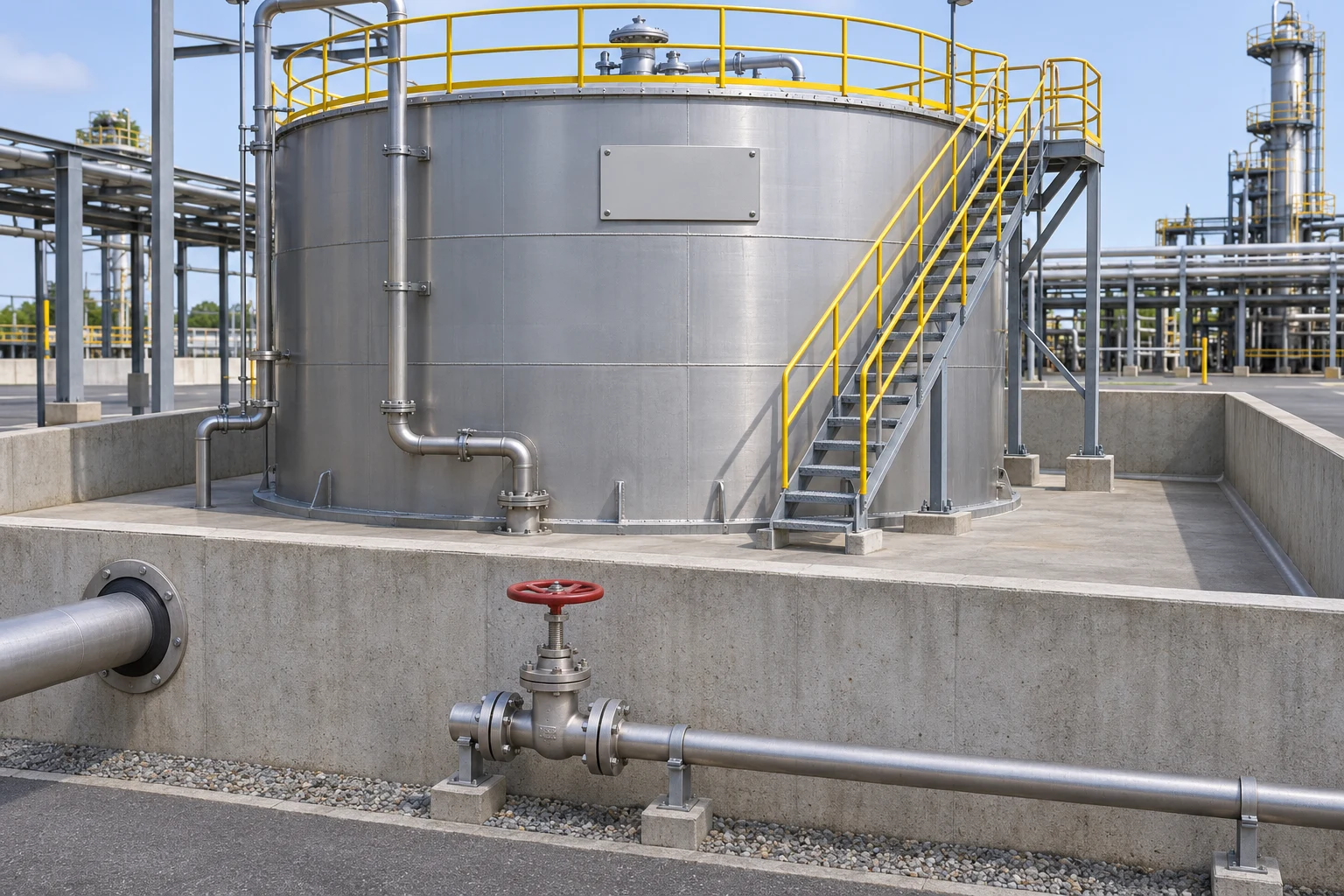
- Penetration: record visible gaps and damage around the pipe.
- External drainage control: match identity and normal state to responsible records.
- Wall-floor boundary: distinguish and report observable cracks or damage.
- Tank identification plate: match the tank to its bund area.
Establish applicable requirements and the normal state
Article 272 of Korea’s Occupational Safety and Health Standards Rules addresses containment against spreading releases from tanks storing the specified hazardous substances as liquids. Confirm the substance and equipment fall within its scope instead of carrying over another tank’s installation or drainage arrangements.
KOSHA Technical Support Regulation C-C-88-2026 covers bund structure, pipe penetrations and drains, including the need to follow other applicable laws for substances within their scope. The equipment owner connects applicable conditions to records and communicates the normal state and locations to check.
Identify the drainage control, its location and the means of checking its state from outside. A visible handle and a verified normal drainage route are different findings. If markings or the controlled drain are unclear, request identification and verification instructions before any operation.
Locate and record penetration gaps and damage
A pipe penetration joins different materials at the bund boundary. C-C-88-2026 addresses settlement and vibration effects, contact between sleeve and bund, and sealing between pipe and sleeve. Locate each penetration and distinguish visible gaps, damaged filling and surrounding cracks.
Record the limits of what could be observed. Parts hidden behind pipework remain unverified. Connect a locatable overview with the observed condition so the equipment owner can establish the scope of further inspection.
Filling a gap with readily available material can overlook required materials and repair conditions. Report its location and state for the responsible owner to define action. After repair, distinguish the treated segment, verification result and remaining unknown areas so the next checker understands the scope.
Handover sequence
| Stage | Owner | Decision or check | Record |
|---|---|---|---|
| Identify | Site and equipment owners | Tank, bund, applicable requirements | Identity, area, records |
| Check boundary | Verifier and equipment owner | Visible penetration, wall, floor condition | Location, damage, unknowns |
| Trace drainage | Equipment owner | Drain and external control match | Route, indication, difference |
| Decide handling | Authorised owner | Liquid information and site procedure | Verification, decision, owner |
| Verify completion | Handling owner and verifier | Normal state restored, remaining issues | Completion conditions and results |
| Hand over | Owner and recipient | Current state and open actions | Part, next check, responsibility |
Match drains to their external controls
Trace the internal drain to the external control valve. The regulation addresses drains for rainwater and similar liquid, with operating valves outside the bund. Equipment conditions such as indoor installation can differ; use drawings and records to establish the actual arrangement.
Check externally identifiable controls and state markings, and confirm their meaning with the responsible owner. Retain unclear piping segments as unresolved. Since exploratory valve movement can alter drainage, first use available information and the authorised owner’s procedure.
Where different discharge routes are close together, record their separate functions and ownership. Tank condensate outlets and bund rainwater drainage are distinct. Establish drawing-to-equipment correspondence before assuming one nearby valve controls both. Record discrepancies between drawing identity and physical markings. Obtain the owner’s resolution of the documented and physical routes to reduce repeated confusion at the next shift.
Connect liquid-handling decisions to the responsible owner
Report the time, location and equipment state when pooled liquid is found. Discovery after rain differs from verification of whether stored material has leaked. Appearance or perceived odour cannot establish that the liquid is suitable for rainwater handling; connect the decision to the site procedure and responsible owner.
Separate available information from what still needs confirmation. Pooling location, equipment identity and previously reported abnormalities can support the handover. If liquid condition or treatment routing is unresolved, retain that uncertainty and do not mark drainage preparation complete.
Where a release or vapour presents a suspected urgent hazard, remain in a safe position and use the site emergency response system. Avoid entering the bund or approaching the liquid to investigate first. Communicate location and observation limits so the responsible team can establish access and handling conditions.
Distinguish handling in progress from the normal closed state
C-C-88-2026 addresses keeping the control valve closed except when draining rainwater or similar liquid, with its state readily checkable from outside. Distinguish normal conditions from authorised handling in progress. Identify responsibility and progress rather than recording only that drainage is underway.
An authorised owner determines whether and how handling proceeds under the applicable site procedure. Receive the assigned role and verification scope, and report changed conditions. At a shift change or reassignment, leave the current stage, next check and identified recipient.
Maintaining the normal closed state and checking its indication belong together. Report markings or identities that are difficult to verify externally. Resolve them through equipment-specific management so the next person does not mistake a marking alone for confirmation of the actual control state.
Recheck the boundary and open issues after completion
After receiving a completion report, connect the owner’s completion conditions to the present state. Distinguish return to the normal drainage-control state, the means of verifying it and remaining abnormalities. A finish time alone can omit the containment conditions that matter to the next person.
Previously identified damage at penetrations or wall-floor boundaries needs a separate action status. Reduced liquid does not establish that structural damage is resolved. Consolidate reported issues and unverified areas so drainage completion and repair completion remain distinct.
The KOSHA Practical Guide’s tank checklist supports checking penetration sealing, holes, cracks and damage. Connect leakage detection and collection-facility status to relevant records. Keep detector indications, penetration observations and drainage-control conditions as separate findings.
Leave a handover the recipient can trace on site
Include tank and bund identity, before-and-after conditions, checked locations and outstanding actions. Make locations traceable so the recipient can continue verification. Use the site management format and separate completed checks from items awaiting a responsible response. When photographs are used, connect them to observation time and direction and identify conditions outside the view. Confirm receipt and the recipient’s next check so outstanding actions survive the completion notice.
The recipient compares the current state with the normal condition and receives responsibility for any difference. Record unclear drain identities or unverifiable states. Distinguish actual findings from remaining review instead of assuming somebody checked them during the previous shift.
Bund management connects the wall to its crossings and the condition after handling. Link penetration damage, drainage-control identity, pooled-liquid decisions and completion handover to their respective owners. Communicate the verified scope and leave each changed or unresolved location with a next responsible person.