Match confined-space measurement points and records to work locations
Select points from the structure and working positions, then hand over each location, time, condition, result and unresolved area together.
Connect the space to where people will work
Record where a result came from as well as the space name and reading. A distant work position, internal partition or recess can change the locations that need examination. Compare the request with the structure to identify entry scope, travel and working positions before selecting measurement locations.
Article 619 of the Occupational Safety and Health Standards Rules requires confirmation of work information, oxygen and hazardous-gas results and follow-up actions, and possible leakage, ingress or generation during the work. Plan measurements for the same actual scope. A familiar space name can conceal a move into another compartment, so use a drawing or clear site description to identify locations.
Under Article 619-2, a designated person with relevant knowledge and practical experience performs measurement and evaluation using provided equipment. Confirm familiarity with hazards, equipment, methods and evaluation criteria. If different people label points and evaluate results, verify that their descriptions refer to the same positions. Also identify safe access and areas where approach remains on hold.
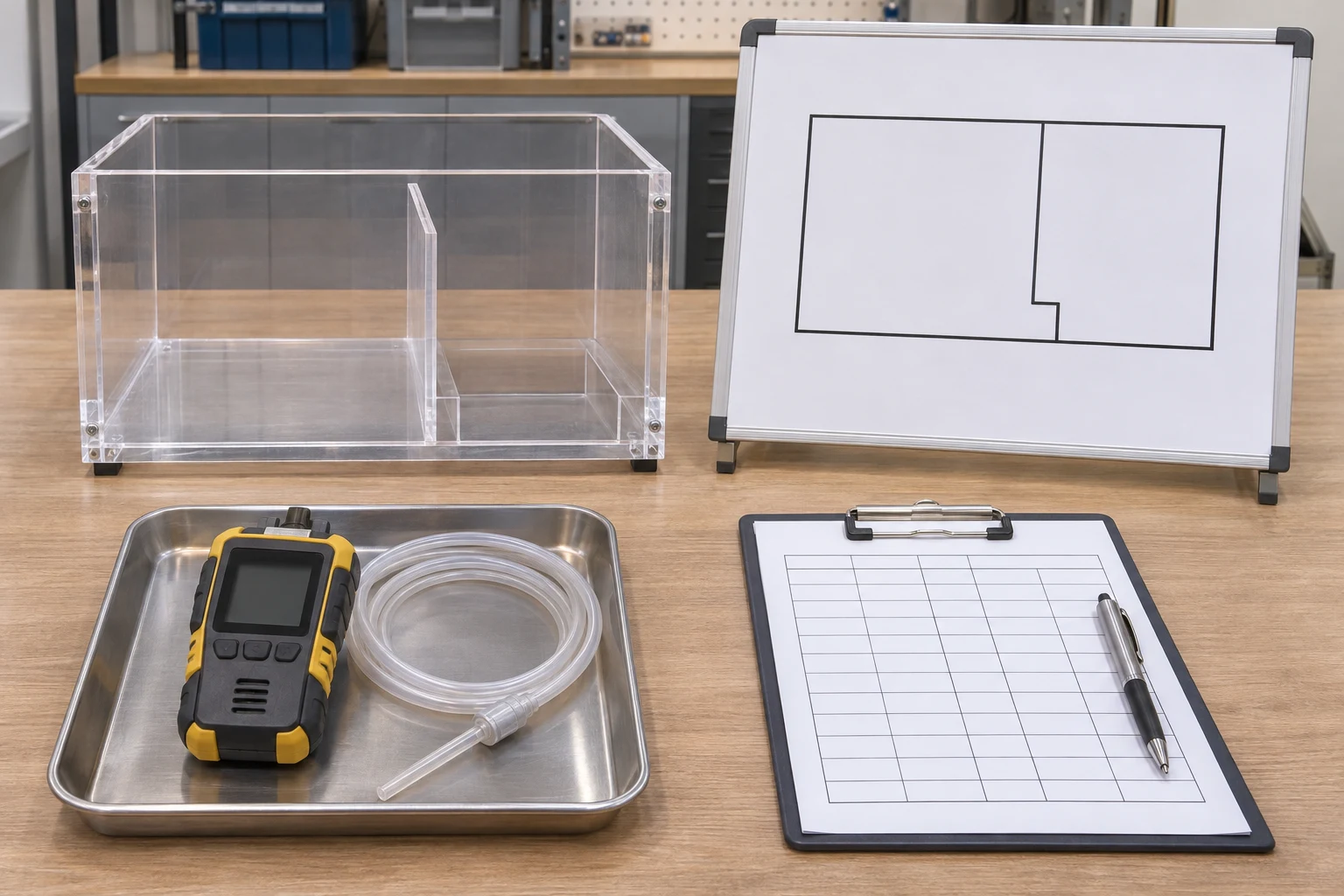
- Space model: examine partitions, recesses and actual working positions together.
- Location board: distinguish heights and horizontal positions so points can be found again.
- Instrument tray: verify suitable equipment and accessories for the target and sampling path.
- Location record: retain point, time, conditions, results and outstanding checks together.
Consider both vertical and horizontal positions
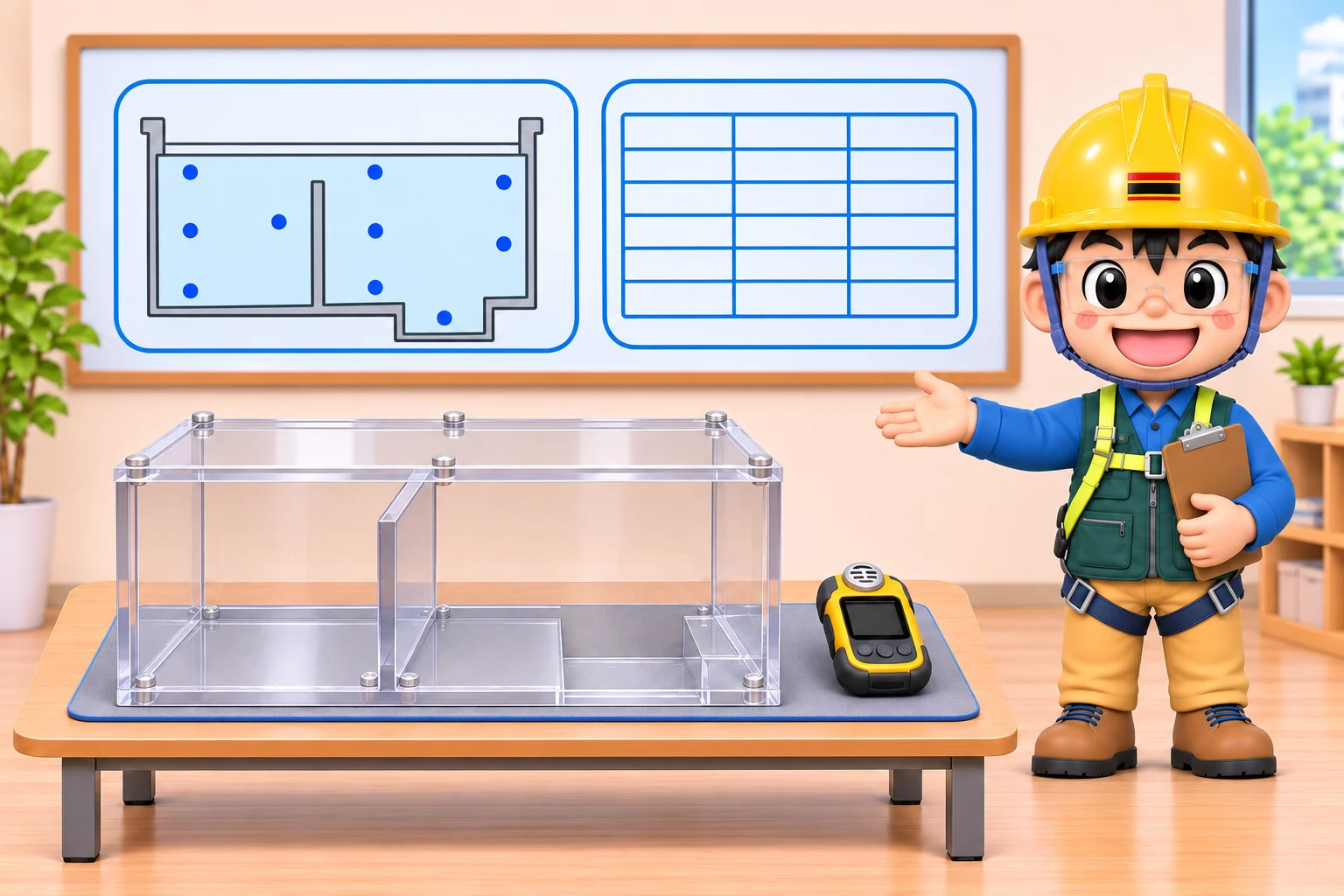
KOSHA Technical Support Regulation (KOSHA GUIDE) E-G-18-2026 considers vertical and horizontal positions, breathing locations, area and depth when selecting points. Examine separated compartments and working positions as well as upper and lower levels. The designated measurer should review the structure, airflow influences and work conditions to determine the necessary coverage.
Review spaces behind partitions, recesses and possible stagnant areas within the overall structure. Working posture can change breathing height. Where a plan view is insufficient, connect section information and site records. A brief reason for selecting each point helps the next person identify omissions and assess changes in work position.
Give each point a description that can be located again. Supplement vague labels such as entrance or inside with fixed features and height relationships. Keep inaccessible or unverified areas explicit. Do not substitute a neighbouring result; identify the additional method and owner needed and carry the uncertainty into readiness decisions.
Compare target substances with the reasons for selecting points
Identify target substances using equipment history and the planned work. Review previous contents, substances to be used and possible ingress with supporting information and responsible personnel. The designated measurer should verify that the equipment can measure the targets. Keep unresolved targets separate and do not equate the instrument’s displayed channels with assessment of every hazard.
Connecting substance information with the structure helps identify additional locations to examine. Review possible ingress connections and areas affected by the work. Avoid assuming a substance exists at only one height; apply the relevant method to the actual conditions. Include working positions and compartments that may have different atmospheric conditions.
Escalate conflicting substance information to the person deciding the measurement scope. Have relevant departments verify information where equipment names or old records cannot establish present contents. Separate known targets from open checks and confirm suitable equipment and methods. Retain this preparation with work information so the evaluator understands the assessment’s coverage.
Handover sequence
| Stage | Owner | Decision or check | Record |
|---|---|---|---|
| Confirm scope | Requester and measurer | Compare structure, work positions and targets | Space, scope, unknowns |
| Select points | Designated measurer | Review heights, plan positions, breathing zones and compartments | Point descriptions and reasons |
| Prepare method | Designated measurer | Verify safe position, equipment and accessories | Equipment combination and inlet position |
| Measure and evaluate | Designated measurer and evaluator | Match actual point to the result | Name, time, place, result |
| Review change | Work owner and measurer | Assess resumption and changed conditions | Changes, additional points, actions |
| Hand over and retain | Measurer and recipient | Match assessed coverage to work locations | Applicable results, unknowns, receipt |
Distinguish the measurer’s position from the sampling point
Plan separately where the person stands and where the air sample is taken. For external sampling, verify the inlet location so surrounding air is not recorded as the internal point. Assess fall and exposure hazards near openings. Prepare a safe means of locating the point rather than leaning into the space to improvise a check.
E-G-18-2026 addresses pumped sampling, suitable accessories and clearing air from sampling lines. Verify that accessories suit the equipment and target substance and follow the applicable instructions. Kinks or uncertain connections require checking whether air from the intended point can reach the instrument. Record the verified equipment combination and conditions of use.
When moving between points, ensure the location label and displayed result refer to the same sampling state. Align measurement and recording order to prevent carrying the previous result into the next record. Coordinate point changes, the verified instrument method and reading time. Resolve uncertain location or equipment condition before using the result for evaluation.
Keep time and conditions with each location result
Article 619-2 requires records of the measurer and evaluator, time, place and results, with retention. A reproducible point description helps review multiple readings from the same space. Distinguish each position and height. A date alone can leave pre-work results confused with evaluations after conditions changed.
Connect results with the state of work and relevant conditions at measurement. Distinguish initial preparation, preparation to resume and checks after ventilation or surrounding-work changes. These details help explain differences between results. Separate verified facts from unresolved conditions and communicate the same coverage to the evaluator.
Check that units remain connected to point identifiers when completing or transferring records. Carry location, time and evaluation together into other documents. Keep corrections traceable and never mark an unmeasured point as assessed. Organise the record so a replacement owner can locate the actual points and outstanding checks.
Review affected locations after changes in work or conditions
Article 619-2 requires measurement and evaluation before starting, including resuming after a temporary interruption. Review present scope and conditions as well as previous records. If working positions have moved, check whether existing points cover them. Have the designated measurer review changed areas and additional locations for resumption preparation.
E-G-18-2026 addresses additional measurements according to timing and changed conditions. Examine which points may be affected by ventilation problems, changed ingress possibilities or altered work. Old readings alone cannot establish a changed condition. Communicate the location and time of a change to the work owner and measurer so follow-up checks can be arranged.
Distinguish new measurement times and conditions rather than deleting earlier records. Separate repeat results at existing points from newly added points. Communicate conditions requiring action and verify their disposition. Keep site postings and handover information consistent so workers can identify the applicable results and outstanding conditions.
Hand over assessed coverage and unresolved areas together
Pass the locations measured and outstanding coverage along with readings and evaluation. Identify omitted points on the drawing or description. The preparation owner should compare planned work positions with the assessed area and connect necessary follow-up actions. Match point identifiers and scope rather than relying only on a shared space name.
KOSHA’s Practical Guide covers oxygen and hazardous-gas measurement before starting and resuming work, and equipment preparation. Distinguish equipment availability from completed evaluation at the required locations. At handover, make it possible to identify who checked each position, when, and what remains. Use verified results alongside work information in readiness decisions.
Article 619’s entrance information includes measurement results and follow-up actions. Resolve differences between posted information and actual scope. Explain open conditions or location restrictions using clear position descriptions. Confirm that the recipient understands the applicable area and further checks as well as acknowledging receipt.
Organise records so the next measurer can find the same points
At closeout, check that point names allow the locations to be found again. Link temporary markers to enduring equipment features or drawing positions. Retain changes in work position and reasons for additional measurements to support later preparation. Keep results, evaluations and location information connected in storage.
Before reusing a point list, compare current structure and work. Changes to partitions, connections or access positions require review of its applicability. Add new points with their reasons and explain unused points. Never reuse previous readings as measurements for the next task; distinguish the measurements and evaluation performed under present conditions.
Location-based records should connect the space, actual work positions, conditions, results and follow-up actions. During preparation, check coverage; during measurement, verify that the intended locations were assessed using suitable methods; at handover, convey coverage and uncertainty together. Maintaining these links makes the affected areas identifiable when conditions change.