English names and summaries of Korean laws are unofficial translations. The Korean text on the Korean Law Information Center (law.go.kr) prevails.
Shelter from rain does not remove electrical risk: outdoor rebar cutting
Key terms in Korean and English
- serious accident (중대재해, OSH Act)
- collapse (무너짐)
- electric shock (감전)
- earthing (접지)
- residual-current device (RCD) (누전차단기)
- mobile scaffold (이동식비계)
At a glance
On 8 August 2022, 1 worker cutting rebar in the rain at a Gyeonggi Province construction site died from electric shock.
The cutter’s insulation and the additional distribution board’s earthing and earth-leakage protection were defective.
From preparation to the aftermath
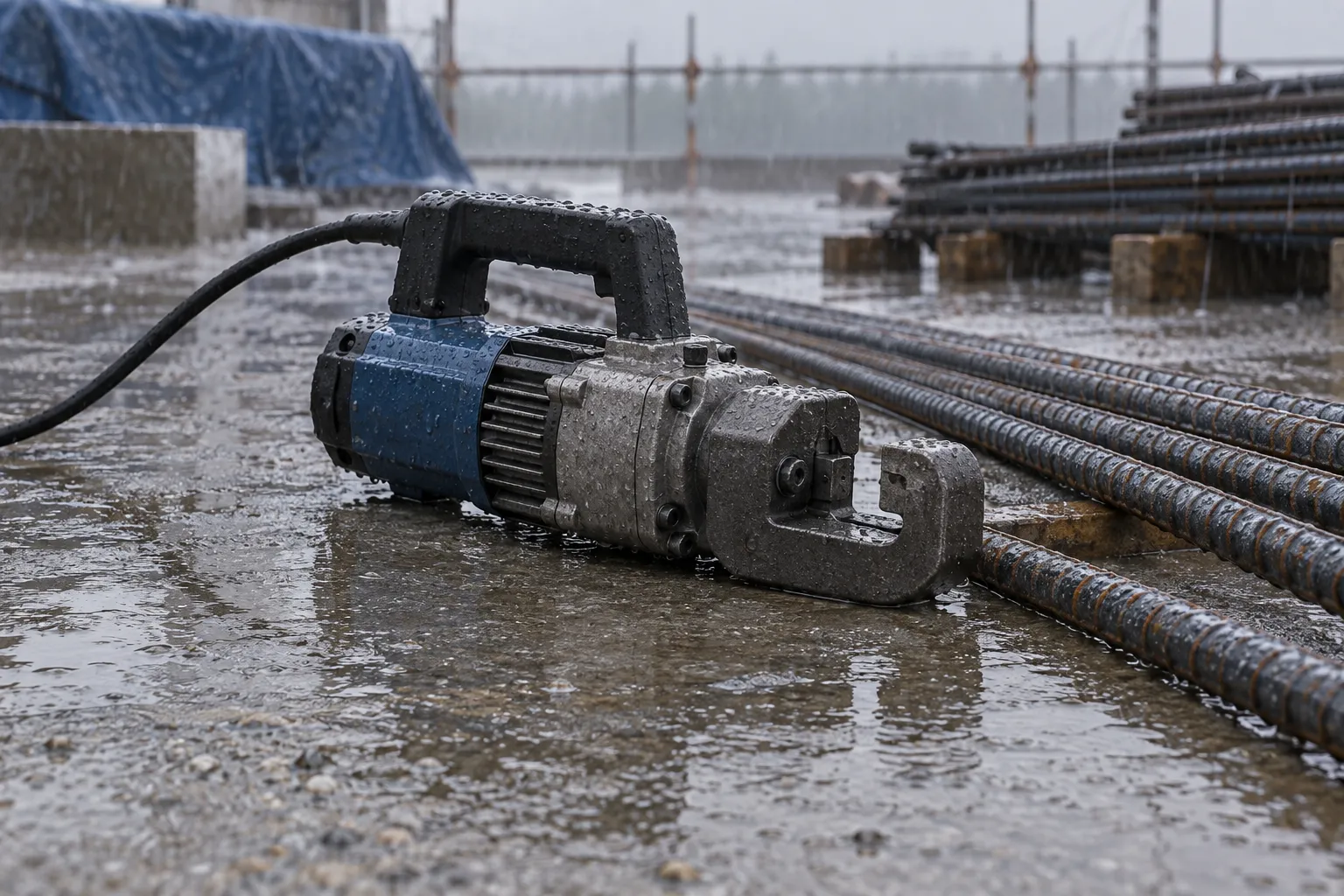
On 8 August 2022, rebar cutting continued at a construction site in Gyeonggi Province. Rain was falling and a heavy-rain warning was expected for the afternoon. Workers put the cutter beneath a mobile scaffold with a top deck to keep rain off it. The ground containing rebar, cables and the metal scaffold remained exposed to the outdoor conditions.
Rebar measuring 8 m was cut for handling and use on other floors because storage space was limited. Cutting resumed after lunch. The rain alert was raised to a warning, but no instruction to stop followed. Under pressure from a delayed schedule, the combination of a powered tool and wet conditions was not reassessed.
A colleague heard a brief cry and turned to find the cutter operator collapsed. Without emergency contact information or response training, the colleague went to the office and then found managers in the canteen. The site manager ordered power isolation, but the worker died.
The initial account referred to supply from the earthed main distribution board. MOEL inspectors compared police photographs from the accident day with the site the following day. A closer additional board was present, and the photographs showed that its earthing had not been connected. Looking only at the repaired condition before inspection could have concealed the original defect.
According to the investigation described in the white paper, the cutter had insulation failure and the additional board’s RCD was faulty. Leakage could pass through rebar and the metal scaffold to the worker. An external technical-guidance body had identified the earthing defect 5 days earlier, but it had not been corrected before use.
Investigators also found that safety-management documents had been prepared retrospectively after the accident. Possessing documents was not the same as taking effective action on site. The regional office stopped part of the work and required a prevention plan.
Trace the electrical path from the tool to the added board
Insulation is the first protection against current escaping its intended circuit. An undamaged exterior does not establish the condition of internal insulation. Here, a defect inside the cutter combined with contact through nearby metal. A pass mark on the tool alone would not verify the path from the added board to the working position.
Earthing limits dangerous potential on exposed metal during a fault and assists protective operation. An RCD is a separate device that disconnects supply in response to current imbalance. The presence of either does not remove the need to check the other. An earthed main board does not by itself verify continuity through a newly added board, socket and extension lead.
Adding a board near the work reduces cable distance but creates more electrical connections. Trace the actual socket, its protective device and its earthing connection. Assuming that the main board shown on a drawing protects every endpoint can leave added connections outside the inspection scope.
A scaffold deck only partly shields a tool from rain above. Wet ground, rebar, metal frames and cable connections remain. Selecting a work location requires checking surfaces beneath the feet and metal within elbow reach, not only overhead cover. Neither residual moisture nor an insulation defect disappears simply because rain stops.
Briefly running a tool is not an insulation or earthing test. A faulty RCD may still supply power. Availability of electricity does not establish that protection works. Remove defective equipment from use and have a qualified person verify it using the appropriate equipment and circuit checks before reuse.
Weather changes are a reason to revisit an earlier work decision. A worker improvising rain cover may signal a condition the plan did not address. Relocate cutting or stop until safe conditions are established. Management should not leave an individual worker to weigh schedule delay against electric-shock risk.
Grabbing a collapsed person or connected metal during a suspected electrical incident can endanger the rescuer. Workers need a way to isolate the supply safely and summon emergency help before approaching. Isolation locations and contact arrangements should be known before the tool is used, rather than searched for after an accident.
Photographs mattered because they showed the condition before repair. Earthing connected during inspection did not establish that it had been connected at the accident. Supply point, lead and repair timing needed to agree. Routine checks likewise should not substitute a test at another board for verification of the circuit actually used.
Repair and return to work need a verification step between them. Separate defective tools so another person cannot take them back into use, and establish what was corrected before releasing repaired equipment. If a board is moved or an extension added, check whether prior verification still covers the new configuration.
The external earthing finding did not lead to equipment being taken out of use. The finder, person authorised to arrange repair and equipment user may be different people. Beyond a repair request, verify that use is prevented while the defect remains and that protection is restored afterwards.
Completing paperwork afterwards does not correct an electrical path. The assessment needs to identify the actual cutter, added board and wet position. Workers familiar with the task should explain which socket and lead are used so connections differing from the drawing are not missed. Records should capture the result of that examination.
Weather protection and electrical protection are both necessary. A roof alone is insufficient where the person still works on wet metal. Even after equipment repair, do not leave the bench and leads exposed to water; use the stop to correct both the electrical arrangement and the environment.
What the comparison shows
The wet-season example on page 155 of the same white paper describes fatal shock involving damaged portable-cable insulation on a wet floor. The rebar-cutting accident involved the tool’s internal insulation and an added board; the comparison began with cable-sheath damage. Failure anywhere between the tool and supply can make surrounding moisture and metal part of a hazardous path.
Applying both cases means going beyond separate pass marks for tool, cable and board. Verify protection through the actual connected system and change routes that place leads on wet ground. An identified defect needs removal from service and confirmation of repair, not merely a note that repair is planned.
Causes and protective layers
| Layer | At the time | Workplace action |
|---|---|---|
| Insulation | Cutter insulation failure | Remove the defective tool and arrange qualified checks |
| Earthing | Missing connection at the added board | Verify continuity through to the endpoint |
| RCD protection | Faulty protective device | Pre-use function checks and replacement |
| Corrective action | Earlier finding left unresolved | Link removal from use, repair and release |
| Rain response | Work continued after the warning escalated | Reassess changing weather and site conditions |
Investigation and proceedings
The regional office stopped part of the work and required a safe-work plan. In April 2024, the representative received 1 year’s imprisonment, suspended for 2 years; the first-instance judgment became final.
Why the consequences were severe
Insulation, earthing and residual-current protection all failed to provide effective protection. Rebar and scaffolding close to the worker allowed leakage to extend beyond the tool. Covering the cutter from above did not change those electrical paths.
A colleague noticed the accident but could not immediately connect discovery with isolation and emergency contact. This is why new arrivals also need clear isolation and contact arrangements. Responses should be organised by work location so a hazardous supply does not remain energised while someone searches for a manager.
Questions at the work position
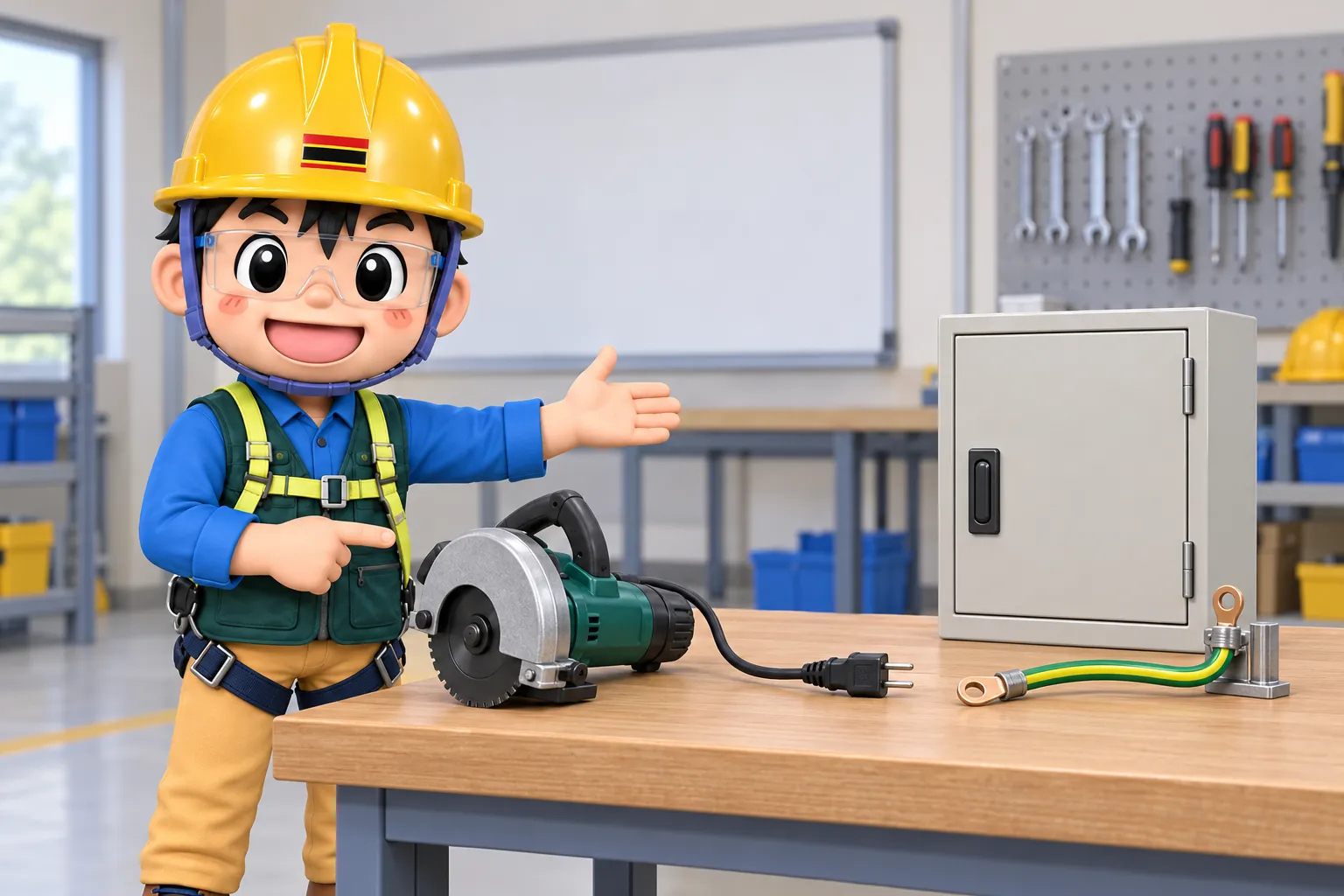
| Question | What to examine |
|---|---|
| Which circuit supplies the tool? | Trace the actual socket through added and main boards |
| Was the earthing repair completed? | Verify corrective work and release for use |
| Was the RCD function checked? | Separate operation of the tool from operation of protection |
| Where are moisture and metal? | Examine wet rebar, scaffold, leads and connections |
| What happens after suspected shock? | Safe isolation, access control and emergency contact |
Korean legal references
Article 302 of the safety rules addresses earthing of covered equipment and maintenance of earthing systems; Article 304 addresses RCD installation and pre-use function checks. Exceptions such as double insulation require verification against the actual equipment and conditions. Improvised cover or ordinary work gloves cannot substitute for those requirements.
The white paper gives the construction value as KRW 9.8 billion. This exceeded the SAPA construction threshold in force at the time. Linking current Enforcement Decree Article 4(3) to the case means examining whether an external earthing finding results in completed corrective work. No new finding of breach is added; the existing account of the judgment is retained.
Occupational Safety and Health Act (Korean) · Rules on Occupational Safety and Health Standards (Korean) · SAPA Enforcement Decree (Korean)
Sources
MOEL and KOSHA, 2024 Serious Accident White Paper, 134–155 pages. Official publication (Korean)