English names and summaries of Korean laws are unofficial translations. The Korean text on the Korean Law Information Center (law.go.kr) prevails.
Is lubrication planned into production?: clothing caught in a rotating shaft
Key terms in Korean and English
- serious accident (중대재해, OSH Act)
- caught in or between (끼임)
- rotating shaft (회전축)
- lubrication (급유)
At a glance
On 18 January 2023, 1 worker died after becoming caught in a rotating shaft while lubricating machinery at a corrugated-box factory in Jeju.
Lubrication during operation had become routine because stopping the machine could spoil the board.
From preparation to the aftermath
Demand at the Jeju corrugated-box factory peaked during the agricultural shipping season. Stopping the corrugator interrupted output and produced rejected board during restart. To avoid these losses, workers greased bearings while the line ran. Lubrication during production became a method passed from experienced workers to newcomers.
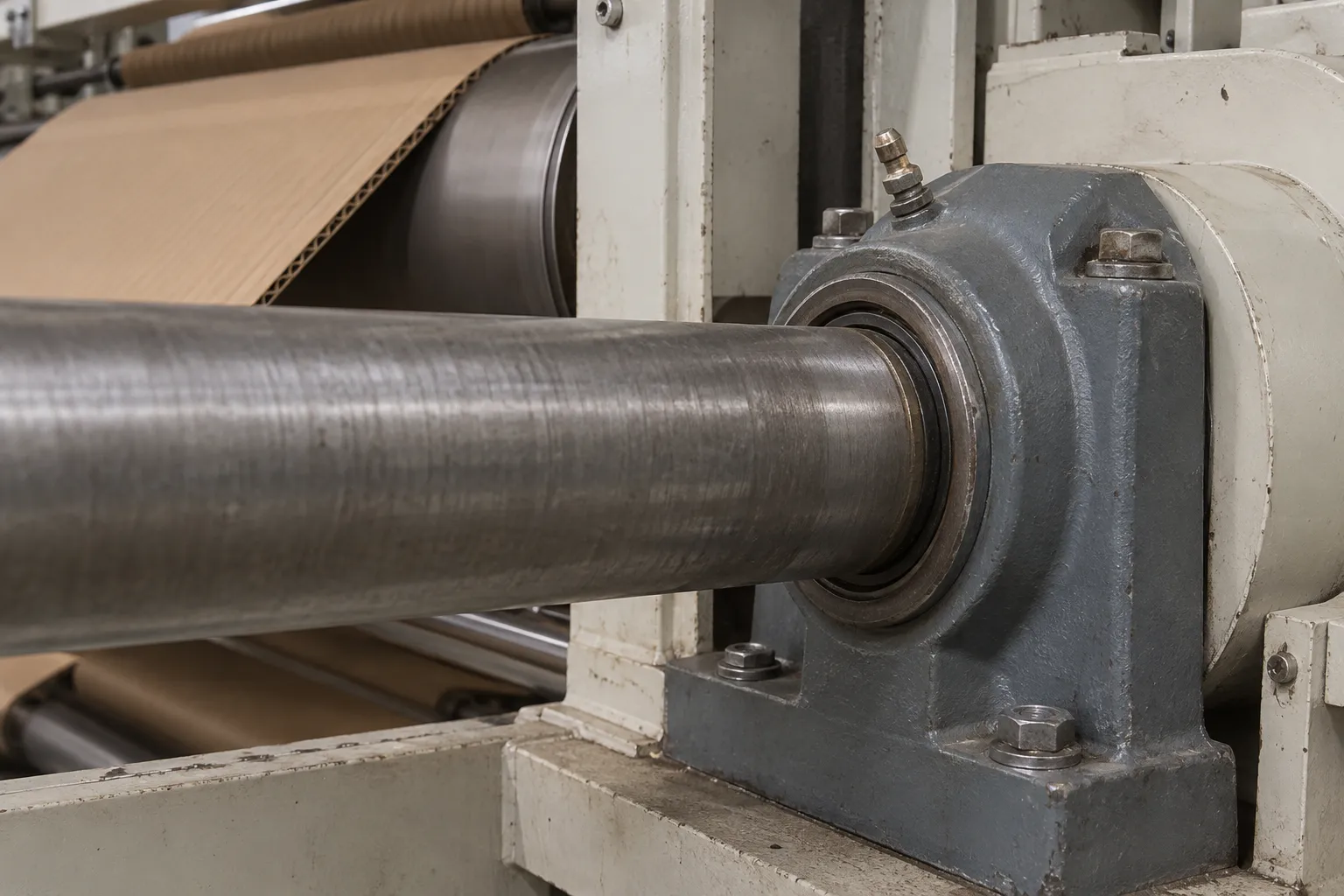
Bearings on the single facer required lubrication to manage heat and wear from repeated rotation. The white paper describes greasing about once a week and approximately 3 minutes at a point. Although brief and familiar, connecting the tool required entry beside a drive shaft. Lubrication time and exposure within the danger zone were not addressed together in the work plan.
On 18 January 2023, a worker carried lubricant to the side of the machine. The task involved connecting a pump to the plant air hose and the bearing-housing inlet. Another worker monitored production from an upper level. The machine remained in operation.
A colleague heard an impact and came down to find clothing wrapped around the rotating part. Other workers gathered after the entanglement, and emergency responders took the worker to hospital, but the worker died. On the solo approach beside the machine, no barrier prevented contact between the person and the rotating components.
After the accident, the factory prohibited greasing during operation. Its revised procedure required verification of shutdown, lockout and tagging, followed by completion checks before restart. Shaft covers and lockable access gates were installed. Instructions were posted at the machine and translated for foreign workers.
When MOEL revisited the factory, maintenance formerly squeezed into production had been replaced by work scheduled for shutdown periods. KOSHA consultations took place in June and October 2023. Follow-up measures extended beyond greasing to guarding around conveyors and robots.
The approach to the grease point is part of the machine task
A corrugator forms and bonds paper into corrugated board. The single facer joins fluted paper to a liner, while shafts and bearings support rotation of the rolls. Production may appear to concern paper and adhesive, but the person greasing the machine stands beside components transmitting power. Production and maintenance therefore expose people at different locations.
A bearing housing encloses the bearing; its grease point provides a lubricant passage. The inlet can remain stationary while a nearby shaft rotates. Greasing is not safe merely because the hand does not grip the shaft. The assessment must include shoulders and clothing moving while the hose is connected.
Fabric caught by a rotating component transmits the pulling force to the body. A person cannot reliably respond simply by noticing the hazard and withdrawing a hand. Guards and maintenance shutdown serve different purposes: guarding prevents contact during operation, while shutdown removes movement when access inside protection is needed.
At this factory, board losses during a stop influenced the lubrication method. Telling people to shut down while retaining a schedule that makes stopping difficult leaves that conflict unresolved. Demand, restart preparation and lubrication scheduling must fit together so workers are not driven to enter during operation to avoid losses. Maintenance needs an actual place in the schedule.
A stop button stops an operation but does not automatically prevent someone else from operating the machine during maintenance. Identify the energy sources, maintain isolation and verify that movement has stopped. On an interconnected production line, stopping the grease point does not establish that every other drive is also stopped.
The improvements included posting the lubrication procedure at the machine. Its location matters: workers should be able to compare it with the actual inlet and isolation point. Translated instructions must also allow them to identify the equipment. Any mismatch between the documented and physical isolation points needs resolution first.
The follow-up changed more than isolation hardware. Previously workers agreed among themselves before greasing; afterwards they notified the relevant people and verified shutdown before starting. Completion involved checking the surroundings and people’s positions before releasing locks and tags and restarting. Isolation on entry and restoration on exit became connected parts of one task.
People on a continuous line may observe the machine from different positions. Someone watching board flow above may not see the person greasing below. Stopped product flow and clearance of people therefore require distinct confirmation. Restoration also needs checks that tools and hoses are removed and guards are back in place.
The factory’s changes went beyond PPE. Covers separate people from rotating parts, lockable gates restrict casual access and translated instructions explain the task sequence. Each addresses a different problem. After an external inspection, verify that they work together along the lubrication route rather than treating installation of one as completion of all measures.
Moving a lubrication point or providing remote greasing requires the equipment maker’s review. A longer hose alone does not complete the change to work outside the danger zone. Reassess whether connection checks still require shaft-side access, whether the hose can catch moving parts and how leaks will be dealt with under shutdown conditions.
Lubricant distribution and the supposed need for a person beside rotating parts are separate questions. The method must follow equipment instructions and risk assessment. Where a verbally learned method persists, examine its actual actions: preparation, approach, connection, disconnection and withdrawal, identifying where each brings the person near a shaft.
What the comparison shows
In the 2024 white paper’s die-casting mould-cleaning case, a safety switch had been defeated so that an open door did not stop the machine. The process differs from corrugator lubrication, but both involved human access while production continued. The central issue was failed safeguarding in one case and entry beside a rotating shaft without shutdown in the other.
For mould cleaning, test the stopping response when the door opens. For lubrication, first examine whether the route to the inlet passes exposed rotating parts. Even where lockout procedures share a format, boundaries and isolation scopes differ by machine. Mapping the actual route must precede borrowing another factory’s procedure.
Causes and protective layers
| Layer | At the time | Workplace action |
|---|---|---|
| Production planning | Greasing during operation avoided shutdown losses | Schedule lubrication and restart time |
| Access guarding | The route led beside a shaft | Maintain covers and access protection |
| Maintenance isolation | Entry to the inlet during operation | Equipment-specific shutdown, isolation and restart prevention |
| Instructions | Reliance on verbal custom | Procedures, translation and explanation tied to the equipment |
Investigation and proceedings
The representative received 1 year’s imprisonment, suspended for 2 years, and the company a criminal fine of KRW 10 million. Lubrication was subsequently moved to shutdown periods, with improved lockout procedures and guarding.
Why the consequences were severe
Lubrication looked unlike major repair and was a short recurring task. Entry beside the shaft was therefore treated as part of ordinary production. Its brief duration did not reduce the consequences of contact with rotating machinery.
By the time a colleague heard the impact and arrived, clothing had already become entangled. A rapid response after discovery could not compensate for the lack of access protection. Removing movement and the possibility of restart before entry must come before checks at the end of greasing.
Questions at the work position
| Question | What to examine |
|---|---|
| Where is shutdown scheduled? | Confirm that lubrication and restart preparation have real time in the schedule |
| How far does the body enter? | Check the reach beside shafts and joints while connecting and disconnecting hoses |
| Must a guard be opened? | Establish maintenance isolation before opening it |
| Can another person start it? | Check locking, isolation scope and verified standstill |
| Can the instructions be used at the machine? | Match inlet and isolation names and translated instructions to the equipment |
Korean legal references
Articles 87 and 92 of the current Rules on Occupational Safety and Health Standards address guarding dangerous rotating parts and stopping and preventing restart for hazardous lubrication and maintenance. Lubrication is not excluded from isolation planning. The structural-safety exception in Article 92 does not permit work beside an exposed shaft merely because the task is brief.
The white paper describes a business with fewer than 50 workers. The accident occurred in 2023, before SAPA coverage expanded to that size. Examine shutdown, locking and guarding for lubrication work.
Occupational Safety and Health Act (Korean) · Rules on Occupational Safety and Health Standards (Korean)
Sources
MOEL and KOSHA, 2024 Serious Accident White Paper, 172–197 pages. Official publication (Korean)