English names and summaries of Korean laws are unofficial translations. The Korean text on the Korean Law Information Center (law.go.kr) prevails.
Were process-gas hazards communicated for electrical repairs?: arsine poisoning
Key terms in Korean and English
- serious accident (중대재해, OSH Act)
- chemical release or contact (화학물질 누출·접촉)
- arsine (아르신)
- agitator (교반기)
At a glance
On 6 December 2023, workers replacing an agitator motor at a zinc smelter were exposed to arsine.
1 worker died and 3 others were hospitalised with poisoning.
From preparation to the aftermath
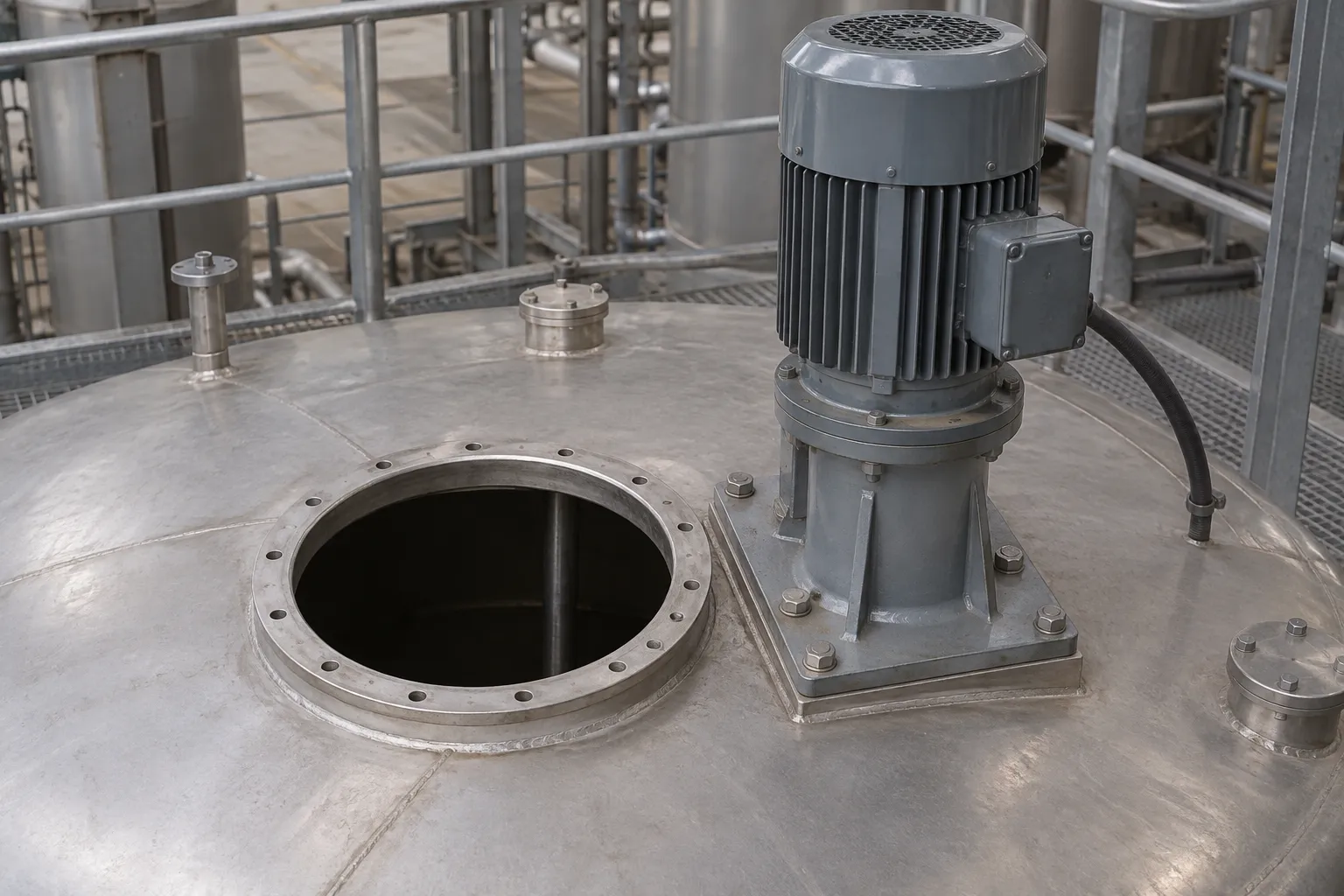
On 6 December 2023, electrical maintenance workers replaced a failed agitator motor at a zinc smelter. They worked around the motor rather than entering the tank. The repulper tank beneath it, however, remained connected to upstream processing and could receive process liquid during maintenance.
Work began at 10:00 and ended at 17:00 after corroded bolts and nuts delayed replacement. Workers remained in the confined working space around the motor for an extended period. Repairing an electrical failure became prolonged exposure to gas from the tank.
The upstream filter press was cleaned with a 10% sulphuric-acid solution. It entered the tank through an inadequately isolated route and reacted with arsenic-containing deposits. The white paper also identifies the transfer pump being stopped from 04:00 to 14:00, increasing residence time, as a condition that intensified gas generation.
An opening about 40 cm in diameter remained at the tank top, allowing arsine into the workplace. Concentration at the work position was not checked. An upstairs detector alarm at around 14:00 did not lead to a stop or evacuation. The arrangement did not translate the warning into action for the maintenance workers.
After work, workers developed symptoms including bloody urine, headache and dizziness. One reached hospital at 19:00 on the 6th and was diagnosed with acute arsine poisoning at 00:30 on the 7th. Another arrived at 14:30 on the 7th and received a poisoning diagnosis at 17:45. Additional workers from the site were admitted at 11:00 on the 8th; one worker died at 13:20 on the 9th. The final toll was 1 death and 3 other workers requiring hospital treatment.
The investigation identified missing substance information and training for subcontractor workers, inadequate enclosure and extraction, and the absence of suitable respiratory protection. Earlier poisonings and calls for equipment improvement had not resulted in effective measures for the work where the accident occurred.
The motor stopped; the process reaction did not
A repulper mixes solid material and liquid, using an agitator to stir its contents. A stopped motor means mechanical mixing has stopped, not that incoming flow or chemical reactions have stopped. Defining maintenance boundaries only around the motor terminals and rotating parts leaves out the tank and upstream material paths.
Here, arsenic-containing deposits, incoming acidic liquid and changed residence time acted together. The maintenance position was also close to the gas outlet. A permit review therefore needs the connected tank contents, possible cleaning-liquid entry and operating state, as well as the name of the component being repaired.
Enclosure and local exhaust control gas at its source. Moving air around a room with a roof fan differs from capturing emissions at a tank opening. Missing covers or temporarily open inspection points require examination of paths toward workers’ breathing positions.
Arsine is a toxic arsenic-containing gas. NIOSH identifies effects including haemolysis and kidney damage. Neither lack of an obvious smell nor a normal oxygen reading establishes safety; measurement must address the expected substance and the exposure conditions of the task.
A particulate respirator is not a control against arsine gas. Respiratory protection must fit the substance, concentration, oxygen level, task and emergency conditions. Choosing an arbitrary cartridge for an unknown concentration does not establish safe entry conditions. Resolve isolation, enclosure and extraction first.
Detector location on another floor matters. A high alarm must trigger an appropriate stop and evacuation response, but silence elsewhere does not establish safety at the task. Locate monitoring with the repair position and emission source in mind and define who stops which work when an alarm occurs.
Corrosion-related delay increases exposure duration. Reassess whether the original permit conditions remain appropriate when work runs beyond its planned time. Check fastener condition during preparation; if the problem cannot be resolved, reconsider the maintenance method rather than continuing attempts in the exposure area.
Substance information must extend beyond incoming raw materials to substances that can form during the process. An electrician assigned a motor repair needs to know which alarms require withdrawal and which possible exposures to identify to medical staff if symptoms develop.
Conditions during maintenance can differ from normal production. A stopped transfer pump altered residence conditions while cleaning liquid entered. Each change may appear temporary to an operator, but together they create a different exposure for the person beside the motor. Review concurrent cleaning, repair and stopped equipment together before authorising work.
Contracting out motor work without process-hazard information prevents an informed assessment. Electrical competence is needed for the motor but does not automatically identify gases produced by the process. The requester must explain substances and isolation boundaries, then relate the worker’s understanding to the actual location.
Symptoms after the shift should not be dismissed as unrelated to work. Check the condition of others who worked there and provide process and possible exposure information during medical care. Make permit and substance information available without relying solely on personal recall; site staff should not substitute for diagnosis or treatment.
Completing the motor replacement is separate from confirming prevention. Verify tank openings, incoming-flow isolation, local extraction, detector location and alarm response individually. For measures planned after an earlier accident, check their operation at the work position rather than only completion records.
What the comparison shows
The same chapter covers arsine poisonings during tank work in 2011 and filter-cloth folding in 2017. The 2011 event involved acid cleaning of residues; the 2017 work took place over a wastewater tank. Although the tasks differed, both failed to separate the gas-generating tank from occupied work space.
Closing only the opening on a tank involved in an earlier accident does not protect work at other tanks. Review equipment with similar contents and connected processes together. The motor replacement shows why electrical maintenance belongs within that review.
Following another arsine poisoning in 2022, gas detection and respiratory-protection measures were planned. Prevention becomes an operating condition only when equipment is installed and functional, subcontractors are included and alarms result in people withdrawing.
Causes and protective layers
| Layer | At the time | Workplace action |
|---|---|---|
| Incoming flow | Cleaning solution entered during maintenance | Isolate and verify connected process paths |
| Source control | Gas escaped through a tank opening | Maintain enclosure and source extraction |
| Monitoring and alarms | No task-position testing; work continued after alarm | Substance-specific monitoring linked to withdrawal |
| Respiratory protection | Particulate respirators used | Select protection for substance, concentration and oxygen conditions |
| Hazard communication | Contractor training and information missing | Explain process products, symptoms and contacts to maintenance workers |
Investigation and proceedings
In August 2024, the main contractor’s representative was indicted while in custody on suspicion of violating the SAPA. The white paper covers that stage of the proceedings but provides no court decision.
Why the consequences were severe
The motor-repair delay prolonged time near continuing emissions. The upstairs alarm did not interrupt exposure, and workers sought treatment only after symptoms developed following the shift. Gas generation, detection, evacuation and medical communication were not connected into an effective response.
Similar symptoms among people who worked in the same area warrant consideration of workplace exposure information. Serious symptoms require immediate emergency medical assistance and information on location, time and substances. Do not re-enter the source area without protection to investigate.
Questions at the work position
| Question | What to examine |
|---|---|
| What can react beneath the motor? | Tank deposits, incoming liquids and process changes |
| Can another task introduce cleaning liquid? | Upstream connections and isolation |
| Does testing represent the task location? | Gas, sensor, source and breathing position |
| Who acts on the alarm? | Stop and evacuation arrangements for all employers |
| What information reaches clinicians? | Work time, location and possible substances |
Korean legal references
Relevant provisions include OSH Act Article 63 on principal-contractor safety and health measures and safety-rule Article 422 on enclosure or local extraction of controlled hazardous substances. Verify the substance and equipment conditions and plan process-liquid isolation separately from electrical isolation for the motor.
The white paper gives the principal contractor’s workforce as about 600 and dates the accident to 2023. With that applicability basis, Enforcement Decree Article 4(3) is relevant to hazard-correction procedures. The preventive question is whether enclosure, extraction and monitoring planned after earlier poisoning reached maintenance work in practice.
Occupational Safety and Health Act (Korean) · Rules on Occupational Safety and Health Standards (Korean) · SAPA Enforcement Decree (Korean)
Field practitioner note
Sources
MOEL and KOSHA, 2025 Serious Accident White Paper, 70–99 pages. Official publication (Korean)