English names and summaries of Korean laws are unofficial translations. The Korean text on the Korean Law Information Center (law.go.kr) prevails.
Who checks after a safety net is removed?: a fall while erecting scaffolding
Key terms in Korean and English
- serious accident (중대재해, OSH Act)
- risk assessment (위험성평가)
- suspended sentence (집행유예)
- fall from height (떨어짐)
- guardrail (안전난간 / 난간)
- safety net (추락방호망)
At a glance
On 5 January 2023, 1 worker erecting scaffolding during repairs at a cement factory in North Chungcheong Province fell and died.
A safety net had been removed for other installation work, leaving the opening without replacement protection.
From preparation to the aftermath
Winter maintenance required scaffolding around the elevated preheater. Separate contractors replaced equipment and erected access scaffolds in the same area. Protection was needed both for people using the finished scaffold and for those assembling its first parts.
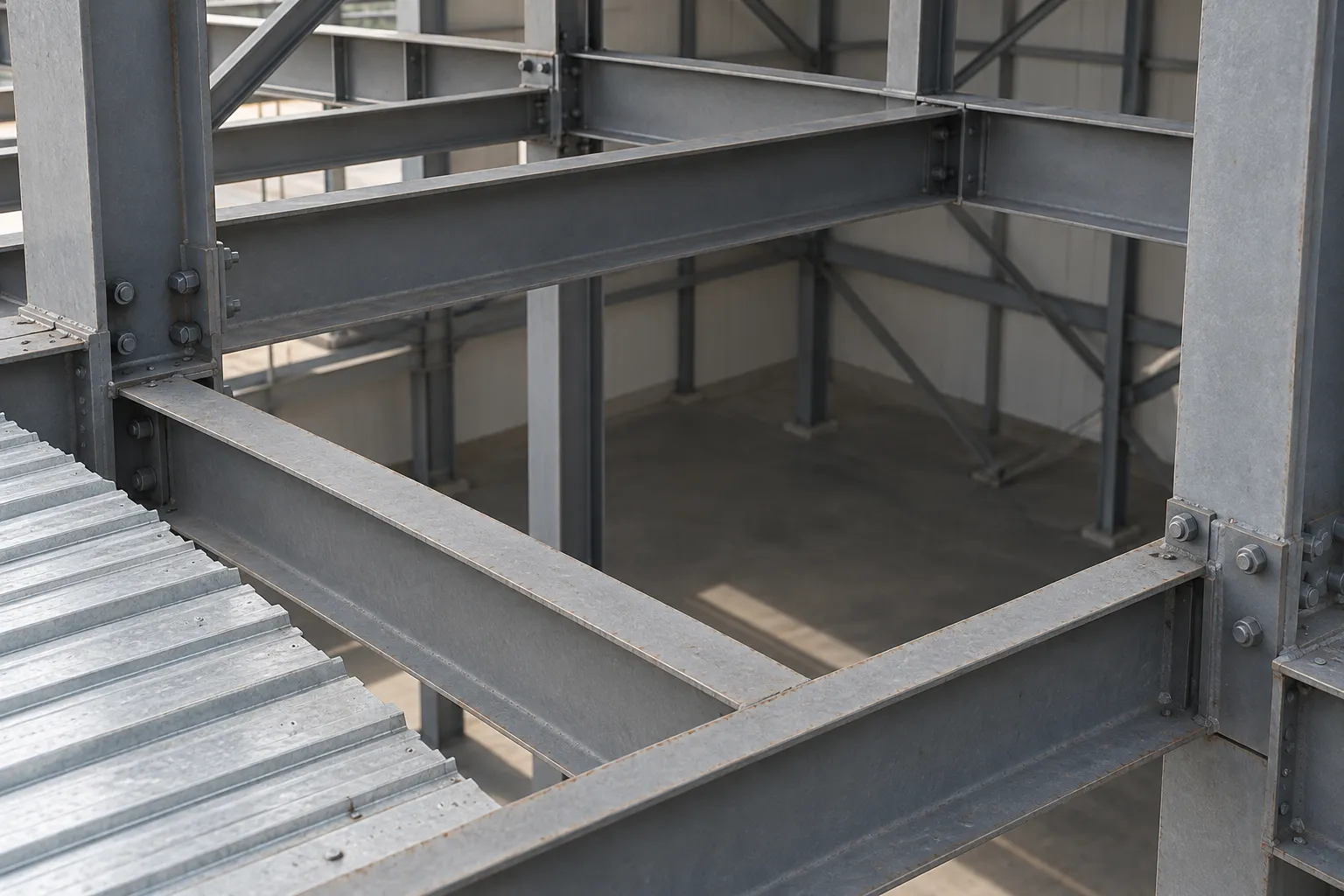
On the morning of 5 January 2023, the scaffold team went up after its pre-work meeting. Openings lay between the steel members. Nets normally protecting them had been removed for preheater installation, and platforms and guardrails were also absent around the opening.
The worker wore a helmet and harness, but there was no proper anchorage. The white paper reports the inspector's assessment that the worker may have leaned towards a protrusion to attach the lanyard and then fallen. That movement remains the inspector's reconstruction.
The opening was 35.5 m above ground; scaffold tubes were stored at the 29.5 m level below. The worker fell about 6 m onto the materials. An emergency medical helicopter took the worker to hospital, where the worker died that morning. The opening led directly towards stored materials on the lower level.
The work permit specified platforms and guardrails and had been checked by the principal contractor. Those measures were absent at the opening. The site manager was elsewhere in the factory. Approval of the document had not ensured installation at the work position.
After the accident, the contractor received MOEL and KOSHA consultancy. The principal contractor's manager and the scaffold team leader took part in reviewing work locations and sequences, which were then discussed before work. The white paper records protective improvements dated 26 February and 31 May 2024.
Protection while the scaffold is still being built
On a completed scaffold, the platform carries the worker and guardrails protect its edges. During erection, the worker must move before the next platform exists. Assessing only the finished scaffold misses this interval. Each erection stage needs a defined standing position, handhold and anchorage.
Removing a net removes the means of arresting a fall below the opening. The steelwork may look unchanged while protection has changed completely. Completion of net removal is therefore not enough: replacement protection must be coordinated with the start of every other task using the opening.
A harness works as a system of wearing, connection and a suitable supporting anchorage. A nearby protrusion is not automatically an anchorage. If attachment requires first entering the fall zone, access before attachment must be redesigned in the scaffold plan rather than left to improvisation.
Making room for the next operation must be planned with protection for the current team. Net removal for equipment access may require separation of areas, resequencing or prior installation of another safeguard. The permitted access boundary during the unprotected interval must be explicit.
Scaffold erectors encounter the hazard while creating access for others. Complex equipment may prevent use of a standard facade-scaffold sequence. The team leader should identify actual footholds and material-transfer positions and coordinate when the equipment contractor needs those areas cleared.
The post-accident assessment went beyond filling in a form. The principal contractor's manager and team leader reviewed installation conditions and discussed preparation before work, including tools and protection needed to install the net itself. The installation process became part of the plan rather than just the name of a safeguard.
Where one contractor removes protection and another uses the space, a hazardous condition can persist between their tasks. Access should follow verification of the remaining opening and replacement safeguard, not just a removal-complete notice. Allocating reinstatement and its timing also helps prevent the opening being left after the other task ends.
What the comparison shows
In the warehouse-roof dismantling case in the 2023 white paper (2022-12), a harness was also worn without an anchorage. There the roof fixing failed; here the worker fell through an existing opening. The initiating events differ, but issuing a harness did not provide a place to connect it.
Roof dismantling calls for checking the panel supports and fixings; scaffold erection calls for replacement opening protection and a safe erection sequence. Treating both merely as harness-use problems overlooks their different starting conditions. Compare what must be ready before anyone enters the hazardous position.
Causes and protective layers
| Layer | At the time | Workplace action |
|---|---|---|
| Opening protection | No replacement after net removal | Complete removal authorisation together with verification of replacement protection |
| Work position | Platform and guardrails absent | Plan standing positions throughout erection |
| Personal fall protection | Harness present without anchorage | Provide attachment before entry into the fall zone |
| Permit and assessment | Recorded measures differed from the site | Have the team leader verify installation and communicate changes |
Investigation and proceedings
A suspended sentence was imposed in proceedings concerning OSH Act violations involving the site manager and company. The sentence length, suspension period and judgment date are not recorded in the white paper. Subsequent consultancy led to risk assessments involving the team leader and improved protective measures.
Why the consequences were severe
Scaffold tubes lay in the fall path. There was no opportunity to avoid them after falling, and the unconnected harness could not arrest the fall. Protection of the opening and control of access during net removal had to precede reliance on rescue.
Holding a pre-work meeting does not itself resolve a changed opening. If yesterday's net is absent today, the discussion must address why it was removed, what replaces it and who controls access until reinstatement, using the actual location.
Questions at the work position
| Question | What to examine |
|---|---|
| Where does the person placing the first platform stand? | Mark support positions for the erection stages as well as the completed scaffold |
| Will another contractor enter while the net is absent? | Compare equipment-access schedules with the exclusion boundary |
| Can the harness be attached before entry? | Check the route and the actual attachment position |
| Where are the permit's guardrails and platforms installed? | Locate the recorded measures with the team leader |
Korean legal references
For current work, Rules on Occupational Safety and Health Standards Article 43 addresses openings and temporary removal of protection; Article 44 addresses harness anchorages. Removing protection for work still requires fall safeguards. Harness issue does not replace installation and inspection of the anchorage.
OSH Act Article 36 requires assessment and improvement of risks arising from equipment and work activities. When maintenance changes protection, the scaffold erector's movements also belong in the assessment. The linked provisions are current workplace references; the proceedings above follow the white paper.
Occupational Safety and Health Act (Korean) · Rules on Occupational Safety and Health Standards (Korean)
Field practitioner note
Sources
MOEL and KOSHA, 2024 Serious Accident White Paper, 198–221 pages. Official publication (Korean)
Comparison: 2023 Serious Accident White Paper (Korean), 276–307 pages