English names and summaries of Korean laws are unofficial translations. The Korean text on the Korean Law Information Center (law.go.kr) prevails.
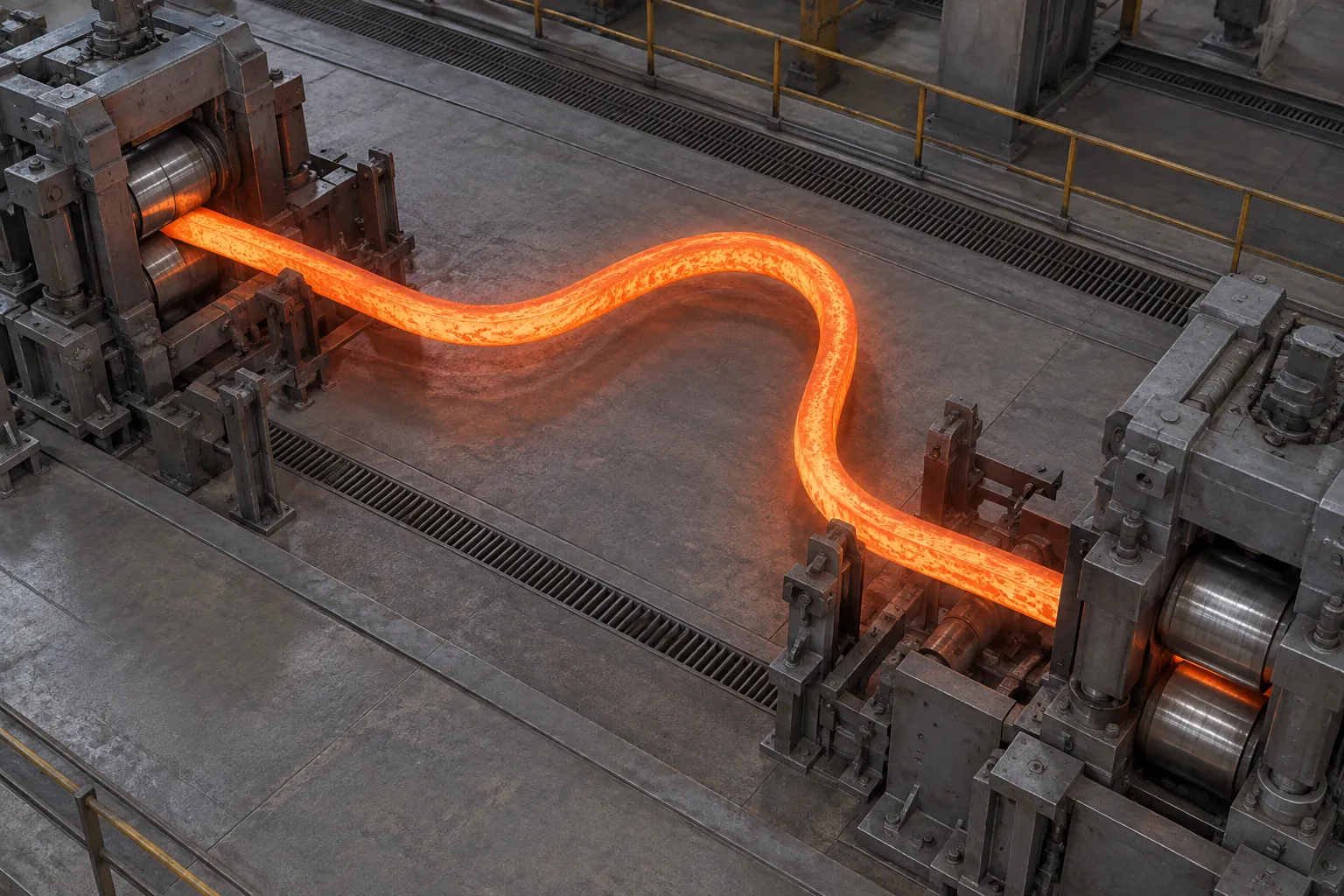
Have repeated cobbles been controlled?: hot material ejected from a rolling line
Key terms in Korean and English
- serious accident (중대재해, OSH Act)
- risk assessment (위험성평가)
- struck by object (물체에 맞음)
- interlock (인터록)
- cobble (코블)
At a glance
On 31 March 2023, 1 worker died after being struck by hot material escaping a rolling mill at a reinforcing-steel factory in South Chungcheong Province.
Cobbles, where material leaves its intended path, had recurred, but protection near the work positions was inadequate.
From preparation to the aftermath
The plant reheated billets and passed them through successive rolling stands to produce reinforcing bar. Between opposing rolls the material became thinner and longer. Loopers controlled the material between stands. The worker observed its movement and adjusted cooling-water delivery.
During the early hours of 31 March 2023, sparks appeared between stands 14 and 15. The worker adjusted a cooling nozzle at the looper and then used a wooden board to position material entering the mill. This brought manual intervention close to hot moving steel.
As the worker was about to move away, material left its intended path and struck the worker. This departure from the rolling path is called a cobble. The worker suffered severe injuries, was taken to hospital and died.
Cobbles had occurred before. In 2022, escaping material reached a passageway, ignited a door lock and damaged equipment. The subsequent assessment led to fencing near that event, rather than containment across the other escape locations.
On 14 April 2023 the company submitted improvements to seek release of the work suspension. They included guards, interlocks and increased line inspection, with further work on operating standards. These differed from relying on workers to avoid recurrent escaping material.
When rolling speed and material path diverge
Rolling stands reduce material progressively rather than reaching the final size in one pass. A mismatch in successive speeds can leave the intervening material slack or unstable. Loopers and rollers manage this flow. Adjusting an immediate source of sparks does not by itself resolve every path or tension problem.
The white paper discusses deposits on rollers and unstable flow in ageing equipment. Inspection improves process stability and reduces the likelihood of a cobble. A guard addresses escaping material reaching the work area. Controlling initiation and protecting against escape are complementary functions.
An access fence and a guard containing hot material do not necessarily perform the same function. A person outside a fence may still be exposed if material can escape over it or through gaps. Define protection using escape paths and occupied positions, not only the location of the previous event.
The wooden-board adjustment was used to correct product position and flow. The white paper treats it as an example of hazardous work without a safe standard, rather than identifying it as the direct cause of this accident. Improvement needs to address why the intervention was necessary and how to adjust or intervene after stopping. Changing the tool alone does not eliminate exposure.
Portable screens were used for products frequently affected by cobbles. A change of product does not remove exposure to rarer escapes if adjustment still requires standing beside the material. Review positions, gaps in protection and passages after product changes rather than comparing frequency alone.
Material in adjacent sections keeps moving while a worker adjusts a nozzle. Watching only the nearest roller cannot control an escape beginning at another stand. Define access boundaries around the connected moving material, rather than only the name of the equipment being adjusted.
Installing a guard can change passage width and maintenance access. Ignoring those changes can create pressure to remove it for later checks. Plan observation positions and safe stopped access together so that protection remains in place during production.
What the comparison shows
The 2022 cobble damaged equipment and the entrance area; the 2023 event struck a worker. More important than the earlier absence of injury was the material reaching a passage outside its normal path. Reassessment must consider a person occupying that path, not only repair the previous damage.
The belief that another product size had fewer cobbles did not justify omitting protection. The white paper explains that portable screens were used for frequently affected thinner products, yet escape also occurred with the product involved here. Work areas reachable under less frequent conditions still need protection.
Causes and protective layers
| Layer | At the time | Workplace action |
|---|---|---|
| Process stability | Deposits and unstable material flow | Inspection under safe stopped conditions and equipment improvement |
| Containment | Insufficient guarding of escaping material | Cover escape routes towards occupied positions |
| Work method | Manual adjustment close to moving material | Review remote methods and safe intervention procedures |
| Risk assessment | Response limited to the earlier event area | Examine recurrent locations across the line with workers |
Investigation and proceedings
On 14 April 2023, plans for guards, interlocks and more inspections were submitted to obtain release of the work suspension. The main account in the white paper does not record a criminal outcome for this incident.
Why the consequences were severe
Hot material escaped a narrow production path into occupied space. Evasion can begin only after a person recognises its movement and direction. Instead of relying on skill to withstand recurrent escapes, separate occupied positions from possible material paths through engineering measures.
Production delay received management attention while repeated hazards did not receive equivalent improvement action. More inspections need to be accompanied by authority to stop for deposits or guide defects and clear repair-completion conditions. Assigning delay responsibility solely to the person stopping work can discourage reporting.

Questions at the work position
| Question | What to examine |
|---|---|
| Can a cobble reach passageways beyond the fence? | Compare previous damage locations with occupied positions |
| Under what conditions is the nozzle adjusted? | Compare reach during operation with the stopped-work procedure |
| Is assessment limited to one product size? | Review protection when products change |
| Who can stop after a defect is found? | Specify stop authority and checks before restart |
Korean legal references
Current risk assessment under OSH Act Article 36 should address recurring escapes together with manual adjustment. Include the places where workers reach cooling nozzles and guides and adjacent passages, rather than only the previous accident location.
Rules Article 92 addresses stopping for hazardous maintenance, cleaning, repair and adjustment and preventing operation by others. Where inspection requires entry into the equipment, a practice of approaching it in production must first be changed.
Occupational Safety and Health Act (Korean) · Rules on Occupational Safety and Health Standards (Korean)
Field practitioner note
Sources
MOEL and KOSHA, 2025 Serious Accident White Paper, Part 2, 55–75 pages. Official publication (Korean)