English names and summaries of Korean laws are unofficial translations. The Korean text on the Korean Law Information Center (law.go.kr) prevails.
Is concrete accumulating only where the hose reaches?: a floor collapse during pouring
Key terms in Korean and English
- serious accident (중대재해, OSH Act)
- collapse (무너짐)
- shoring (동바리)
- formwork (거푸집)
- bearer (멍에)
At a glance
On 9 August 2023, temporary works collapsed during a concrete pour at a construction site in Gyeonggi Province.
2 workers checking the structure on the floor below were crushed and died.
From preparation to the aftermath
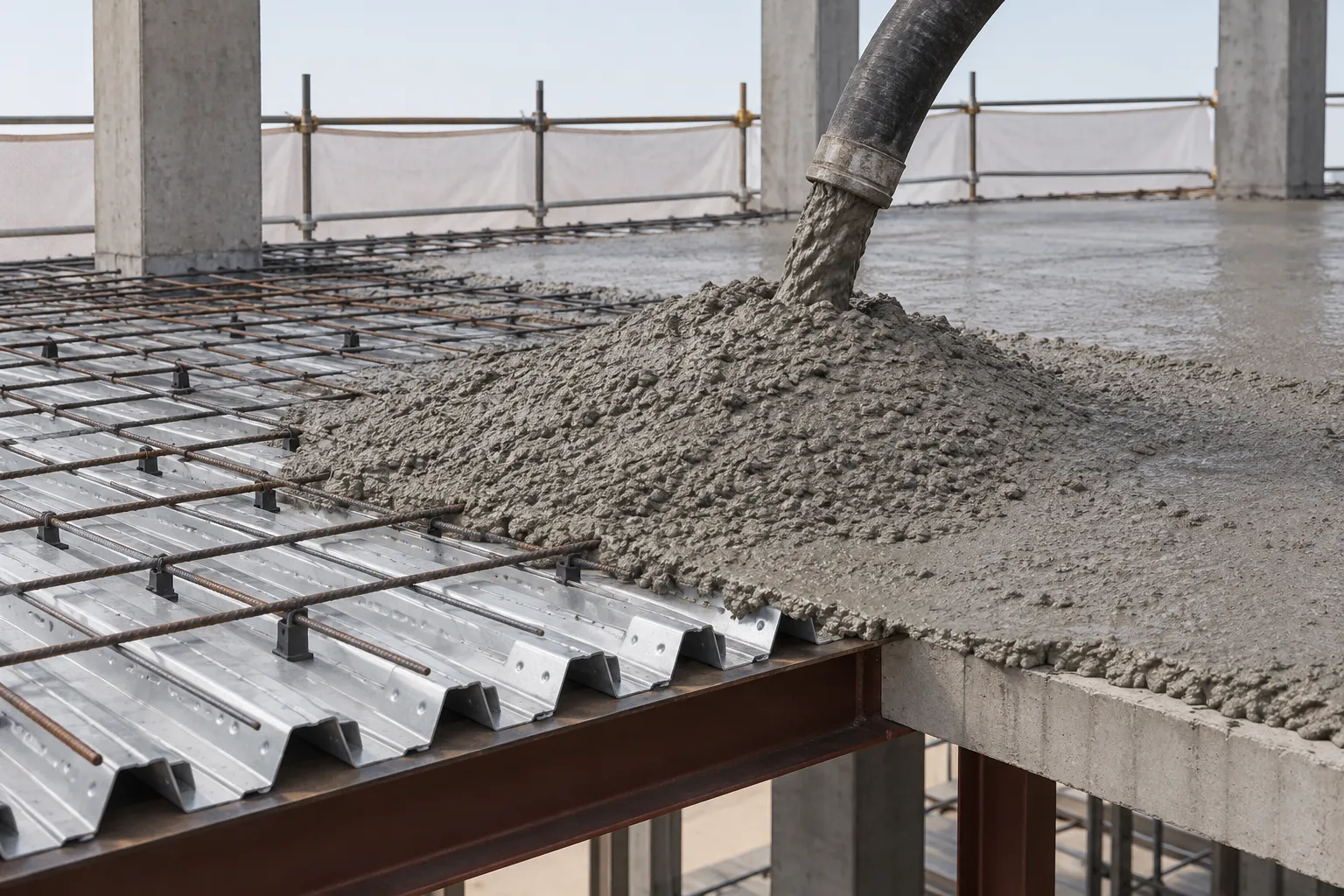
Concrete was to be poured for an upper floor at a construction site in Gyeonggi Province on 9 August 2023. A new contractor had taken over, and the floor method had changed from conventional formwork to deck plate. Work proceeded under schedule pressure and a typhoon forecast for the next day.
Pouring workers were on the upper level, with 2 workers below checking formwork and shoring. The plan divided the floor into areas, pouring columns and beams before the slab. Equipment positioning and reach did not serve the full extent of the intended area.
The pump boom was obstructed by the tower crane, so a hose was added. Reach remained insufficient. Concrete was accumulated where the hose could reach and spread sideways with a vibrator. Instead of repositioning the pump and revising the sequence, load became concentrated.
Pouring continued despite an on-site warning about the load. As the floor sagged, more concrete collected there. Beam formwork tilted, shoring buckled and the floor collapsed. The 2 workers below died while being taken to hospital.
The joint investigation addressed inadequate beam support, inclined shoring and insufficient bearer installation. Beam rotation and deck deformation were also found on other floors. Structural review and assembly planning had not been updated to the changed construction method.
Reducing slab props changes the load carried by beams
Fresh concrete cannot support load like a completed floor. During pouring, the deck plate, beam formwork and temporary supports carry its weight. Treating the construction-stage load path as if it were the completed building overlooks the critical temporary condition.
Replacing conventional slab formwork with deck plate can reduce slab props while changing the load delivered to beams. It does not mean beam props can remain unchanged. Connections, restraint against beam rotation, bearers and supports must be reviewed along the revised load path.
Slender supports can lose capacity by bending sideways. Inclined props introduce eccentric loading. Tilting beam formwork adds further unfavourable deformation. The specified alignment, connections and bracing therefore matter more than an impression that the individual members look strong.
Accumulating concrete and then spreading it produces a different load from the assumed distributed pour. Material collecting in an initially sagging area increases demand there. An intention to spread it later does not establish safety while it is piled up. Pump reach is part of structural planning.
If the hose cannot reach an area's end, review space and time for repositioning, possible resequencing and the condition of material already poured. A need for adjustment is not permission to continue by any means. Authority to revise the pour plan and criteria for stopping belong in pre-work planning.
Deformation on other floors provided an opportunity for review before the next pour. Beyond retaining photographs, check whether the same member arrangement and method will recur above. Repeating the pour without resolving the earlier deformation carries the uncertainty forward.
A plan needs a stop-and-change process for locations beyond equipment reach. Before improvising an extra hose, examine how the changed delivery method affects accumulation and worker positions. Concentrating load cannot safely substitute for the time needed to reposition equipment.
The shoring observer's role also needs definition. If delivery continues while a warning travels upwards, conditions can deteriorate further. Agree beforehand how the pump supply will be stopped and how people below will leave. Reinforcement during work is not a decision to rush while people remain in the danger zone.
What the comparison shows
Beam and deck deformation was also found on other floors. In a building repeating a method, a defect below is evidence to review before the next level. Completing one pour does not validate repeating the same support arrangement above.
The apartment-building progressive collapse in the 2023 white paper also concerns construction loads and support conditions. Compare where loads moved after a change, rather than only the names of materials. Different structures and work conditions require their own engineering review to determine reinforcement.
Causes and protective layers
| Layer | At the time | Workplace action |
|---|---|---|
| Change review | No adequate structural review after deck conversion | Revise design and assembly drawings for the changed load path |
| Shoring assembly | Inclination and insufficient bearer support | Verify alignment, connections and bracing against drawings |
| Pour planning | Concentrated placement after equipment interference | Match equipment reach to distributed placement |
| Response to warning | Work continued after load warnings and sagging | Stop pouring, evacuate danger areas and review stability |
Investigation and proceedings
MOEL and KOSHA investigated jointly. At the first trial, approximately 1 year and 2 months after the accident, the contractor’s representative was sentenced to 2 years’ imprisonment. The white paper does not record whether the sentence was suspended or whether the representative was taken into custody in court.
Why the consequences were severe
The workers checking the structure were directly below the loaded area. An observer within the collapse zone may have little chance to escape when the structure fails. Monitoring positions must be planned against the potential collapse area below as well as the active pour above.
Load continued to increase after the warning. The representative who also served as site manager was absent. Stop and evacuation arrangements must work when a worker reports danger even if the person normally making decisions is away.
Questions at the work position
| Question | What to examine |
|---|---|
| Were slab props removed without redesigning other supports? | Check the review of loads transferred to beams, connections and bearers |
| Can the hose reach every pour position? | Plot crane interference and equipment-repositioning routes |
| Did deformation below change the next-floor plan? | Compare defect records with completed reinforcement |
| Can observers monitor from outside the collapse zone? | Define observation positions, communication and supply stopping together |
Korean legal references
Current Rules Article 331 requires structural review and assembly drawings for formwork and shoring. Article 334 addresses pre-work checks, observation of deformation, stopping and evacuation on abnormality, and distributed placement. Drawings for the previous method cannot alone verify the changed structure.
The white paper gives a project value of approximately KRW 15 billion. On 9 August 2023 it was outside the deferral for construction projects below KRW 5 billion. Article 4(3) of the SAPA Enforcement Decree provides a reference for procedures to identify and improve hazards, including responsibility for reviewing a changed method and checking actions. This adds no finding of a violation.
Occupational Safety and Health Act (Korean) · Rules on Occupational Safety and Health Standards (Korean) · SAPA Enforcement Decree (Korean)
Sources
MOEL and KOSHA, 2024 Serious Accident White Paper, 12–35 pages. Official publication (Korean)
Comparison: 2023 Serious Accident White Paper (Korean), 18–27 pages