English names and summaries of Korean laws are unofficial translations. The Korean text on the Korean Law Information Center (law.go.kr) prevails.
Was the route to the damaged guardrail safe?: a fall during a ship-repair pre-check
Key terms in Korean and English
- Serious Accidents Punishment Act (중대재해 처벌 등에 관한 법률)
- Enforcement Decree of the Serious Accidents Punishment Act (같은 법 시행령)
- serious accident (중대재해, OSH Act)
- occupational disease (직업성 질병)
- responsible management officer (경영책임자등)
- risk assessment (위험성평가)
- fall from height (떨어짐)
- cargo hold (화물창)
- guardrail (안전난간 / 난간)
- safety net (추락방호망)
At a glance
On 2022-02-19, 1 subcontractor worker died while checking guardrail-replacement locations on a ship under repair.
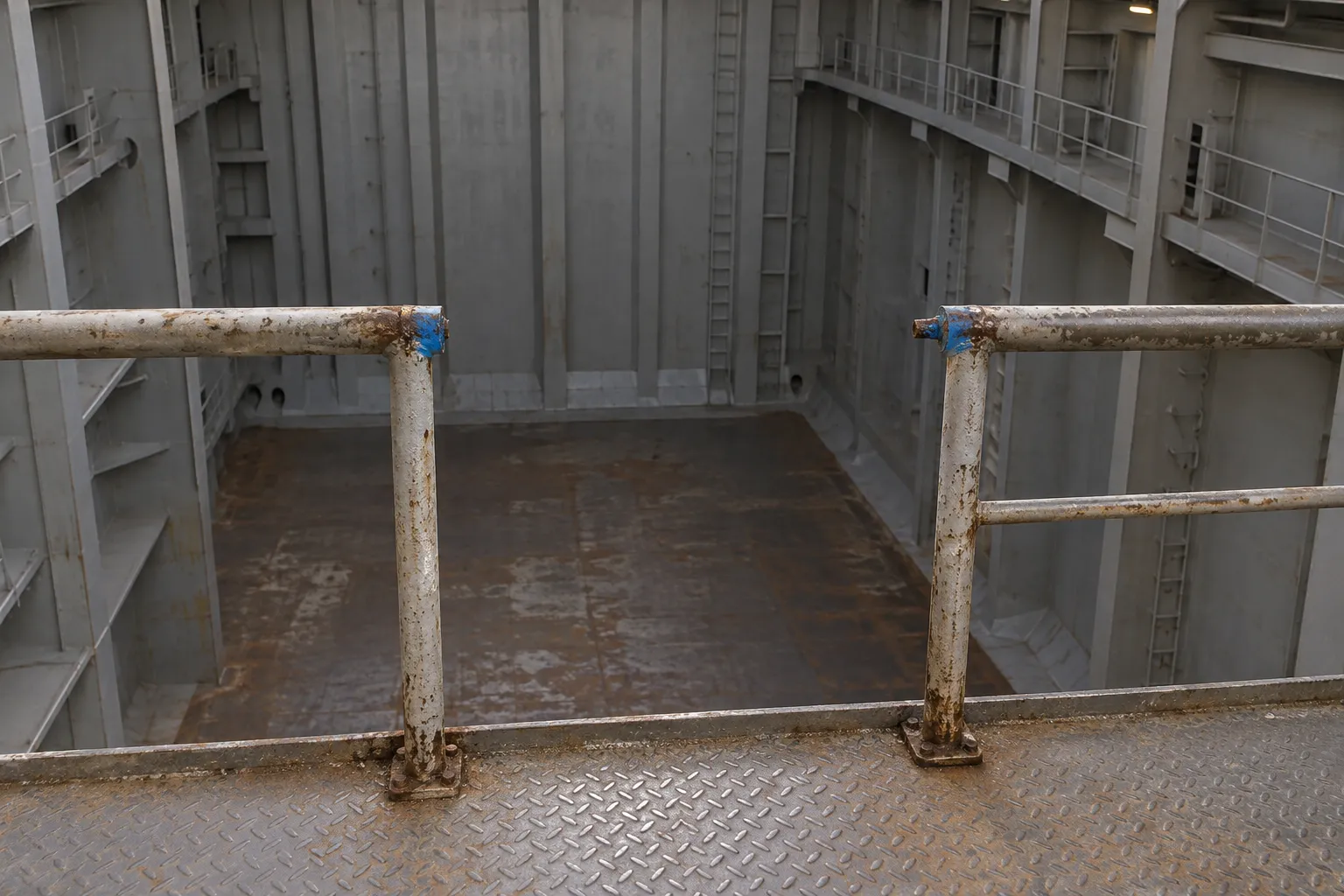
A passage inside the cargo hold had damaged guardrails and lacked additional fall protection.
Providing protective equipment and making it usable along the actual access route were separate management tasks.
From preparation to the aftermath
On 2022-02-19, 1 subcontractor worker died after falling while checking a cargo hold before ship repairs. The worker had gone down to identify guardrails requiring replacement and the material needed. The pre-work inspection already involved fall exposure, before welding or removal began.
The contractor was replacing valves, linings and guardrails. The crew was repairing rails from lower levels upwards. On the accident day, another contractor was opening hatch covers for replacement. Simultaneous tasks on the same ship had changed the working environment from the previous day.
A colleague prepared welding equipment on deck while the foreman entered the hold to inspect the work area. A hatch-cover worker later heard a noise, looked down and discovered the victim. No one witnessed the fall itself.
The principal contractor argued for a different fall location using a welding hose draped over an intact upper rail. The lower rail under repair had a missing section and blue paint marks. A colleague explained that the foreman marked repair locations in advance. Investigators considered these traces strong indications of a fall near the level 5 railing scheduled for repair.
The damaged gap was about 30cm. Investigators used a demonstration under similar conditions to examine whether a person could pass through it. Although the exact motion was not witnessed, the investigation addressed why a small-looking opening did not rule out a fall.
The victim wore a safety harness, but there was no anchorage arrangement along the route. The cargo hold also lacked fall-arrest nets. Separate protection for the person approaching the damaged guardrail had not been provided.
The route to a damaged guardrail also needs protection
During guardrail repair, the protective barrier itself is the object of work. Approaching the repair moves the worker towards a known weakness. The rail under repair cannot also be assumed to provide protection. Define temporary separation, access platforms and fall protection for the inspection route as well as the repair.
A harness cannot arrest a fall merely by being worn. It needs a suitable anchorage and a means of maintaining connection during movement. Repeated disconnection or reliance on the damaged rail can interrupt protection. Anchorage strength and position require a task-specific review; an arbitrary pipe is not automatically an anchor.
In a hold with walkways at different levels, lower barriers may be hard to see from deck. Review missing rails, platforms and level changes along the access route before sending the crew in. Establish safe observation and access restrictions rather than asking an inspector to enter the hazard first to take photographs.
Hatch-cover replacement was a separate contract, but changed the hold's openings. Review how one contractor's cover movement affects another crew's access and fall exposure. An instruction simply to continue yesterday's work can miss changed openings and simultaneous-work conditions.
Difficulty installing nets or anchors calls for review of bulkheads, routes and work sequence. Where the proposed arrangement is unsuitable, change the sequence or access method. Attachment to ship structures requires design and strength checks.
What the comparison shows
The whitepaper also describes a later fatal fall during scaffold dismantling at the same company while the earlier case was on trial. Inspection and dismantling differ, but both require protection when temporary barriers are absent. An earlier corrective action needs implementation across vessels and contractors, not just retention in a file.
Causes and protective layers
| Layer | At the time | Workplace action |
|---|---|---|
| Access route | Approach to damaged rail | Establish protected access before inspection |
| Personal fall protection | Harness worn without anchors | Provide an arrangement that maintains connection |
| Collective protection | No fall-arrest net in hold | Review nets or alternative access for the structure |
| Simultaneous work | Hatch covers opened by another crew | Coordinate openings with the repair route |
Investigation and proceedings
Holding the company accountable for 4 deaths over 3 years, the court sentenced the responsible management officer to 2 years in prison and took the officer into custody in court, and imposed a criminal fine of KRW 2 billion on the corporation. The sentencing date and definitive floor and fall height were not published in the whitepaper.
Why the consequences were severe
The first person to notice the incident was another worker on deck. The arrangement did not provide continuous knowledge of the inspector's position near the hazard. Communication is necessary but does not replace missing edge protection. First prevent access to the fall path, then coordinate work within the protected area.
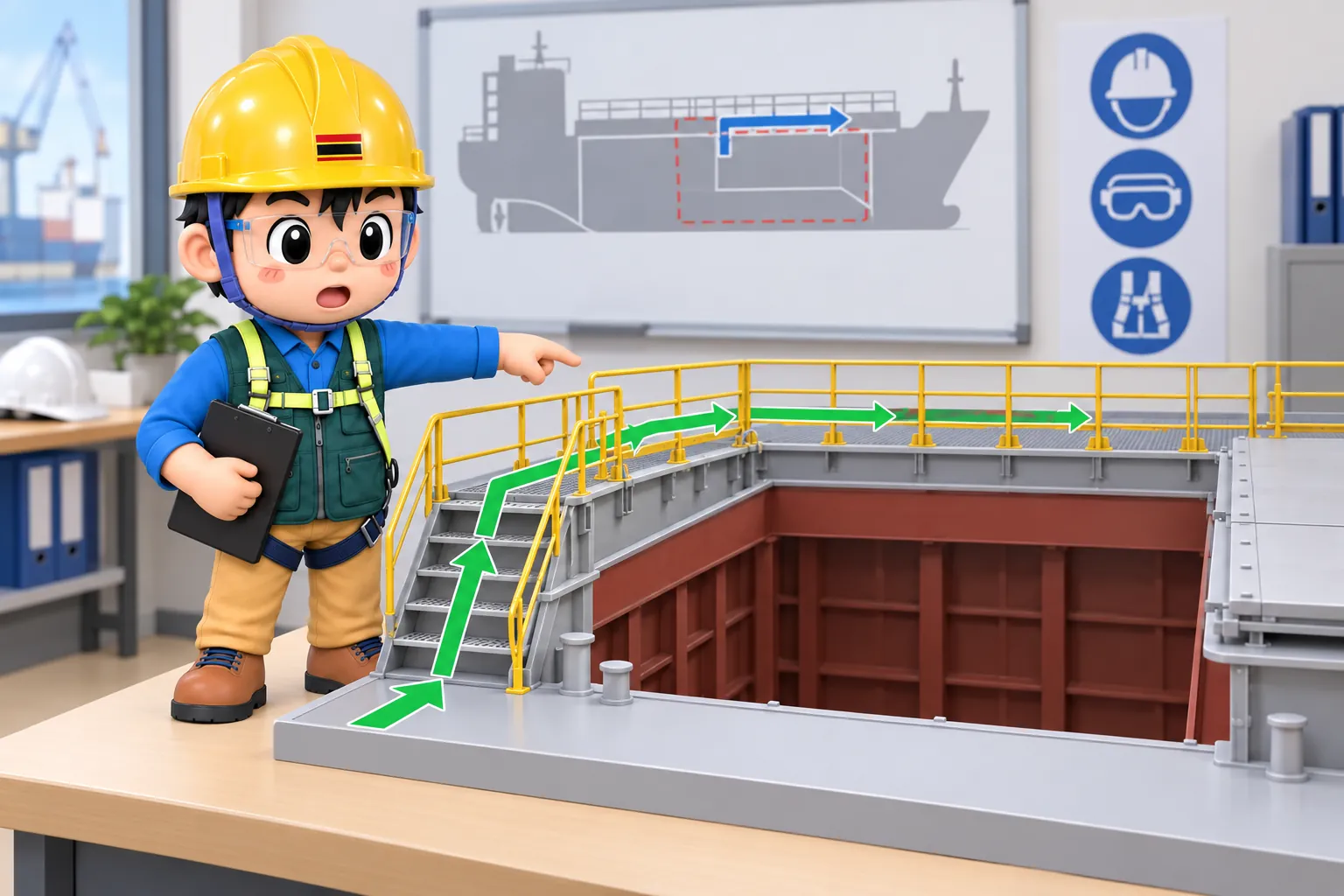
Questions at the work position
| Question | What to examine |
|---|---|
| How will the inspector reach the area? | Check rails and platforms on the pre-repair route. |
| What protects the edge during repair? | Link temporary protection to the work sequence. |
| Where is the harness connected during movement? | Review approved anchors and continuity. |
| Is another contractor opening covers? | Coordinate cover movement with access. |
Korean legal references
Rules Articles 42 and 44 address fall protection and safety-harness anchorage arrangements. Include inspection access within the work scope. Article 13 also provides guardrail requirements to review after repair.
The whitepaper records an accident date of 2022-02-19 and more than 200 regular workers at the principal contractor. It occurred after SAPA took effect and met the then-applicable size threshold. Enforcement Decree Article 4 provides a connection to management systems and contracting procedures; specific court findings remain limited to the recorded proceedings.
Occupational Safety and Health Act (Korean) · Rules on Occupational Safety and Health Standards (Korean)
Field practitioner note
Sources
MOEL and KOSHA, 2024 Serious Accident White Paper, 88–113 pages. Official publication (Korean)