English names and summaries of Korean laws are unofficial translations. The Korean text on the Korean Law Information Center (law.go.kr) prevails.
Are improvements confined to the last accident?: repeated deaths at a steel works
Key terms in Korean and English
- serious accident (중대재해, OSH Act)
- risk assessment (위험성평가)
- administrative fine (과태료)
- struck by object (물체에 맞음)
- contact with extreme temperature (이상온도 접촉)
- combustion tower (연소탑)
- slag (슬래그)
- bundle of round bars (환봉 묶음)
- pipework (배관)
At a glance
At a special-steel works, 3 accidents between May 2022 and 2 March 2023 caused 4 deaths.
A subsequent accident on 16 April 2024 killed 1 worker, bringing the total for the incidents in the table to 5.
From preparation to the aftermath
After a forklift collision killed 1 worker at the steel works in May 2022, a round-bar loading accident followed on 2022-09-08 and a combustion-tower cleaning accident on 2023-03-02. An order to review workplace-wide risk assessment after the first accident did not adequately reduce risks in other work.
The forklift accident occurred while a worker finishing the night shift walked toward the administration building. It was dark and noisy, and the carried blooms obstructed the driver’s view. The route described as a safe walkway did not effectively separate pedestrians from vehicles.
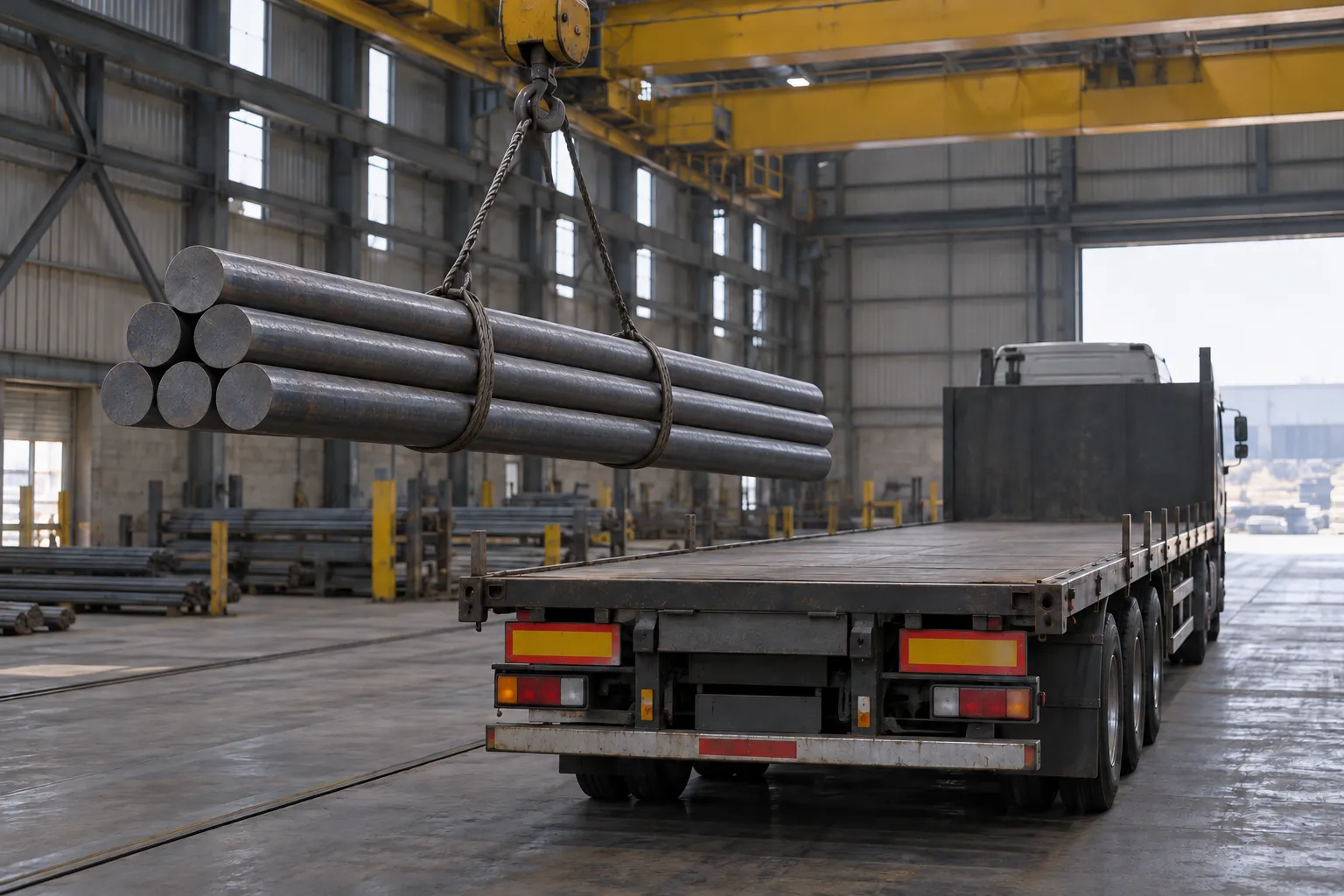
During round-bar loading, a transport driver helped on the truck deck to cover another contractor’s labour shortage. The bars were bundled in groups of 6 weighing about 7.5t. The overhead crane was rated for 10t, but adequate lifting capacity did not protect the person receiving the load.
The crane operator was on the 3rd day in that role. The operator stopped the control on receiving a stop signal, but the load continued moving. Investigation identified travel of about 4–9m after braking. The manual called for approach from the truck side; the actual approach was from the rear.
On the combustion-tower accident day, the furnace stopped at 05:38 and excavator removal of slag began at 08:00. Ahead of an equipment replacement scheduled for the evening, employees entered around 16:20 with a water hose to help. Water contacting hot slag caused a steam explosion, killing 2 workers.
A further fatal accident occurred during subcontractor pipe cutting on 2024-04-16. The incident table distinguishes the 3 accidents and 4 deaths through March 2023 from the total of 5 deaths including the later accident.
| Date | Type | Event | Deaths |
|---|---|---|---|
| May 2022 | struck against / collision | Pedestrian struck by a forklift | 1 |
| 2022-09-08 | struck against / collision | Struck by a moving bundle of round bars during loading | 1 |
| 2023-03-02 | contact with extreme temperature | Exposure to hot material during combustion-tower slag removal | 2 |
| 2024-04-16 | struck by object | Struck by falling pipework during cutting | 1 |
A stop command and a stopped load are different
A suspended bundle does not become fixed in place as soon as the crane control is released. Moving equipment and loads need time and distance to stop, and a suspended load can sway. Relying on a receiving worker’s last-moment signal leaves inadequate space for residual motion.
The recorded stopping distance belongs to this equipment. It must not be adopted as a universal crane distance. Establish the actual equipment behaviour under the intended load and travel conditions, then plan approach direction, deceleration and where people remain clear. Capacity checks alone are insufficient.
A long load entering from the rear can trap a person between the load and truck structure. Changing a planned side approach for convenience can also remove the escape space built into that plan. A driver taking on loading duties requires corresponding review of the work plan.
The tower involved retained heat rather than a travelling load. Shutdown time is not the time at which internal residue has cooled sufficiently. Appearance from outside is inadequate, and water contacting hot material can rapidly become steam and displace surrounding material.
The whitepaper records absent pre-cleaning temperature checks and standard procedures, with differing practices for water use. Entry conditions and cleaning methods must be established before adding people to meet a schedule. Additional PPE does not replace control of the method itself.
Recording shutdown time does not establish readiness for maintenance. The work authorisation should identify what locations and conditions were checked, and how. Switching from excavator removal to work by people inside creates a new exposure position. Put a review hold point at that transition in the maintenance plan.
What the comparison shows
The forklift and round-bar accidents shared overlap between people and moving heavy loads. The specific issues were driver visibility and pedestrian segregation for the forklift, and stopping behaviour and approach direction for the crane load. One additional traffic sign cannot address both sets of conditions.
Tower cleaning differed from vehicle movement, but was likewise non-routine support work. Changes such as a transport driver helping with loading or owner employees assisting cleaning needed a defined review of methods and hazards when people crossed their ordinary task boundaries.
Causes and protective layers
| Layer | At the time | Workplace action |
|---|---|---|
| Forklift | Load obstructed vision and routes overlapped | Check loading, visibility, travel routes and pedestrian segregation together |
| Round bars | Rear approach and insufficient stopping-behaviour training | Plan the route and receiving position around actual deceleration and stopping |
| Combustion tower | Water applied inside without temperature or procedural checks | Verify residual heat, control entry and use a validated cleaning method |
Investigation and proceedings
Between 2023-03-29 and 2023-04-07, the special inspection identified 592 violations: 328 led to judicial action and 264 to administrative fines totalling about KRW 380 million; the white paper does not cover subsequent court proceedings.
Why the consequences were severe
Correcting only the first accident location can leave hazards in other transport and maintenance work undiscovered. Review tasks that bring people near moving loads or residual energy, not only identical equipment, including contractor work.
Questions at the work position
| Question | What to examine |
|---|---|
| Is residual travel after a stop understood? | Deceleration points and receiving positions suited to the load and route |
| Are transport workers also helping load? | Training, planning and direction for the changed role |
| Does stopped equipment retain heat? | Internal-state checks and validated entry and cleaning conditions |
Korean legal references
Rules Articles 172 and 173 address contact prevention, visibility and maximum loading for handling vehicles. Planning under Article 38 must reflect actual movements of equipment and people. Naming a route safe does not create physical separation.
For hot work environments, also examine protective measures under Articles 32 and 254. Establish temperature conditions and a safe method first, then provide protection suited to those conditions.
Occupational Safety and Health Act (Korean) · Rules on Occupational Safety and Health Standards (Korean)
Sources
MOEL and KOSHA, 2025 Serious Accident White Paper, 42–69 pages. Official publication (Korean)